Yes. It's legal, no law in any major jurisdiction prohibits it, and it happens every single day through established marketplaces built specifically for this kind of transaction. But the honest, complete answer is more layered than a flat yes, because YouTube's own Terms of Service don't clearly bless the practice either, and the difference between doing this safely and doing it in a way that gets a channel terminated comes down to a handful of specifics almost nobody explains clearly.
I've been on the inside of this decision personally. I once had real offers on the table to sell one of my channels for around $100,000. I turned them down and kept building it instead, which I'll get into later in this article, because the reasoning behind that decision matters more than the headline number. This isn't a marketplace trying to get you to list your channel. It's the full breakdown, legal nuance, valuation, process, and the real risks, from someone who's actually weighed this decision on a channel that was genuinely worth selling.
The Short, Honest Answer
Selling a YouTube channel is legal. There's no statute anywhere that prohibits the sale of a digital asset like a channel, the same way there's no law against selling a website or a domain name. Thousands of channels change hands every year through structured marketplaces, and large channel acquisitions have made real headlines for years.
Where it gets genuinely murky is YouTube's own Terms of Service, which don't explicitly authorize channel sales and, depending on which clause you read, arguably don't fully permit them either. YouTube doesn't facilitate these transactions, won't help value your channel, and won't step in if a deal goes wrong. That combination, legal but unsupported by the platform, is exactly why this topic generates so much conflicting advice online.
What YouTube's Terms Of Service Actually Say (And Why People Disagree About It)
Here's the actual source of the confusion. YouTube's terms include language restricting the sale of certain things related to the Service, and separately, account access itself has historically been treated as non-transferable without permission. Read narrowly, that sounds like a flat prohibition. In practice, it isn't enforced that way, and there's a specific reason why.
YouTube itself built a mechanism, the Brand Account system, that exists precisely to allow ownership and management changes on a channel. A Brand Account isn't tied to a single person's personal Google login the way a standard channel is. It supports multiple owners and managers, and ownership can be formally transferred to someone else entirely through YouTube Studio, without anyone sharing a password or handing over login credentials.
That last detail is the whole ballgame. Sharing your personal Google account's login credentials with a buyer, so they can log in as you, is the version of "transferring a channel" that actually risks violating YouTube's terms and puts both sides at real risk if Google's systems ever flag unusual login activity. Formally transferring ownership of a Brand Account through YouTube's own built-in tools is a completely different action, using a feature YouTube designed and maintains for exactly this purpose. One is a workaround. The other is the intended mechanism.
Quick disclaimer, because this sits at the edge of legal territory: I'm not a lawyer, and this isn't legal advice. If you're negotiating a genuinely large sale, get an actual contract and a professional to review it. Everything below is the practical, real-world picture, not a substitute for that.
Personal Account Vs. Brand Account: Why This Distinction Decides Everything
A personal Google account channel is the default setup most people start with. The channel is tied directly to your personal Google login, and that creates a specific problem when it comes to selling.
If you try to sell a channel tied to a personal account, the buyer needs your actual login credentials. That is the riskier version of the transaction. It gets close to what YouTube's "non-transferable account" language is actually about. It also complicates your ability to keep using your own other channels afterward, because your personal Google identity is now part of the deal. And it leaves both sides exposed if Google's systems flag unusual login activity from a new location.
A Brand Account channel is a different structure. It is not tied to a single person's personal Google login. Instead, it supports multiple owners and managers, and ownership can be formally transferred to someone else through YouTube Studio.
That means the buyer is added as an owner, they accept the transfer from their own account, and the channel is now under their control. No password is shared. You are using a feature YouTube built and maintains for ownership changes. Your personal account stays completely separate from the transaction.
If your channel is still tied to a personal Google account and you're seriously considering a sale, converting it to a Brand Account before you do anything else is the single most important step in this entire process. It's free, it's reversible up to the point of transfer, and it's the difference between a clean transaction and a genuinely risky one.
What Actually Transfers, And What Doesn't
This surprises a lot of first-time sellers and buyers alike, so it's worth being precise.
Transfers with the channel
- The content library
- The subscriber count
- The watch time history
- The monetization eligibility status, if the channel already meets the YouTube Partner Program thresholds
A buyer taking over a channel that already qualifies for monetization typically doesn't need to rebuild that eligibility from zero.
Does not transfer
The AdSense account itself. AdSense is tied to the seller's personal identity, tax information, and bank details, not to the channel. A buyer has to link the channel to their own AdSense account after the transfer completes. If the channel already meets the Partner Program thresholds, this relinking process is usually fast, often within days, and channels that were already earning tend to resume earning quickly under the new owner's account.
Doesn't meaningfully transfer, even if technically included
- Anything tied to the creator's personal identity rather than the content itself
- An on-camera personality
- An established individual reputation
- Existing brand relationships built on trust with that specific person
A buyer can take over the account, but they can't take over who the audience believed they were watching. This is one of the clearest reasons a faceless, evergreen channel is a fundamentally more sellable asset than a personality-driven one. The value lives in the content and the positioning, not in a specific person's face and voice that walks away the moment the deal closes.
How Much Is A YouTube Channel Actually Worth?
Valuations across the industry are generally expressed as a multiple of average monthly net profit, not revenue, and not subscriber count. The typical range cited across marketplaces and brokers is roughly 12x to 36x average monthly profit, with the specific multiple shaped by a handful of factors.
What pushes the multiple up
- Revenue diversification: ad revenue plus affiliate plus digital products or brand deals
- Low owner dependency: faceless, evergreen, doesn't require a specific person
- Growth trajectory: consistent month-over-month growth
- Stable traffic profile: the channel earns from existing content without needing constant new uploads
- High-CPM niche: finance, business tools, buyer-intent categories
- Large content library: evergreen videos still earning without new work
What pushes the multiple down
- Ad revenue only: one single income source
- Personality-driven: requires the original creator on camera
- Flat or declining trend
- Upload-dependent: income relies entirely on constant new uploads or viral spikes
- Low-intent niche: broad entertainment categories
- Small catalogue: mostly time-sensitive content
Notice how closely this lines up with the exact model I've taught for years, independent of ever caring about resale value. A channel built around specific, evergreen, buyer-intent content with multiple income streams stacked on top of ad revenue isn't just a better channel to run day to day. It's also a structurally more valuable asset if you ever decide to sell it, because every one of those qualities is exactly what a serious buyer is evaluating.
A worked example
Say a channel nets $2,000 a month in profit, averaged over the last six months, split across AdSense, one affiliate program, and a small digital product. It's growing steadily, doesn't require the seller's face or voice in any video, and most of its traffic comes from stable sources rather than viral spikes. That combination of factors would realistically land somewhere in the middle to upper end of the range, call it a 20x to 26x multiple, which puts the channel's value somewhere between $40,000 and $52,000.
Now take the same $2,000 a month, but it's entirely AdSense, the creator is on camera in every video, and most of the views come from a handful of videos that went briefly viral rather than steady traffic. That channel might only command a 12x to 15x multiple, $24,000 to $30,000, despite earning the exact same amount today. The gap isn't about current income. It's about how much of that income a buyer can reasonably expect to keep earning without the original owner still involved.
Why Evergreen Channels Sell For More
This is worth its own section because it's the single biggest lever most sellers ignore, and it's not a coincidence that it's also the core of how I build channels in the first place.
A buyer acquiring a channel isn't really buying a subscriber count. They're buying a forecast, a reasonable expectation of what the channel will keep earning under their ownership, without the person who built it. Every quality that makes a channel resilient to that ownership change is a quality a buyer will pay a premium for.
What makes a channel worth more to a buyer
- Content aimed at specific, evergreen problems keeps earning regardless of who's running the channel
- Not tied to one person's face or voice, so the value survives the ownership change completely intact
- Multiple income streams, so one underperforming source doesn't sink the whole channel's earnings
- Documented, repeatable process a buyer can actually continue without guessing
- Stable traffic sources rather than dependence on the algorithm's mood or a lucky recommendation streak
A channel built the opposite way, personality-driven, dependent on constant viral hits, reliant on a single income source, is a much harder sell, because everything a buyer is actually paying for is at risk of disappearing the moment the original creator steps away. This is the same reason I've said for years that treating a channel like a library of independent, evergreen assets rather than a personal brand isn't just the better way to earn from it. It's also the better way to build something that would actually hold its value if you ever wanted to hand it off.
My Own Experience: Why I Turned Down A Six-Figure Offer
A while back, one of my channels had real offers on the table, in the ballpark of $100,000, from people genuinely interested in buying it outright. It wasn't a lowball, and it wasn't a scam, it was a real number from real interest.
I turned it down. Part of that was practical: the channel was still climbing, and a lump sum multiple can undervalue an asset that's genuinely still compounding, the same way selling a cash-flowing rental property for a quick payout can look great on paper and still be the wrong move if the property's income keeps growing every year you hold it. Part of it was strategic: I ended up reshaping that channel's direction rather than exiting it entirely, and the decision to keep building instead of cashing out turned out to be worth more over time than the offer itself.
I bring this up not to talk you out of ever selling, plenty of people have very good reasons to, but because the decision to sell shouldn't be evaluated purely on whether a number sounds big in the moment. It should be evaluated against what the asset would realistically keep paying you if you held onto it instead.
Where To Actually Sell A Channel
If you decide selling is the right move, several established marketplaces exist specifically for this, and using one is significantly safer than a private, handshake-only deal.
- Flippa is the largest general digital asset marketplace, and it lists YouTube channels alongside websites, apps, and other online businesses, with built-in escrow and buyer verification.
- Empire Flippers operates more like a full-service brokerage, with vetted valuations, a sales team, and a migration team that handles the technical transfer for you.
- Fameswap and Social Tradia are marketplaces built specifically around social media accounts and channels, including YouTube.
Whichever route you choose, the underlying safety principle stays the same: avoid a purely private deal on a forum or social media with no escrow and no paper trail. That's where the overwhelming majority of scam stories in this space actually come from.
The Actual Process, Step By Step
- Get your financials in order. Pull your monthly revenue by source, ad revenue, affiliate income, product sales, brand deals, going back at least six to twelve months. Buyers want to see a real profit and loss picture, not just a subscriber count.
- Get a valuation. Use a marketplace's valuation tool or a broker's estimate as a starting reference point, then adjust based on the factors I covered above.
- Convert to a Brand Account if you haven't already. Do this before you list the channel anywhere, not after you've already found a buyer.
- List the channel or find a private buyer. A marketplace listing gets you exposure to vetted buyers actively looking to acquire channels. A private sale requires you to do your own buyer vetting.
- Negotiate and agree on terms in writing. A simple written agreement covering price, what's included, and the transfer timeline protects both sides.
- Use escrow. Funds go into a neutral third party, released only once the buyer confirms they have full control of the channel. Never accept payment before transfer, and never hand over full control before payment clears.
- Add the buyer as owner inside YouTube Studio, and have them accept the ownership transfer from their end.
- Escrow releases the funds once the buyer confirms the transfer went through cleanly.
- The buyer relinks their own AdSense account and updates any other settings, monetization, community guidelines contact info, before resuming normal operations.
The Real Risks, In Detail
Being direct about this, since most articles on this topic gloss over it in a single bullet list and move on.
Fake escrow services
Scammers sometimes set up convincing-looking escrow sites specifically to intercept payment on channel sales, complete with fake reviews and a professional-looking interface. Only ever use an escrow provider built directly into a reputable marketplace, or a well-known, independently verifiable escrow service you found yourself, never a link the other party sends you directly, no matter how legitimate it looks.
Buyers demanding access before payment clears
A legitimate buyer using real escrow never needs this, because escrow exists precisely to solve the trust problem on both sides. Treat any request to hand over access "in good faith" before funds are secured as an immediate red flag, regardless of how reasonable the buyer's explanation sounds.
Payment chargebacks after transfer
Certain payment methods allow a buyer to reverse a payment after you've already handed over the channel. Escrow largely eliminates this risk. A direct payment app or wire transfer without escrow largely doesn't protect you from it at all.
Account recovery abuse
In documented cases, a seller who retained access to old recovery information, a phone number, a backup email address still linked to the account, has used Google's own account recovery process to reclaim a channel after the sale completed. As the seller, fully removing yourself from every recovery option is a step worth taking as seriously as handing over the login itself. As the buyer, confirming this has actually been done, not just promised, is worth doing before you release final payment.
Hidden policy issues surfacing after the sale
A channel that looks completely clean on the surface can have unresolved community guideline strikes, copyright claims, or content flags that only become a real problem after new ownership takes over and starts publishing again. Ask directly about strike history, and where the marketplace or broker allows it, review the channel's own compliance history before finalizing anything.
Cross-account risk
If a seller's other, unrelated channels run into serious policy trouble later, there's some risk, inconsistently reported and not something YouTube has clearly documented, that scrutiny extends to accounts they were previously connected to. This is a reason to fully separate a sold channel's Brand Account from any of the seller's other channels as cleanly as possible during the transfer, removing shared managers, shared payment details, and shared account associations entirely.
A Quick Note On Taxes And Business Structure
This isn't something most articles on this topic mention at all, and it matters more than people expect once real money is involved. The proceeds from selling a channel are generally treated as income or capital gains depending on your jurisdiction, how the channel was structured, and how long you held it before selling. This varies significantly by country, and in some cases by how the underlying business was set up, as a sole proprietorship, through an LLC, or another structure entirely.
I'm not a tax professional, and this genuinely isn't the section to take shortcuts on. If you're looking at a sale large enough to matter, even a few thousand dollars, it's worth a short conversation with an actual accountant before you finalize anything, not after. It's a much smaller cost than an unexpected tax bill months later.
Should You Actually Sell?
This is a separate question from whether you're allowed to, and it deserves its own honest answer.
If a channel is genuinely still compounding, gaining traffic month over month with videos you made a long time ago still earning without new work, selling it at a fixed multiple can mean walking away from more long-term value than the sale price reflects. The same logic applies here as it does to deciding whether to expand into a second channel: a channel that's become a real, largely self-sustaining asset is worth more to you as an ongoing income stream than most buyers are willing to pay upfront for it, precisely because they're the ones who'd benefit from that future compounding instead of you.
Selling makes more sense when you need a lump sum of capital to fund something bigger, when a niche has genuinely run its course and you don't see further upside in it, when a channel demands more day-to-day attention than it's worth to you personally, or when you're consolidating focus onto fewer, larger projects rather than managing a wider spread of smaller ones.
A Practical Checklist Before You List Your Channel
- Confirm the channel is on a Brand Account, or convert it before listing.
- Pull at least six to twelve months of revenue broken down by source, not just a total.
- Remove yourself from every recovery option, backup phone, backup email, tied to the account once transfer is confirmed.
- Check your own strike and community guidelines history honestly before a buyer finds something you didn't disclose.
- Decide your minimum acceptable multiple based on the factors that actually apply to your channel, not a number you saw in someone else's success story.
- Use a real marketplace or broker with built-in escrow, not a private deal with no paper trail.
- Get the agreement in writing, even for a smaller, informal sale.
Frequently Asked Questions
Does selling a YouTube channel violate YouTube's Terms of Service?
It sits in a gray area. YouTube doesn't explicitly authorize channel sales, but it built the Brand Account ownership transfer feature specifically to support legitimate ownership changes. Using that feature, rather than sharing personal login credentials, is the version of a sale least likely to cause problems.
Can I sell a channel that isn't monetized yet?
Yes, though it's generally worth less, since a buyer would need to build it to the Partner Program thresholds themselves. Some buyers specifically look for pre-monetization channels with strong content and a clear growth trend, at a lower price than an already-monetized one.
Does my subscriber count transfer to the buyer?
Yes, subscriber count, watch history, and the content library all transfer with the channel itself when ownership changes hands through a Brand Account transfer.
What happens to my AdSense earnings after I sell?
Your existing AdSense account and any revenue already earned stay yours. The channel itself needs to be relinked to the buyer's own AdSense account going forward, since AdSense is tied to the individual, not the channel.
Is it safe to sell without using a marketplace or broker?
It's possible, but meaningfully riskier. Private, handshake-only deals are where the majority of scam reports in this space originate. If you go this route anyway, insist on independent escrow and a written agreement at minimum.
The Bottom Line
You can sell a YouTube channel, legally, safely, and profitably, if you do it through a Brand Account transfer, use real escrow, and go in with a clear-eyed valuation based on profit and diversification rather than subscriber count alone. Whether you should is a separate, more personal question, one worth weighing against what the channel would realistically keep paying you if you held onto it instead of what a buyer is offering you today.
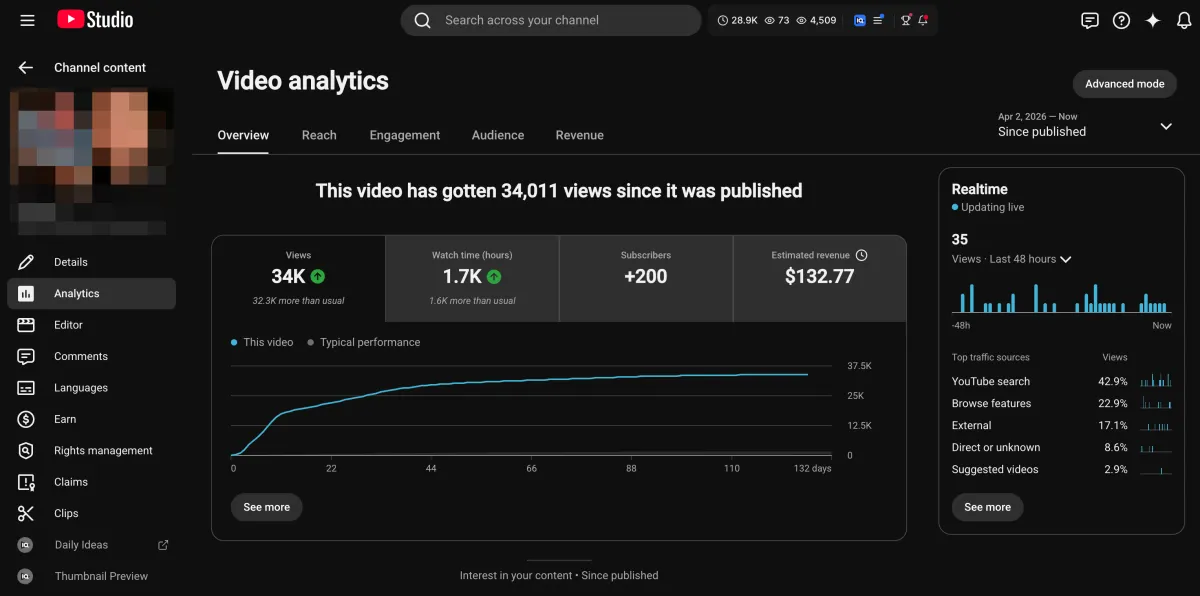
Learn how I turned a $132.77 video into $1000+ per month asset
Full case study on how you can replicate my success with YouTube SEO strategy.
Free downloadThe Zero Audience System
Build permanent YouTube income without a camera or an audience
The full methodology, 31 lessons plus bonuses. Limited spots.