
My Story
I've uploaded over 4,000 videos on YouTube. Some of them made nothing. A handful of them are still paying me every single month, years after I forgot they existed. This article is the practical version of everything I've learned from that. Not the mindset version, not the "believe in yourself" version.
The actual month by month version. If you follow this for a year, genuinely follow it, not read it and nod, $5,000 a month is a realistic number. Not guaranteed, nothing is, but realistic in a way most YouTube advice never actually shows you.
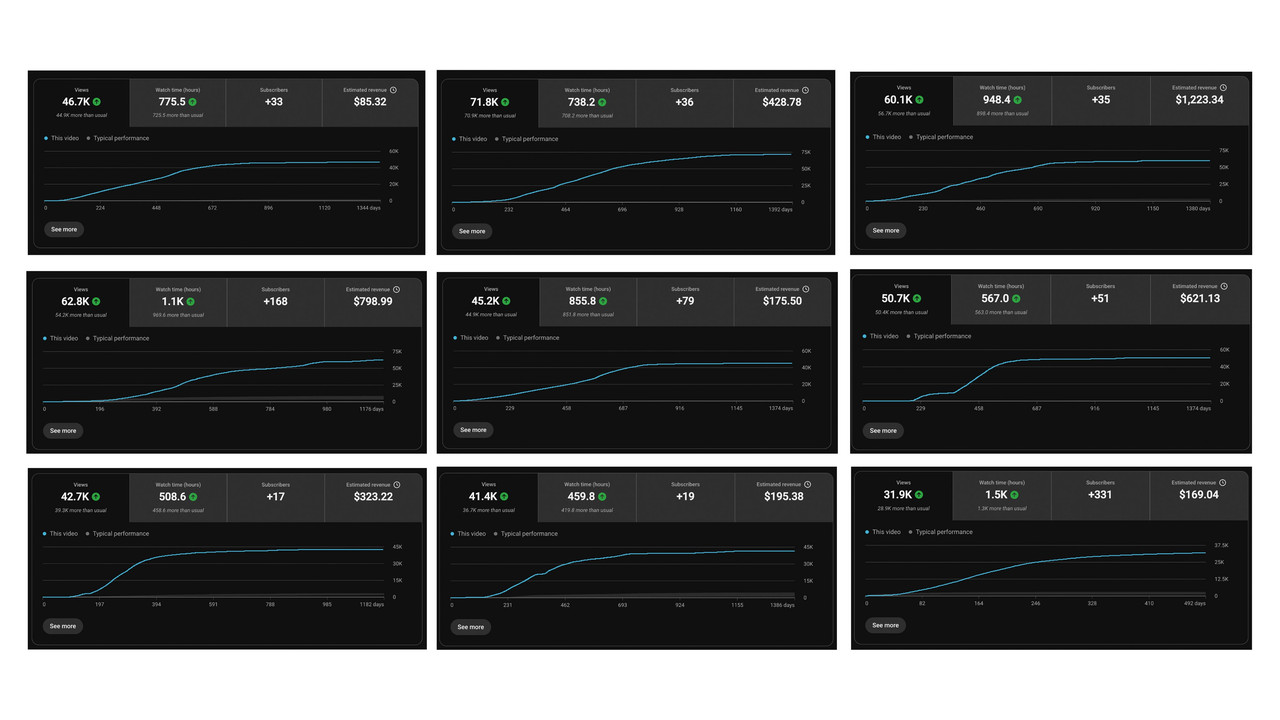
The model, in one picture
Before the month by month plan makes any sense, you need to understand the one thing that separates channels that make money from channels that don't. There are two completely different ways a video gets found on YouTube.
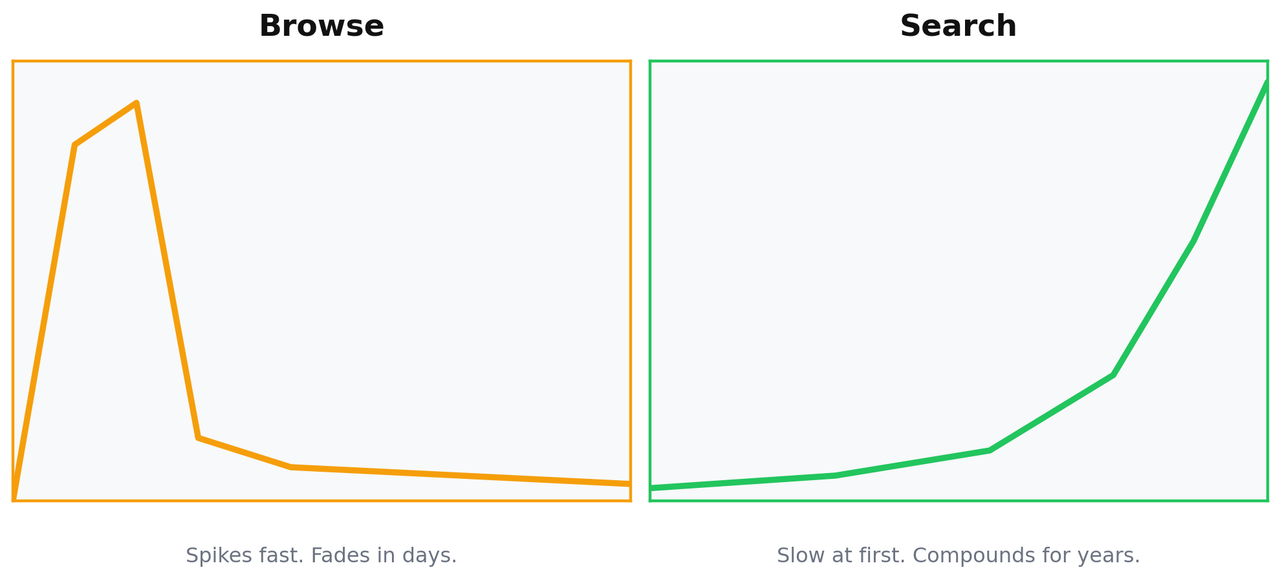
Browse traffic is a recommendation push. YouTube shows your video to people because it thinks they'll like it, based on what they've watched before. You get a rush of views for a few days, sometimes a week, and then it's gone. It doesn't come back. The video did its one job and now it's done.
Search traffic is different. Someone types an actual problem into a search bar, on YouTube or on Google, and your video is the answer. That doesn't spike and disappear. It keeps happening, every single day, for as long as your video stays relevant to that search. That's not luck. That's a video that was built to answer something specific.
Everything in this article is about building search traffic on purpose. Browse traffic is a nice bonus when it happens.It is not something you can build a real income around, because you can't control it and it doesn't last.
The actual math
I want to show you the real numbers before you commit a year of your life to this, because vague promises are useless and I'm not going to give you one.
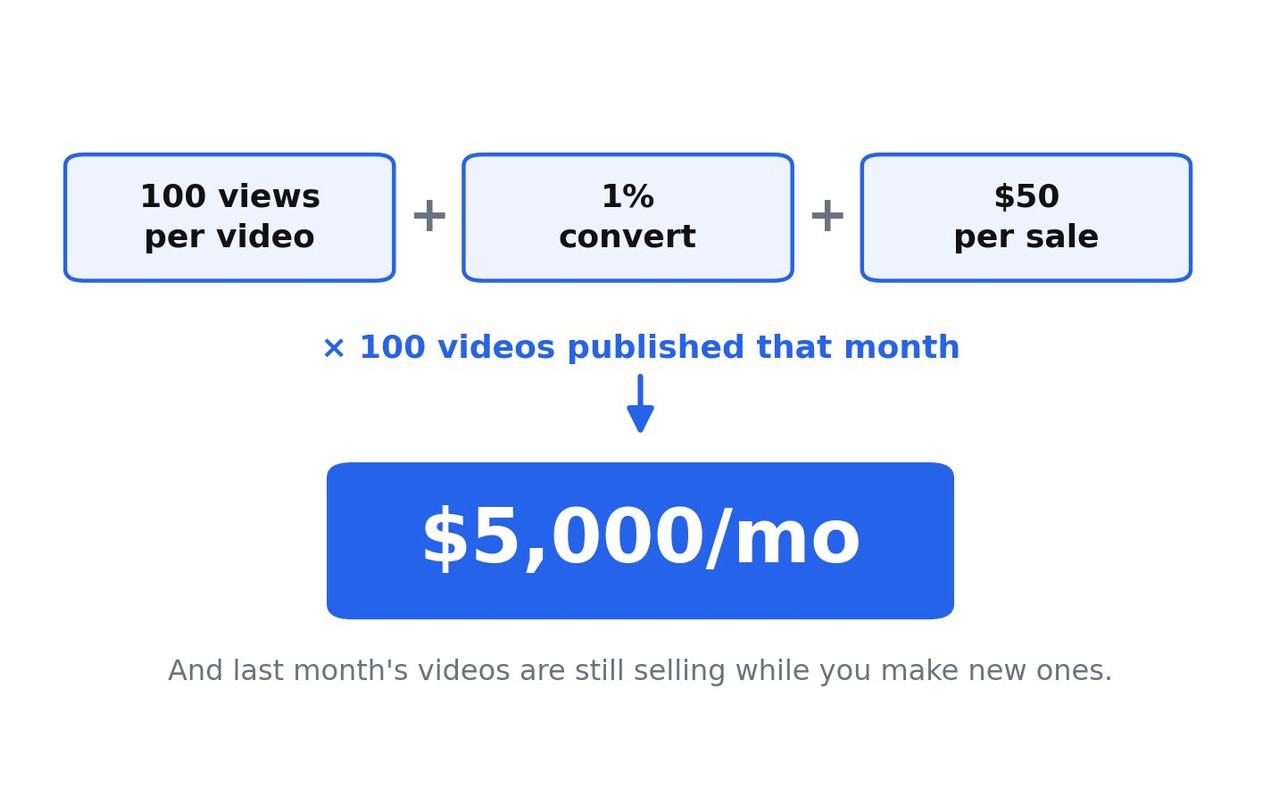
Say you average 100 views per video, which is a completely normal, unremarkable number for a small channel doing this correctly.
Say 1% of those viewers buy something you're promoting inside the video, which is a realistic conversion rate when the video is actually aimed at a buyer instead of just a curious viewer.
Say that sale pays you $50. 100 views, 1% conversion, that's 1 buyer per video, worth $50. Publish 100 of those videos in a month and you're at $5,000 for that month alone. Here's the part that actually matters and the part most explanations of this leave out. That $5,000 doesn't reset next month.
Those same 100 videos are still sitting there, still getting found, still converting, while you publish your next batch. The number doesn't restart at zero. It stacks. Month two isn't "another $5,000." It's the first month's videos still earning, plus whatever the new batch adds on top. That's the entire secret, if you want to call it that. It's not really a secret. It's just math that only works if you don't quit before it has time to compound.
Month 1: Foundation
This month is boring and it's supposed to be.
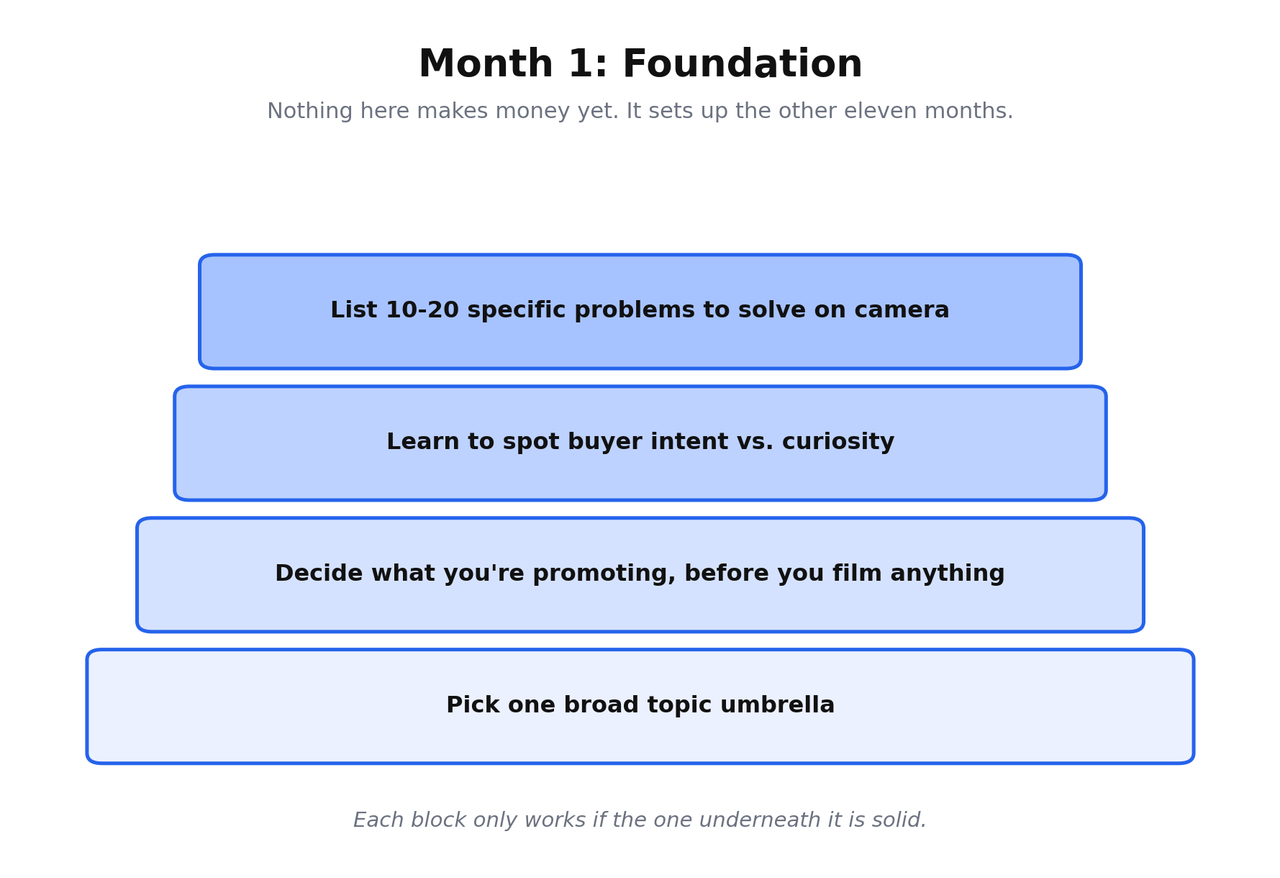
Nothing you do in month one will make you money in month one. Its entire job is to set up the next eleven months correctly. Pick one broad topic area, not a narrow niche. You don't need to be "the one thing" guy.
You need one loose umbrella broad enough to cover a handful of different problems, tight enough that it still makes sense as one channel. If you know something about marketing tools, that's an umbrella. If you know something about home renovation, that's an umbrella. You're not picking a personality.
You're picking a lane you can speak on without sounding like you're guessing. Decide what you're actually going to promote, before you plan a single video. This is the single most skipped step and it's the reason most channels never make a dollar.
Most people record first and hope the monetization figures itself out later. Flip that order completely. Know what you're recommending, or what your own offer is, before you decide what the first video is even about. Learn to recognize a buyer intent problem versus a curious one.
Not everyone who might watch your video wants the same thing. Some people are just learning about a topic. Some are comparing their options. Some already know exactly what they want and are one video away from acting on it.
Your first videos should aim at that last group as often as possible, because that's where the actual money is, even though it's the smallest group by volume. Don't publish anything yet if you can help it, or publish very little.
Spend this month getting clear on the umbrella, the offer, and roughly ten to twenty specific problems inside that umbrella that you could make a video about. You'll add to this list constantly once you're moving, but you need a starting point.
By the end of month one you should have: one broad topic area, one clear thing you're promoting, and a list of specific problems you could solve on camera. That's it. That's the whole month.
Month 2: Volume, without overthinking it
Now you start actually publishing. This month is about getting reps in, not about any single video being perfect. Aim for consistent output, ideally daily or close to it if you can sustain it, but a realistic and sustainable schedule beats an ambitious one you abandon after two weeks.
Every video should follow the same basic shape: identify one specific problem, solve it clearly and completely, and mention what you're promoting early, within the first minute, not buried at the end where nobody sees it.
Don't wait for the perfect idea. A decent video about a real problem beats a brilliant video about nothing.
If you're stuck for what to make, look at what's already ranking for a related problem and ask yourself honestly if you could make a clearer, more complete version.
Often you can, because a lot of what's currently ranking is rushed or incomplete. This is also the month to start a simple swipe file.
Anytime you see a title structure that's clearly working, "best [thing] for [use case]," "how to [do specific task] with [tool]," write it down as a template.
You'll reuse these structures constantly, just swapping in a new variable each time something relevant comes up.
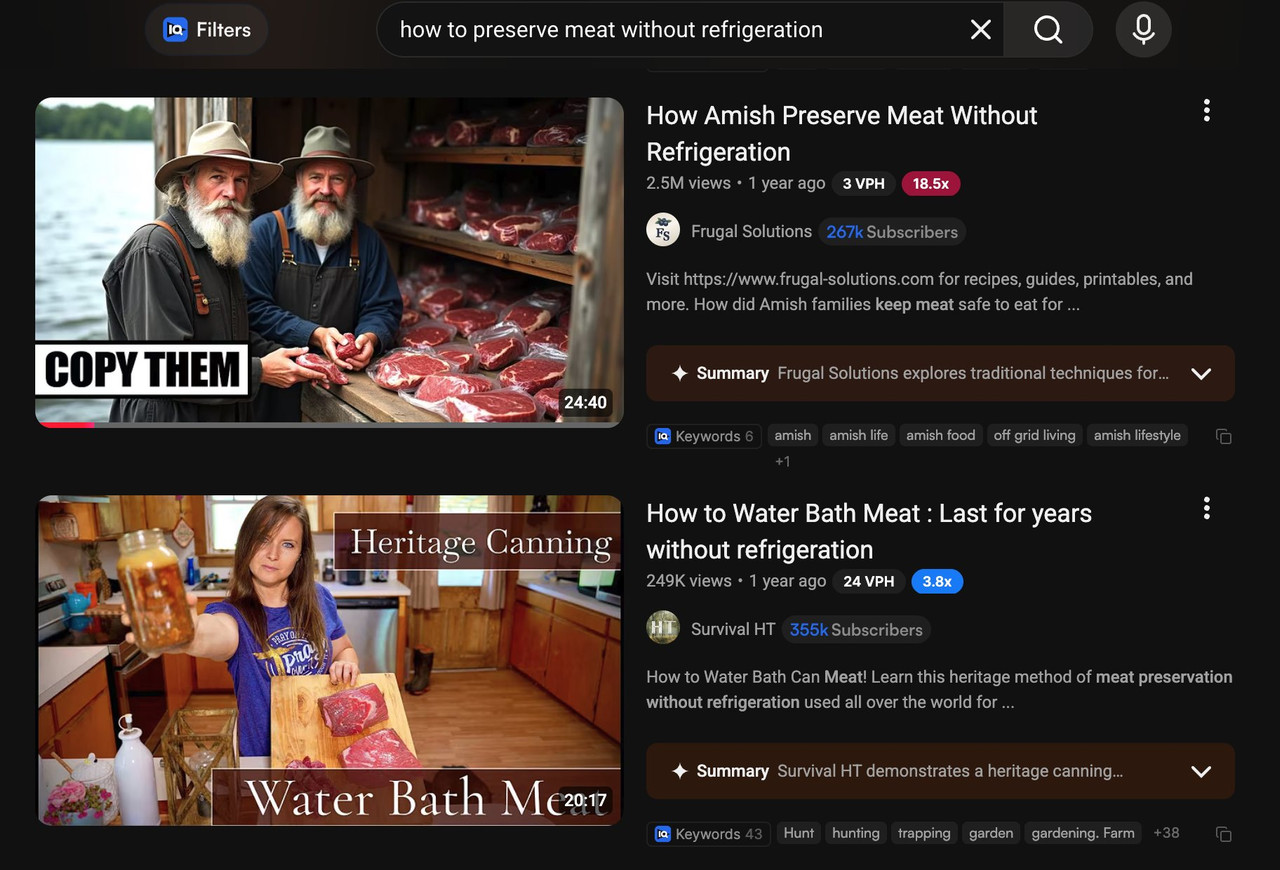
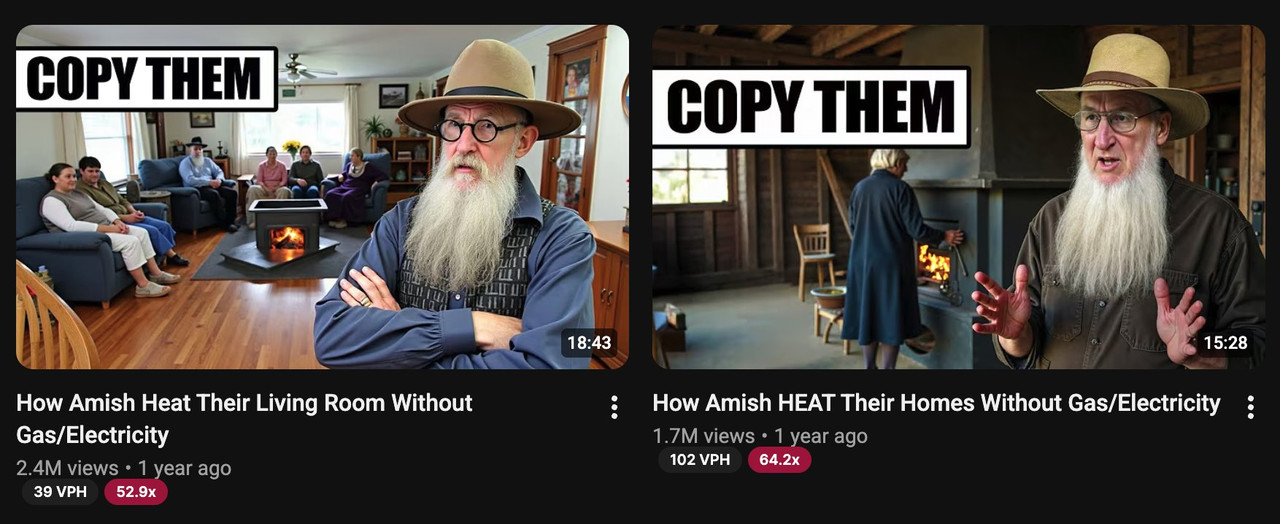
This is one of the most underused tactics in the entire game: find one proven structure, and every time something new becomes relevant in your space, plug it into that same structure instead of starting from scratch.
By the end of month two you should have a real batch of videos published, ideally in the 40 to 60 range if you're publishing close to daily, each one aimed at a specific problem, each one mentioning your offer early.
Month 3: Almost nothing will seem to be happening, and that's normal I want to be direct about this month because it's the one that makes people quit. Most of your videos from month two will still be sitting near zero views. That is not a sign you're doing it wrong.
It's the normal shape of the curve before YouTube has had time to understand what your videos are and who to show them to. This is the least rewarding month of the entire year and it's also one of the most important, because what you do here determines whether you make it to month six at all.
Keep publishing at the same pace. Don't slow down because it feels like nothing's working. Don't speed up out of panic either. Just keep going. Start paying closer attention to the handful of videos that are doing anything at all, even a little more than the rest.
Check where their views are coming from. If you notice a video shifting from being recommended to being found through search, pay very close attention to that one.
That shift is the earliest real signal you'll get that the model is starting to work.
Months 4 through 6: The first real signals
Somewhere in this window, if your foundation and your volume were both solid, you'll start to see something different. A handful of videos will begin climbing instead of sitting flat. Not dramatically. Just a steady, small increase, week over week.
This is the moment to shift from pure volume to volume plus pattern recognition. When a video does better than the rest, don't just move on to the next idea. Go back and figure out specifically why.
Most of the time it's one identifiable thing, a specific problem that a lot of people happen to have, a specific way you framed the solution, a specific product that people were already primed to want.
Once you know that, don't treat it as a one-time win. Make more videos around that same insight, from different angles. This is also the right time to start tracking properly if you haven't already. A view count tells you nothing about which video is actually making you money.
Put a distinct, trackable link on each video's offer, even something as simple as a unique short link per video. Within a month of doing this you'll know, with actual data instead of a guess, which specific topics and framings are converting. Everything after month six should be shaped by that data, not by what feels exciting to make.
Months 6 through 12: The compounding stretch
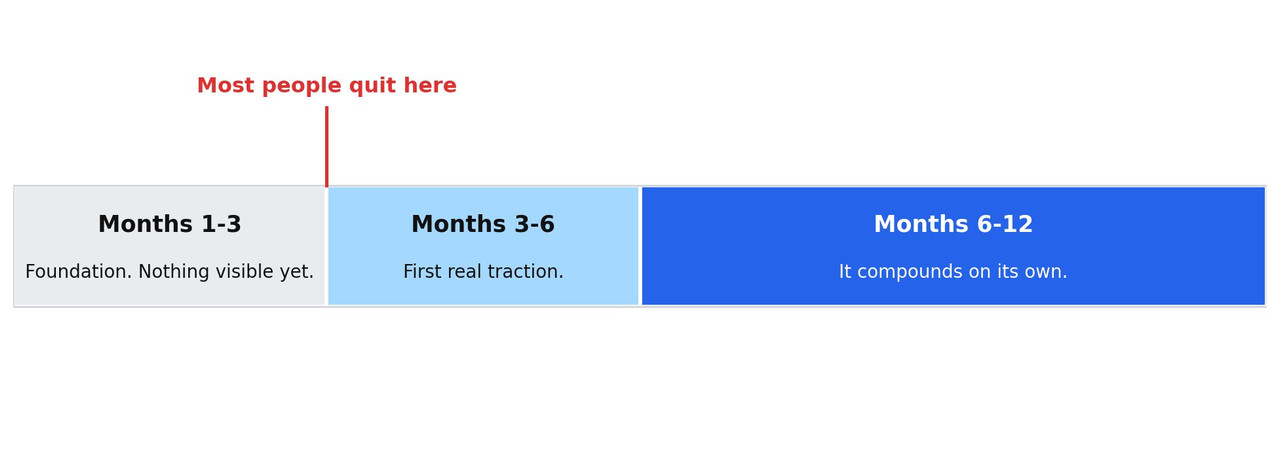
If you made it here, past the point where most people quit, this is where the math from earlier in this article starts to feel real instead of theoretical.
Your earlier videos, the ones you half forgot about, are still sitting there, still getting found, still adding a little revenue every month without any new work from you. Your newer videos are benefiting from everything you learned about what actually converts. The two effects stack on top of each other, and that stacking is the entire reason the second half of the year looks completely different from the first half.
Keep doing what's working. Resist the urge to reinvent your approach just because it's been a while. If a specific type of video, a specific structure, a specific offer keeps converting, make more of it before you go looking for something new. Boring and repetitive is what actually compounds. Novelty for its own sake usually resets you back to zero.
This is also a good window to add a second, related way of getting paid from the same videos.
If you started with one offer, layer in something like ad revenue on top, or a second complementary product for people already primed to buy the first one. You don't need five income streams.
Two, stacked on the same library of videos, will outperform five scattered across different, unfocused efforts.
By month twelve, if you kept the pace and didn't quit during the quiet stretch in months one through three, $5,000 a month is a realistic outcome.
For some people it'll be less. For some it'll be more. The variable that matters most, more than talent, more than luck, is whether you were still publishing in month four.
The four things that kill this before it ever works
Quitting during months one through three. This is the single most common failure point, by far. The videos that will eventually make you money look completely dead during this window. That's not failure. That's the normal shape of the curve.Chasing virality instead of specificity.
A video that spikes and disappears feels great for a week and then leaves you back at zero. A video aimed at one specific, searchable problem keeps paying you long after you've forgotten you made it.
Never tracking what actually converts.
Without a real tracked link on each video, you're guessing at what to make next based on what felt exciting instead of what actually worked. That guess is expensive over twelve months. Reinventing your approach constantly instead of repeating what works. The moment something starts converting, the instinct is often to move on to the next idea. Resist it.
Repetition of a proven structure is what compounds. Constant novelty rarely does.
The honest version of this.
None of this requires being talented on camera, having an audience, or getting lucky with the algorithm.
I started this with zero subscribers and no idea what I was doing, and the videos that ended up making real money were rarely the ones I was most excited about while filming them. What it actually requires is doing the boring parts in order, for longer than feels reasonable, especially through the stretch where nothing looks like it's working yet. That stretch is the whole test. Almost everyone who fails at this fails there, not because the model doesn't work, but because they stopped a few months before it would have.
I built the fuller version of everything in this article, the actual keyword and positioning process, the channel architecture, all of it, into something called The Zero Audience System, if you want to go deeper than what fits in one article, check out the case study I recorded below.
But everything above this line is real, and it's enough to actually start.
Pick the umbrella.
Decide the offer.
Publish the first video this week.
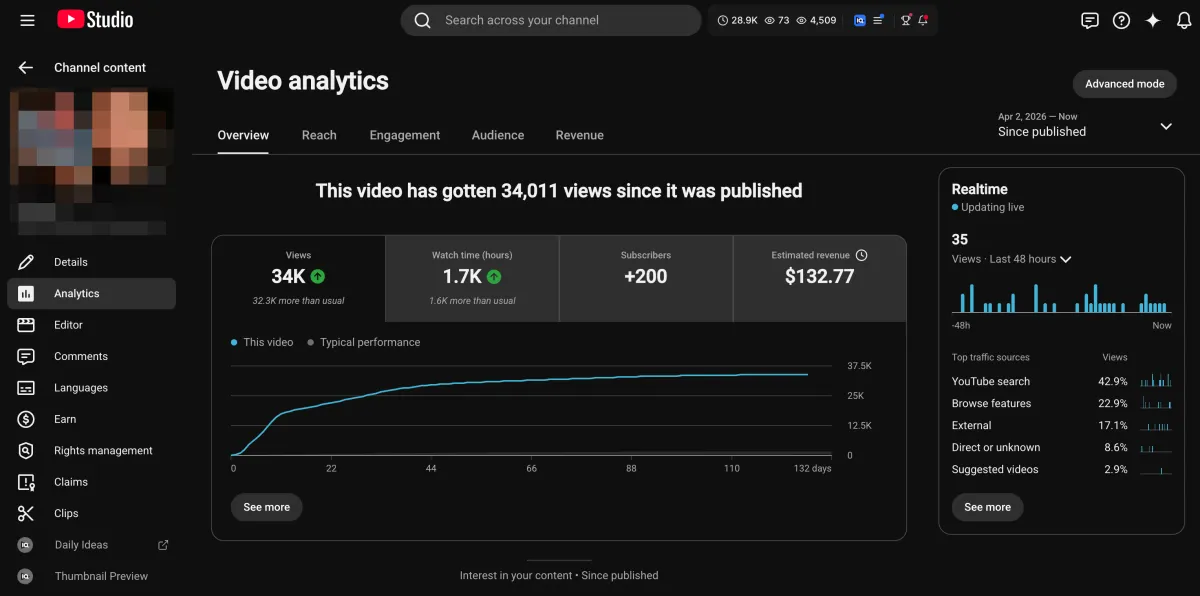
Learn how I turned a $132.77 video into $1000+ per month asset
Full case study on how you can replicate my success with YouTube SEO strategy.
Free downloadThe Zero Audience System
Build permanent YouTube income without a camera or an audience
The full methodology, 31 lessons plus bonuses. Limited spots.