
Short answer: yes, but not the version most people mean when they type this question into Google. If you're picturing the 2022 playbook, pick a trending topic, slap an AI voice over stock footage, publish as fast as the tools allow, hit a hundred videos and let the law of averages do the work for you, that version is functionally dead in 2026. YouTube spent the back half of 2025 and the first half of 2026 proving it with actual channel terminations, not just policy language nobody enforces. The version that's still genuinely worth building, specific, edited with real judgment, aimed at something people are actually looking for, isn't just alive. It's getting easier relative to the competition, because the lazy version is finally getting cleared off the board.
I've published over 4,000 videos across two channels. I've run automated, outsourced, and hybrid production pipelines for years, long before "YouTube automation" became a search term with its own cottage industry of course sellers around it. This article is the version of that answer I'd actually give a friend asking me directly, not the surface-level policy recap most of the results on this topic give you. It's long on purpose, because the honest answer to this question doesn't fit in five hundred words.
What Actually Changed In 2026
YouTube's monetization policy around mass-produced content isn't new. It existed in a lighter form as a "repetitious content" rule for years before getting renamed and sharpened into what's now called the inauthentic content policy. What's different in 2026 is enforcement, not just wording. A clarification pushed out mid-year tightened the definition further and made one thing explicit: YouTube now evaluates the whole channel, not just individual videos, when deciding whether something qualifies as inauthentic. Reviewers look at your main theme, your top-performing videos, your most recent uploads, and even your titles and metadata as a pattern, not in isolation.
That channel-level evaluation is the part that actually hurts the old automation playbook. A single low-effort video used to be able to hide inside a channel of otherwise decent content. In 2026, the channel gets read as a whole, and a library full of templated, interchangeable videos reads as exactly what it is, even if no single video on its own looks obviously bad.
This isn't theoretical. Late 2025 into 2026 saw a real enforcement wave, a cluster of large channels, collectively holding billions of views and meaningful yearly ad revenue, lost monetization in the same window for mass-produced, templated content. Some tried adding disclaimers like "concept trailer" or "parody" to slip back into monetization and lost it again shortly after, this time cited for spam and misleading metadata stacked on top of the original issue. The message from YouTube has been unusually direct for a platform that's historically stayed vague about enforcement: AI was never the actual target. Scale without a human fingerprint is.
AI Isn't Banned. Being Replaceable Is The Problem.
This distinction matters more than almost anything else in this article, so it's worth being precise about it. YouTube's policy does not ban AI-generated content, AI voiceovers, faceless channels, reaction content, compilations, or outsourced production. Plenty of thriving channels in 2026 use every one of those techniques, mine included.
What the policy actually targets is content that adds no real, recognizable original value: videos built from a template with a noun swapped, AI slideshows with a synthetic voice and no actual point of view, mass-posted content where nothing distinguishes one upload from the next, and channels presenting an AI-generated voice or invented persona as an authority figure on serious topics like health, finance, or law without disclosure. There's also a hard disclosure requirement that's separate from the quality question entirely: any video using realistic AI-generated or altered content needs the "Altered or synthetic content" toggle switched on in YouTube Studio. Skipping that disclosure is treated as its own violation, independent of how good or bad the video actually is.
Put simply: the platform is filtering out the appearance of nobody being home, not the use of tools.
What "YouTube Automation" Actually Means (Most Explanations Get This Wrong)
Most articles on this topic use "automation" as shorthand for one specific model, the outsourced compilation channel, and treat every other use of the word as a footnote. That's too narrow, and it's part of why so many people either overestimate or underestimate what's actually possible right now.
Automation exists on a spectrum. On one end, you've got full outsourcing: a freelancer or small team handles scripting, voice, and editing while you steer strategy from a distance. In the middle, you've got tool-assisted production: you're still making the core decisions, but AI handles research organization, first-pass editing, captions, and repurposing long-form into Shorts. On the far end, you've got the version that's actually dying in 2026, a pipeline that runs start to finish with nobody meaningfully involved in deciding what gets made or whether it's any good.
The thing all three points on that spectrum have in common, when they're built correctly, is that a human is still making the one decision that can't be automated: which specific problem this exact video is going to solve, and why. That decision is the whole model. Everything downstream of it, who edits, whether AI writes the first draft of the script, whether you're on camera at all, is a production detail. It's not the strategy.
Why Most Automation Channels Were Always Going To Fail, Policy Or Not
Here's something worth being blunt about: most of the automation channels getting hit by 2026's policy enforcement were already weak businesses before the policy caught up to them. The policy didn't kill a healthy model. It just made an already-fragile one collapse faster and more visibly.
I've talked about the difference between browse traffic and search traffic in nearly everything I teach, because it's the single biggest predictor of whether a channel survives past its first year. Browse traffic is YouTube recommending your video because it thinks someone will like it, based on what they've watched before. It spikes for a few days and disappears for good. Search traffic is someone typing their actual problem into a search bar and finding your video specifically, because it answers that exact thing. That traffic doesn't spike and vanish. It compounds for years.
The classic automation playbook chases browse traffic almost exclusively. Trending topics, viral formats, whatever's currently getting recommended heavily, none of it is aimed at a specific, searchable problem, it's aimed at riding a wave. That's precisely why those channels look so interchangeable to a policy reviewer, and it's the same reason they were already fragile long before any policy existed: a channel built entirely on browse traffic has no floor. The moment the wave passes or the algorithm's mood shifts, the whole channel goes quiet at once, because there was never a foundation of search demand underneath it to fall back on.
The Model That Actually Survives Automation At Scale
If you strip the production method out of the equation entirely, outsourced or not, AI-assisted or not, the channels that hold up long-term all share the same underlying structure, and it's the same structure I've taught for years, well before "automation" became the term people search for it under.
One video, one specific problem. Not a broad topic, a specific, searchable problem with a real person on the other end of that search. A video answering "how to fix a specific error message in a specific piece of software" will outperform a video answering "everything about that software" almost every time, because the first one matches an exact search intent and the second one matches nothing in particular.
Aim at buyer intent, not just curiosity. Not everyone searching a topic wants the same thing. Some people are just learning. Some are comparing their options. Some already know what they want and are one video away from acting on it. Automated channels chasing pure view count usually load up on the curious tier because it's the easiest to script at volume. The channels that actually make money skew their catalogue toward the tier closer to a decision, even though it's harder to write for and slower to scale.
Evergreen over trending, as the default, not the exception. A video aimed at a problem that's relevant today and still relevant in five years behaves completely differently than a video chasing this week's trend. The trend-based video gets a fast spike and then goes quiet. The evergreen video sits there, unglamorous, and keeps getting found for years without another dollar of production spent on it. If your entire automated catalogue is trend-chasing, you've built a treadmill, not an asset.
Decide the offer before you decide the video. This is the step almost every failed automation channel skips entirely. Most people build the video first and hope monetization sorts itself out afterward. Flip that order. Know exactly what you're promoting, an affiliate product, your own offer, a specific CTA, before you decide what the video is even about. A video built around an offer converts. A video built around a topic, with an offer bolted on afterward, usually doesn't.
How I'd Actually Structure An Automated Channel In 2026
Here's the operational version, not the theory. If I were setting up an automated or hybrid channel from scratch today, this is the division of labor I'd use.
- Kept entirely human, no shortcuts: the decision about which specific problem each video solves, the offer or monetization angle behind it, and a final review before anything publishes. This is maybe ten percent of the total hours involved in running the channel, and it's the ten percent that determines whether the other ninety percent is worth anything.
- Automated or outsourced, with a light human check: scriptwriting from an approved outline, voiceover, editing, thumbnail production, captioning, and repurposing into Shorts. This is where AI tools and freelancers genuinely earn their keep, they're fast and increasingly good at execution, they're just not the part of the process that should be deciding what gets made in the first place.
- Tracked, not guessed at: every video gets a distinct, trackable link on its offer, not a generic one reused across the whole channel. Within a month or two of doing this consistently, you'll have real data on which specific angles convert, and that data should shape what gets made next far more than what "felt exciting" to produce.
This structure passes YouTube's 2026 policy review naturally, not because it was designed around the policy, but because a channel built this way was never going to look interchangeable in the first place. Policy compliance ends up being a side effect of building it correctly, not a separate checklist you bolt on afterward.
The Trend-Graft Exception
There's one place automation and trend-chasing genuinely do work together well, and it's worth calling out because it's the opposite of what most automated channels do. I call it trend grafting: find a title structure or format that's already proven to perform in your space, something like "best [device] for running [X]," and when something new becomes relevant, swap the variable into that already-proven structure instead of inventing a new format from scratch.
The difference between this and the failed version of automation is subtle but important. You're not cloning content, you're reusing a structure that's already earned its place, with a new, specific variable each time. Done this way, you catch the early spike from whatever's currently relevant and the long-term search traffic from the underlying keyword, off the same video, and the catalogue still reads as a series of distinct, specific answers rather than a template farm, because each entry is genuinely about something different, even if the shape is familiar.
The Real Costs And Timeline, Without The Hype
Automation isn't free, and it isn't fast, regardless of how it gets marketed. Producing a batch of fifty videos at a rough cost of a hundred dollars each is close to five thousand dollars spent before a single dollar comes back. Reaching YouTube's monetization threshold, currently 1,000 subscribers and 4,000 watch hours in the trailing year, commonly takes somewhere between six months and two years, and that's for channels doing things reasonably well.
Widely cited estimates put the share of channels that ever earn meaningful ad revenue in the single digits. I'd treat any exact percentage here with some skepticism, methodology varies a lot between sources, but directionally it lines up with what I've seen personally over ten years of doing this: most channels that start never reach a point where the numbers matter. The uncomfortable part is that policy enforcement usually isn't why. Most failed automation channels quit somewhere between month three and month six, right around the point where a channel that's actually built correctly starts showing its first real signs of life.
I've watched this exact pattern on my own channels more than once. A video I made cost about the price of a nice dinner out to produce. It's paid for itself hundreds of times over since, because the commissions never stopped once it started ranking, and it's still ranking. The math behind that isn't complicated: 100 views on a video, a 1% conversion rate, a $50 sale, and 100 videos published in a month gets you to five thousand dollars for that month alone, and the videos from that month don't stop earning when the next month starts, they stack. What's hard isn't the arithmetic. It's sitting through the eleven quiet months that usually come before the twelfth one where it all becomes visible.
Why Diversified Income Makes Automation Resistant To Policy Swings
Ad revenue was never supposed to be the whole plan, and this matters even more given how much 2026's policy tightening specifically threatens the AdSense line for weak channels. A single video can realistically get paid three separate ways: ad revenue for the views regardless of what happens after, an affiliate commission when someone acts on what you recommended, and your own offer stacked on top of both if you have one. Most automation channels only ever collect the first of the three, which also happens to be the revenue line most exposed to a policy update like this one.
Channels that reach a genuinely healthy income are almost always stacking multiple sources, not relying on AdSense as the entire business. That's true regardless of what YouTube's monetization policy does in any given year, and it's a big part of why a policy update like the 2026 one doesn't actually threaten a channel built the right way. Most of its income was never sitting on the single most policy-sensitive line to begin with.
The Real Self-Audit: Which Side Of The Line Are You On
Here's a test you can run on your own channel in under ten minutes, and it's a genuinely useful gut check regardless of what the policy says.
- Open your last ten uploaded titles and read only the titles, nothing else. If you could regenerate the next twenty by doing a simple find-and-replace on one noun, "10 Facts About X," "10 Facts About Y," "10 Facts About Z," that's a visible pattern, and it's exactly the kind of pattern a reviewer sees before watching a single second of footage.
- Then ask the harder question: can a viewer tell why each individual video exists? Not why the channel exists, why that specific video, on that specific day, needed to be made, and what it adds that the other nine videos around it don't already cover. If the honest answer is "not really, it's just another one in the format," that was always a weak channel, policy or no policy.
- Also check: does every video that needs it have the altered or synthetic content disclosure turned on? Is there an actual named person, even if it's just you, reviewing what publishes before it goes live? Is the catalogue leaning toward specific, buyer-intent topics, or is it padded out with broad, curiosity-tier filler because it was faster to produce at volume?
The Biggest Mistake People Make With Automation
If I had to pick one mistake that sinks more automated channels than anything else, it's treating automation as a way to skip having a strategy, rather than a way to execute a strategy faster.
Automation speeds up production. It has never been able to replace the judgment behind deciding what's worth producing in the first place. The channels that fail almost always automated the wrong part of the process, they let a tool or a freelancer decide what topics to cover, based on what's trending or what's easy to template, instead of keeping that decision for themselves and automating everything downstream of it. Automate the execution. Never outsource the aim.
So Is It Actually Worth It?
If your plan is the 2022 version, minimal research, generic AI narration, stock footage, publish as fast as the tools allow, then no, it's not worth it in 2026. That version isn't just against policy now, it was always a weak long-term business, and the policy just made the downside show up faster and more visibly than it used to.
If your plan involves real niche specificity, buyer-intent targeting, evergreen topics over trending ones, an offer decided before the video, a human actually reviewing what gets published, and automation used to speed up execution rather than replace judgment, then yes, it's genuinely worth it, arguably more so than a few years ago, because a meaningful chunk of the low-effort competition is currently being cleared off the board.
A Practical Starting Checklist For 2026
Before you commit time or money to an automated channel, run through this, roughly in order:
- Pick one specific sub-niche, not a broad topic, something narrow enough that you can genuinely say something new in each video rather than rotating the same format with a different noun.
- Decide what you're actually promoting before you decide what a single video is about. The offer comes first.
- Build a short list of ten to fifteen proven title structures in your space, so you're never starting from a blank page, just swapping the variable when something new becomes relevant.
- Decide who the named human is that reviews every video before it publishes. If the honest answer is "no one," fix that first.
- Toggle the altered or synthetic content disclosure on every video that needs it. It's a five-second task that avoids an entirely avoidable policy strike.
- Build your monetization plan around more than AdSense from day one, even if the other income streams take longer to activate.
- Put a unique tracked link on every video's offer so you know which specific angles are actually converting within the first month or two, not six months from now when you've already made the wrong fifty videos.
- Commit to a minimum runway of six months before judging whether the channel is working. Most failures happen from quitting in month three, not from anything YouTube did.
- Periodically run the find-and-replace title test on your own catalogue. If your last ten titles could regenerate your next twenty with one word swapped, fix that before it becomes a channel-wide pattern a reviewer catches for you.
Frequently Asked Questions
Do I need to show my face for YouTube automation to work in 2026?
No. Faceless channels remain fully eligible for monetization as long as the content itself carries real, recognizable original value. The policy targets low-effort, interchangeable content, not the presence or absence of a face on camera.
Is AI voiceover still allowed on monetized channels?
Yes, with two conditions: the video needs genuine original value beyond the voiceover itself, and if the content counts as realistic AI-generated or altered material, the disclosure toggle in YouTube Studio needs to be turned on. Skipping disclosure is its own violation, separate from content quality.
How much does it realistically cost to start an automated channel?
Budget for meaningful upfront spend before any revenue arrives, often a few thousand dollars across a first batch of videos, plus six months to two years before hitting the monetization threshold. Anyone selling this as a low-cost, fast-return system is skipping the real numbers.
Should I outsource everything from day one, or do it myself first?
Do the early videos yourself, or at minimum stay heavily involved in every decision, until you have a proven structure worth repeating. Outsourcing a process that doesn't work yet just means paying someone else to repeat your mistakes faster.
Is niche-hopping to chase the highest CPM a good strategy?
Generally no. High-CPM niches tend to be the most saturated, and jumping topics based on CPM alone usually means abandoning specificity, which is the actual thing that makes a channel defensible. A slightly lower CPM in a specific, well-served niche usually outperforms a high CPM in an oversaturated one once you account for how much harder it is to actually rank.
The Bottom Line
YouTube automation isn't dead in 2026. The version that was always going to fail eventually just started failing faster and more publicly. If you're building with real specificity, buyer-intent targeting, evergreen topics, an offer decided up front, and enough patience to sit through the quiet months before it compounds, none of this year's policy tightening changes your odds much, because you were never playing the game it was built to shut down.
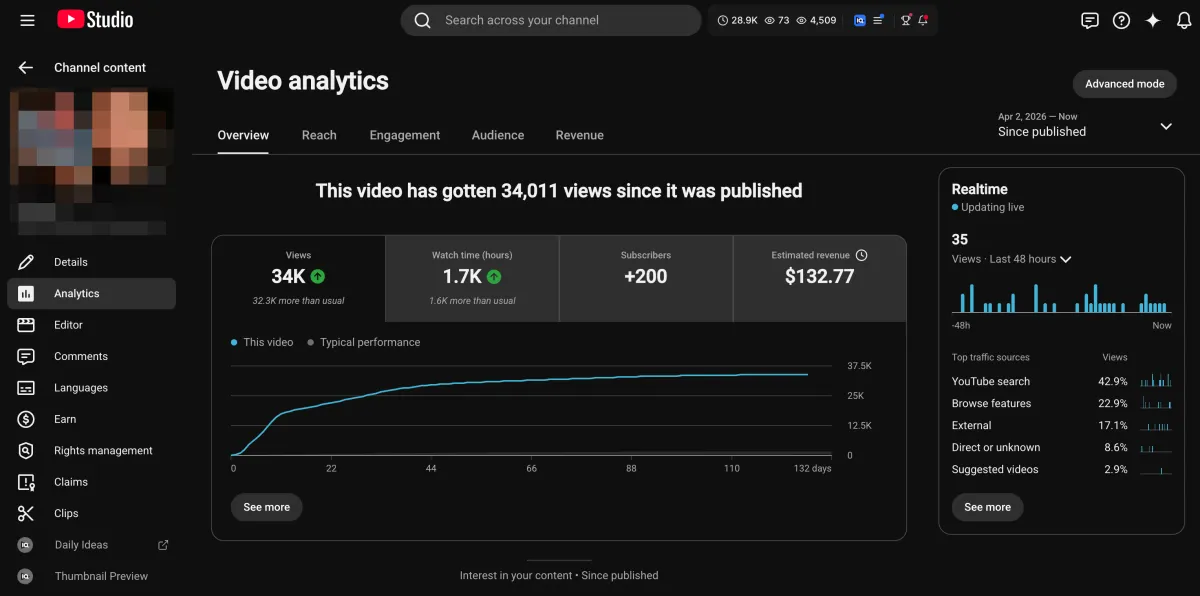
Learn how I turned a $132.77 video into $1000+ per month asset
Full case study on how you can replicate my success with YouTube SEO strategy.
Free downloadThe Zero Audience System
Build permanent YouTube income without a camera or an audience
The full methodology, 31 lessons plus bonuses. Limited spots.