There's no single ranking factor, and anyone telling you it comes down to one thing, thumbnails, keywords, upload frequency, is selling you a simplified version of something that's actually a layered system. What actually decides whether a video and a channel get pushed to more people comes down to roughly six signals working together: click-through rate, retention, viewer satisfaction, session contribution, relevance, and channel-level authority. How much each one matters depends heavily on where the video is trying to rank in the first place, because YouTube isn't running one algorithm. It's running several, and they don't weigh the same things.
I've published over 4,000 videos across two channels, most of them built around ranking in search rather than getting recommended in the home feed, which turns out to be an important distinction most explanations of "the algorithm" skip entirely. Here's the full breakdown, grounded in what YouTube has actually confirmed for 2026, not the vague folklore that gets repeated in most creator forums.
There's No Single Algorithm. There Are Several.
YouTube runs multiple, largely separate recommendation systems: Home, Search, Suggested, Subscriptions, and Shorts, each ranking content differently. A video can perform brilliantly in one of these and be almost invisible in another, and that's not a bug, it's the whole point of how the system is built.
This is the exact distinction I've been teaching for years under simpler terms: browse traffic versus search traffic. Browse, which covers Home and Suggested, is YouTube guessing what a viewer might enjoy based on their watch history and current session. It's a popularity and satisfaction contest, largely disconnected from what anyone typed into a search bar. Search is a completely different contest. It's about whether your video is the correct, specific answer to an actual typed query, and whether the person who clicked it actually got what they were looking for. Shorts runs its own separate system entirely now, fully decoupled from long-form in 2026, so poor Shorts performance no longer drags a channel's long-form recommendations down, and strong Shorts performance doesn't directly lift them either.
Understanding which system you're actually trying to rank in changes almost everything about how you should build a video. Optimizing for Home feed satisfaction and optimizing for Search intent-matching are not the same skill, even though most advice on this topic treats them as interchangeable.
The Signals That Actually Move The Needle
Click-through rate, but relative, not absolute
CTR still matters enormously, but 2026's version of it is measured relatively, against other videos of similar length and topic that a viewer was shown alongside yours, not against some universal benchmark. Thumbnail A/B testing became widely available across the platform, which means the baseline everyone's competing against has quietly risen. A CTR that looked strong in 2024 is closer to average now, simply because more creators are actively testing their way to better packaging. The thumbnail remains the single biggest lever for CTR specifically, more than the title, more than anything else in the metadata.
Audience retention and average view duration
What percentage of your video someone actually watches, and where exactly they drop off, remains a core signal. A five-minute video with strong relative retention will consistently outperform a twenty-minute video where most viewers leave a third of the way through, even though the second one technically accumulates more raw watch time. There's no universally ideal video length. What matters is whether your retention holds up relative to your own video's length and your niche's norms, not whether you hit some arbitrary duration target.
Viewer satisfaction, the biggest confirmed shift in 2026
This is the one thing that's genuinely different from a couple of years ago, and it's worth understanding properly rather than glossing over. YouTube now layers satisfaction signals on top of raw watch time: direct survey responses where viewers rate a video after watching, returning viewer rate, shares, and "not interested" clicks that actively suppress a video's reach. Watch time alone used to be treated as a rough proxy for whether people liked something. In 2026, YouTube is asking more directly, and weighing the direct answer more heavily than the proxy.
Practically, this means padding a video to inflate watch time is a worse strategy than it used to be. A viewer who watches a shorter video fully and comes away satisfied now sends a stronger signal than one who sits through a bloated video and leaves without much positive sentiment attached to it.
Session contribution
What a viewer does after your video ends now carries almost as much weight as what happened during it. Does your video hand them off to another video, yours or someone else's, or a related search, keeping them on the platform, or does it end the session entirely? A video that extends the average session is treated as more valuable to recommend than one that technically performs well but ends the viewing session outright.
This is exactly why playlists, series formats, and structured multi-episode content are outperforming single, disconnected uploads right now. It's also the entire logic behind YouTube's newer Shows feature, which lets you formally organize an existing playlist into seasons and episodes, specifically because that structure keeps people moving from one video into the next instead of leaving after just one. If you've got a playlist that already functions like a series, formalizing that structure is one of the more underused, genuinely free ways to lift session contribution across an entire batch of videos at once.
Relevance and metadata
Title, description, tags, and even the spoken content of your video, indexed through auto-captions, all get evaluated for topical relevance. This has moved well past simple keyword matching. YouTube's language processing now understands semantic meaning and topical alignment, so an exact keyword match matters less than it used to, and how closely your actual content matches what the title and description promise matters more.
Engagement and channel authority
Comments carry more weight than likes as an engagement and satisfaction signal, a shift that's been building for a couple of years now. And underneath individual video performance sits a channel-level signal: authority, built up from returning viewers, consistent positive sentiment, and a track record of videos that satisfy the searches or recommendations that brought people there in the first place. This is separate from subscriber count, and it's worth being precise about that difference, because it's one of the most misunderstood parts of the whole system.
Search Ranking Works Differently Than Home Feed Ranking, And This Is Where Most People Get It Wrong
Search specifically balances three things: keyword and topical relevance, performance signals, and something worth calling intent satisfaction. When someone searches a term, clicks your video, and watches most of it, that's read as a strong signal the video actually matched what they wanted. If they bounce quickly and search again, your video gets demoted for that specific query, even if it performs fine elsewhere.
This is precisely why aiming a video at one specific, well-defined problem outperforms aiming at a broad topic. A video trying to be a general answer to a wide question satisfies almost nobody's exact intent, so it bounces people back to search more often, which actively works against it. A video aimed at one narrow, specific version of that question either fully resolves the exact thing someone typed, or it doesn't get clicked by the wrong audience in the first place. Both outcomes are better for search ranking than being vaguely relevant to everyone and precisely satisfying no one.
Home feed ranking doesn't work this way. It's optimizing for what a viewer is statistically likely to enjoy based on behavior, not for resolving a specific typed intent. A channel can absolutely win in the home feed with broad appeal content. But a channel trying to build durable, compounding traffic from search needs to think about intent-matching as the actual game, not CTR and thumbnails in isolation.
Why Small, Specific Channels Can Outrank Big Ones
Subscriber count functions close to a vanity metric in this system. YouTube evaluates each video largely on its own performance, and a small channel with strong relative CTR and retention for its niche and length category can outperform a much larger channel putting out weaker individual videos. Subscribers don't even guarantee visibility the way people assume, only a fraction of a channel's subscriber base typically sees a new upload through the subscription feed or home page at all. Every video largely has to earn its own distribution.
There's a specific 2026 development that makes this even more favorable for small, specific channels: YouTube overhauled the Browse feed's personalization in early 2026, shifting away from broad topic categories toward clusters based on individual viewer watch history. The reported effect has been increased visibility for niche content specifically, content that used to get lost inside a broad category now has a better shot at reaching the exact viewers whose watch history actually matches it. If you've been building narrow, specific content instead of chasing broad appeal, this shift works in your favor, not against you.
Channel-Level Factors, Not Just Individual Videos
A few things accumulate at the channel level rather than resetting with every upload.
Consistency and cadence matter, not because posting daily is inherently rewarded, but because a sustainable, regular rhythm lets both the algorithm and your actual audience learn what to expect from you. Irregular, unpredictable posting makes that learning process harder on both sides.
Topical coherence helps, though it's a looser requirement than most people assume. A channel doesn't need a razor-narrow niche to build authority, it needs each individual video to be genuinely specific, sitting under one umbrella broad enough to cover a handful of related problems. What actually damages channel-level authority is a library of interchangeable, templated videos that all blur together, the same pattern that got flagged under YouTube's tightened content-authenticity enforcement in 2026. A channel that looks mass-produced and undifferentiated struggles on both the policy side and the ranking side, for closely related reasons.
Production quality matters less than people think, in one specific sense: YouTube doesn't rank higher-resolution video above lower-resolution video just because of the technical spec. What it actually measures is whether people stay and engage. A clearly shot, well-structured phone video will consistently outperform a poorly edited video shot on expensive gear. Audio quality is the one production element that punches well above its weight, poor sound is one of the most common, avoidable reasons viewers drop off in the first few seconds.
What This Actually Means For How You Should Build A Channel
Put all of this together and it lines up almost exactly with the model I've taught for years, which is either a coincidence or a sign that the underlying mechanics were always pointing this direction, well before the platform's language caught up to it.
Aim every video at one specific, real problem, because that's what wins the intent-matching game in search, and it's what keeps satisfaction signals high in the home feed too, a viewer who got exactly what they came for rates the experience well, comes back, and doesn't immediately bounce back into another search.
Favor evergreen topics over trending ones, because search traffic compounds over months and years while a trend-chasing video gets one satisfaction spike and then goes quiet. Evergreen content keeps generating the exact kind of long-term watch time, returning viewers, and session contribution that the 2026 system explicitly rewards.
Structure your catalogue into playlists or formal series where it makes sense, since session contribution is now one of the more heavily weighted signals for long-form, and a well-organized playlist is one of the simplest, most underused ways to lift it without producing a single new video.
Don't chase watch time by padding videos. Chase genuine satisfaction by answering the thing completely and efficiently. A shorter video that fully resolves someone's problem now consistently outperforms a longer one that wastes their time getting there.
Fix your audio before you upgrade your camera. It's the cheapest, highest-leverage production fix available, and it directly affects the retention numbers that feed almost every other signal downstream of it.
What Doesn't Matter As Much As People Think
Subscriber count doesn't reliably predict reach on any individual video, and it's not something the ranking systems weight the way people assume. Video length has no universal ideal, relative retention for your specific length and niche matters far more than hitting some target duration. Hashtags play a limited, mostly categorization role rather than functioning as a real ranking lever. Tags more broadly are useful mainly for disambiguation, helping YouTube understand what an ambiguous title actually refers to, not a magic keyword-stuffing opportunity. And exact keyword matching in titles matters less than it used to, since the system now evaluates semantic and topical alignment rather than literal string matching.
A Practical Checklist To Audit Your Channel Against These Factors
- Pull your last five videos and check retention against similar-length videos in your niche, not against an arbitrary universal benchmark.
- Check whether your thumbnails are being A/B tested at all. If not, you're likely competing against a rising CTR baseline without adjusting for it.
- Look at whether your videos are organized into playlists or a formal series structure. If not, this is one of the cheapest available fixes for session contribution.
- Read your last ten titles together and ask honestly whether each one promises something specific enough to fully satisfy the exact search behind it, or whether they're vaguely aimed at a broad topic.
- Check your audio quality specifically, separate from your video quality, on your most recent upload.
- Review whether your catalogue reads as specific and differentiated, or interchangeable and templated, the same test that matters for both channel authority and content-authenticity policy.
- Confirm you're not relying on subscriber count as a proxy for whether a video will perform. Judge each upload on its own relative CTR and retention instead.
Frequently Asked Questions
Does subscriber count actually affect YouTube ranking?
Not directly. YouTube evaluates each video largely on its own relative performance, CTR, retention, and satisfaction signals compared to similar content. A small channel with strong numbers can outperform a much larger one with weaker metrics on a given upload.
How important are tags in 2026?
Limited but real. Tags mainly help YouTube disambiguate an unclear title rather than functioning as a significant keyword-stuffing opportunity. Titles, descriptions, and even spoken content in the video matter more for topical relevance.
Do Shorts help a channel's long-form videos rank better?
Not directly anymore. Shorts and long-form now run on fully separated recommendation systems, so strong or weak Shorts performance doesn't carry over to long-form ranking the way it once did.
What's a good click-through rate in 2026?
There's no single universal number, since CTR is judged relative to similar videos in your niche and length category, and that baseline has risen as thumbnail A/B testing became widely available. Track your CTR against your own niche's norms rather than a generic industry figure.
Does posting every day help ranking?
Consistency helps more than raw frequency. A sustainable, predictable cadence that you can maintain without sacrificing video quality outperforms aggressive daily posting that burns out either your quality or your ability to keep it up.
The Bottom Line
A successful YouTube channel isn't the result of gaming one ranking factor. It's the result of a video being specific enough to satisfy an exact intent, retaining people because it delivers efficiently rather than padding for watch time, extending the session through smart structure like playlists, and doing all of that consistently enough that channel-level authority builds on top of it. None of that requires a huge following to start. It requires each individual video to earn its own distribution, on its own merits, which has always been more within a small channel's control than most people realize.
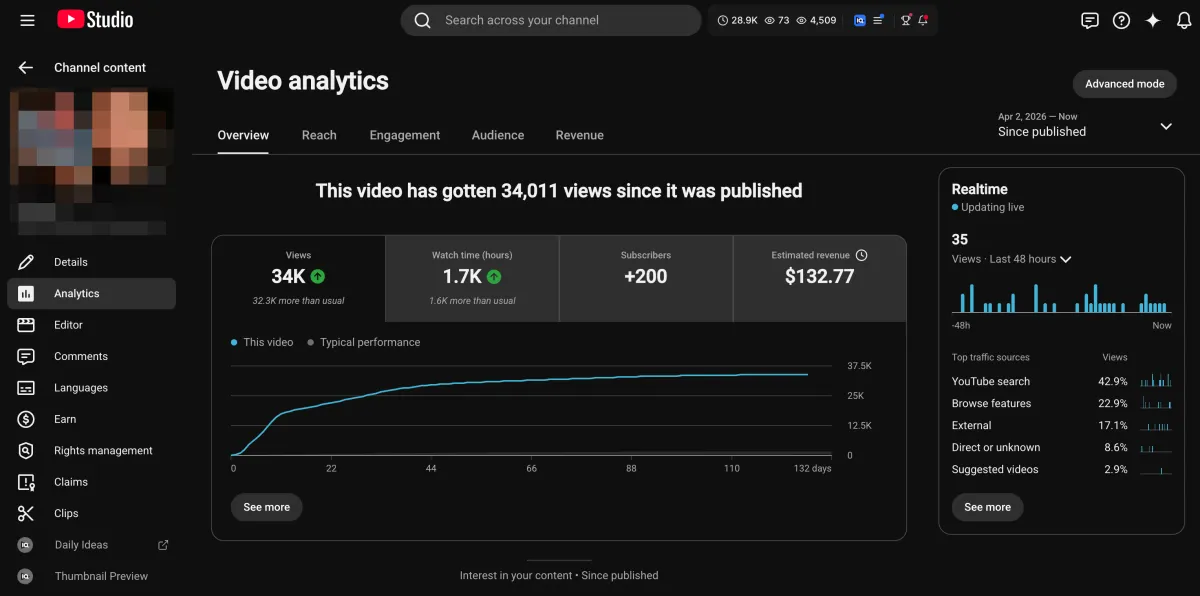
Learn how I turned a $132.77 video into $1000+ per month asset
Full case study on how you can replicate my success with YouTube SEO strategy.
Free downloadThe Zero Audience System
Build permanent YouTube income without a camera or an audience
The full methodology, 31 lessons plus bonuses. Limited spots.