
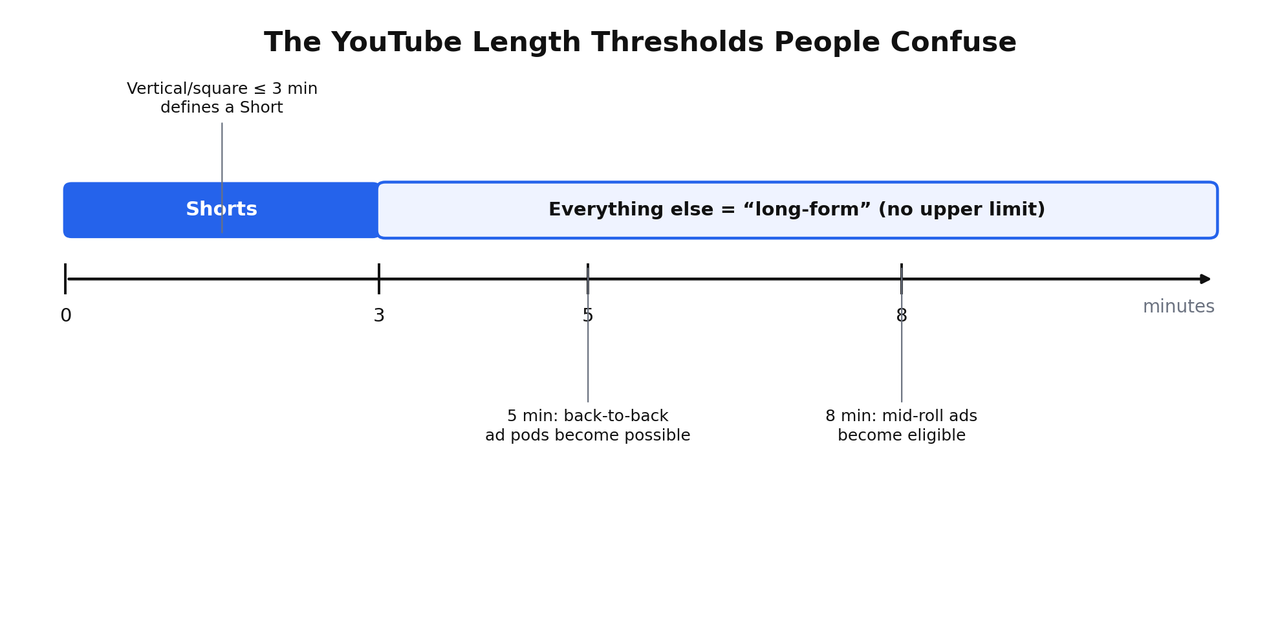
YouTube doesn't actually define "long-form" with its own fixed minimum length. The only length-based category YouTube officially defines is a Short, a vertical or square video up to three minutes long. Everything else, any horizontal video regardless of length, or a vertical video over three minutes, falls into what's generally called long-form or regular content. There's no separate rule that says a video needs to hit 8 minutes, or 10, to count as long-form. That number gets attached to it for a completely different reason, and mixing the two up is where most of the confusion on this topic comes from.
Here's the actual breakdown of where each length threshold comes from, why they get confused with each other, and what actually matters for a video's performance once length stops being the question.
The Real Definition: Anything That Isn't a Short
YouTube's official Shorts definition is specific: a video with a square or vertical aspect ratio, three minutes or under, uploaded after October 15, 2024. That date matters, a video uploaded before that cutoff keeps whatever classification it originally had, even if it technically fits the new criteria now.
Long-form content is defined by exclusion rather than by its own positive rule. A four-minute vertical video is long-form. A ninety-second horizontal video is also long-form, since it's not vertical or square. Length alone doesn't put a video in either bucket, orientation and the three-minute ceiling do.
Why The Three-Minute Line Moved At All
Shorts didn't start at three minutes. The format launched with a 60-second cap, and YouTube extended that to three minutes starting October 15, 2024, widely read as a direct response to competing platforms giving creators more room for short-form storytelling and tutorials. That single change is also why so much content published before late 2024 is still officially long-form even though it's short and vertical, the classification was locked in at upload time, not recalculated retroactively.
The Length Thresholds People Actually Confuse With "Long-Form"
The eight-minute and ten-minute numbers that show up constantly in creator advice aren't about what counts as long-form. They're about ad eligibility, a completely separate system that happens to also be measured in minutes.
| Length | What actually happens at this point |
|---|---|
| 3 minutes | The ceiling for a vertical or square video to qualify as a Short |
| 5 minutes | Videos become eligible for back-to-back ad pods (two video ads in a row) |
| 8 minutes | Videos become eligible for mid-roll ads |
| 10 minutes | The old mid-roll threshold before YouTube lowered it to 8 minutes in 2020 |
YouTube's own help documentation confirms the current mechanics directly: mid-roll ads require a video to be 8 minutes or longer, and back-to-back ad pods become available starting at 5 minutes. Neither of these numbers has anything to do with whether a video counts as long-form. A 4-minute horizontal video is already long-form. It just isn't eligible for mid-roll ads yet.
What Creators Actually Mean When They Say "Long-Form"
In practice, when creators and marketers say "long-form video," they're rarely using YouTube's technical definition. They usually mean something closer to 8 to 10 minutes or longer, because that's the point where mid-roll ad revenue kicks in and where a video starts to feel like a substantial, standalone piece of content rather than a quick clip. That's a real, useful distinction in conversation. It's just not the same thing as YouTube's actual classification system, where a 4-minute horizontal video and a 25-minute one are both equally "long-form" from a platform standpoint.
Worth knowing if you're deciding on a length for a specific video: there isn't a minimum you need to hit to be taken seriously as long-form content, and there isn't a required length to satisfy some unwritten platform expectation. A 4-minute horizontal explainer is exactly as officially long-form as a 40-minute one.
Does Length Itself Affect How A Video Performs?
Not directly, and this is where a lot of advice about long-form content goes wrong. YouTube doesn't reward a video for being longer. What it rewards is retention relative to a video's own length, whether people who start watching keep watching, measured against similar content, not against an arbitrary duration target. A tightly made 5-minute video with strong retention consistently outperforms a padded 12-minute video where most viewers drop off halfway through.
The honest reason to make a longer video isn't "long-form performs better." It's that the topic genuinely needs more time to answer completely, and once you're past 8 minutes anyway, you might as well make the video as long as it needs to be to fully deliver, since you've already crossed into mid-roll ad eligibility regardless of whether you stop at 8 minutes or continue to 15.
How I'd Decide Between Long-Form And A Short For A Given Idea
The decision that actually matters isn't "how many minutes should this be." It's whether the specific problem you're solving needs the fuller explanation a longer video allows, or whether it's genuinely a quick, self-contained answer that works better as a Short. A tutorial with several real steps, each requiring some explanation, needs the room long-form gives it. A single quick tip, a before-and-after result, or a fast answer to a narrow question often works better short, and forcing it into a longer format just adds filler that hurts retention.
Start from the problem the video is solving, not from a target runtime. The length that actually serves the answer is the right length, whether that lands at 4 minutes or 40.
Frequently Asked Questions
Is there an official minimum length for long-form content on YouTube?
No. YouTube defines Shorts directly, up to three minutes, vertical or square. Long-form is simply anything that doesn't meet that definition, with no minimum length requirement of its own.
Does a video need to be at least 8 minutes to be considered long-form?
No, that's a common mix-up. Eight minutes is the threshold for mid-roll ad eligibility, a monetization feature, not the definition of long-form content. A 4-minute horizontal video is already long-form.
Can a vertical video ever be long-form?
Yes. Any vertical or square video over three minutes falls outside YouTube's Shorts definition and is treated as long-form, regardless of orientation.
Does making a video longer help it perform better?
Not on its own. Retention relative to a video's own length matters far more than raw duration. A shorter video with strong retention typically outperforms a longer one that loses its audience partway through.
The Actual Answer, One More Time
If you came here needing one number, there isn't one to give you, and that's the honest answer, not a dodge. Long-form on YouTube means anything that isn't a Short: over three minutes in a vertical or square format, or any length at all in a horizontal one. The 8-minute and 10-minute numbers that get repeated constantly are about ad eligibility, not classification. Build your video to the length the topic actually needs, and let the ad thresholds fall wherever they fall.
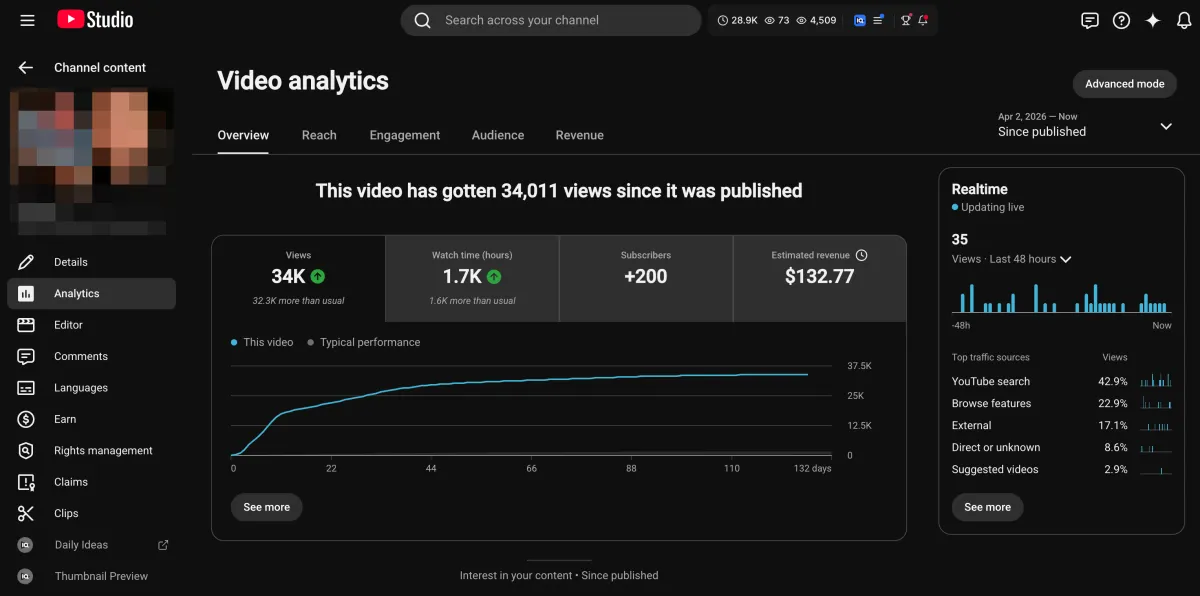
Learn how I turned a $132.77 video into $1000+ per month asset
Full case study on how you can replicate my success with YouTube SEO strategy.
Free downloadThe Zero Audience System
Build permanent YouTube income without a camera or an audience
The full methodology, 31 lessons plus bonuses. Limited spots.