The honest answer has two parts. The official, platform-defined answer is: once you hit YouTube's monetization thresholds, get approved into the Partner Program, and clear the minimum payout balance, which realistically takes most channels somewhere between two and six months of consistent uploading just to reach the application stage, then another month or two before the first payment actually lands. The more useful answer, the one that actually matters for your income, is that AdSense was never the fastest or the biggest way to start earning on this platform in the first place, and treating it as the starting line is why a lot of creators wait far longer than they need to before they see their first real dollar.
Here's the full breakdown, the official thresholds, a real timeline, an upcoming 2027 change worth knowing about now, and the part almost every other article on this topic leaves out entirely.
The Official Threshold: YouTube Partner Program Requirements
YouTube runs a two-tier system. The first tier unlocks fan-funding features. The second, full tier, unlocks actual ad revenue.
| Tier | Subscribers | Watch Hours / Views | What It Unlocks |
|---|---|---|---|
| Tier 1 (early access) | 500 subscribers, 3 public uploads in the last 90 days | 3,000 valid public watch hours in 12 months, or 3 million valid public Shorts views in 90 days | Channel memberships, Super Chat, Super Thanks, Super Stickers, YouTube Shopping. No ad revenue yet. |
| Tier 2 (full monetization) | 1,000 subscribers | 4,000 valid public watch hours in 12 months, or 10 million valid public Shorts views in 90 days | Ad revenue, YouTube Premium revenue share, and everything from Tier 1 |
A few conditions apply on top of the numbers themselves: two-step verification enabled on your Google account, no active Community Guidelines strikes, a channel based in an eligible country, and a linked AdSense account. Watch hours from Shorts don't count toward the long-form 4,000-hour threshold, the two paths are entirely separate, so pick one and build toward it deliberately rather than splitting effort across both.
A Change Coming In 2027 You Should Know About Now
This is recent enough that most existing guides on this topic don't mention it yet, and it directly affects your timeline if you're starting a channel today. YouTube has announced that starting February 1, 2027, new creators applying to the Partner Program will need 8,000 qualified watch hours in the past 12 months, double the current requirement, or 20 million qualified Shorts views in the past 90 days, also double.
Creators already accepted into the Partner Program before that date aren't affected. But if you're building a channel now with the expectation of applying sometime next year, this is worth planning around. Getting your channel to the current 4,000-hour threshold and applying before the change takes effect is a meaningfully easier target than waiting and having to hit double that number instead.
Hitting The Threshold Isn't The Same As Getting Paid
Meeting the subscriber and watch-hour numbers only means you're eligible to apply. From there:
- YouTube reviews your application, typically within days, though the platform's own published guidance allows up to a month, especially under the more thorough content-authenticity review standards in place now.
- Once approved, ads switch on for your monetized videos, and revenue starts accruing in your linked AdSense account.
- AdSense only pays out once your balance crosses the minimum threshold, generally $100 USD, depending on your country.
- Payments are released on a monthly cycle, typically between the 21st and 26th of the month, for the balance accrued the prior month. If you cross $100 in a given month, you're generally paid the following month, not immediately.
Add it up, and even a channel that hits the subscriber and watch-hour thresholds quickly is often still two to three months away from an actual deposit landing in their account, simply because of review time, the payout threshold, and the payment cycle lag stacked on top of each other.
The Realistic Timeline To Your First Dollar
Here's what this tends to look like in practice, assuming consistent uploads aimed at real, specific problems rather than scattered, unfocused content.
- Months 1 to 3: Almost nothing visible. This is normal, not a sign anything is wrong. You're accumulating the early watch hours and subscriber count that everything else depends on.
- Months 3 to 6: If the channel is built around specific, evergreen topics, this is usually when the watch-hour and subscriber thresholds start becoming realistic, and a handful of videos begin showing real traction.
- Months 6 to 9: Many channels cross the Tier 2 thresholds somewhere in this window, apply, get approved, and start seeing their first AdSense balance accumulate.
- Months 9 to 12: First real AdSense payout typically lands somewhere in here, assuming the $100 minimum was cleared a month or so earlier.
This is a general shape, not a guarantee, some channels move faster, especially in high-demand niches, and some take considerably longer. But if you're several months in and haven't hit the thresholds yet, that's closer to normal than it is to a sign you're doing something wrong.
Why AdSense Isn't Actually When You "Start Earning"
Here's the part almost every other article on this exact question skips entirely, and it's the most important reframe in this whole piece: AdSense is not the first way most successful channels actually make money. It's usually the slowest one to activate, and often not even the largest income source once a channel matures.
Affiliate commissions and your own digital products don't require YouTube Partner Program approval at all. You can put an affiliate link or a link to your own offer in the description of your very first video, on a channel with zero subscribers, and if that video is aimed at a real, specific, buyer-intent problem, it can generate a sale before you've come anywhere close to 1,000 subscribers or 4,000 watch hours.
This isn't a workaround or a loophole. It's simply a completely separate system from YouTube's own monetization program, one that YouTube has no involvement in approving, reviewing, or gating behind a threshold.
The Three Ways You Can Actually Earn, And When Each One Realistically Kicks In
| Income Source | Requires YPP Approval? | Realistic Earliest Timing |
|---|---|---|
| Affiliate commissions | No | Your first video, if it's aimed at a real, specific, buyer-intent problem |
| Your own digital product or offer | No | Same as above, as soon as you have something to sell and a video that earns the right to recommend it |
| AdSense (ad revenue) | Yes | Typically 6 to 12 months in, after thresholds, review, and payout cycle |
| Brand deals and sponsorships | No, but requires real traction first | Usually after a channel has demonstrable, consistent performance, often 6 months or more |
Notice that two of the four rows don't require YouTube's permission at all. If your actual goal is earning money as early as possible, not specifically earning ad revenue as early as possible, affiliate and product-based income is the faster path, by a wide margin.
What Actually Determines How Fast You Get There
Regardless of which income source you're chasing first, the underlying speed comes down to the same handful of things. Videos aimed at one specific, well-defined problem reach the right viewers faster than broad, unfocused content. Evergreen topics keep accumulating watch hours for months after publishing instead of spiking once and going quiet, which matters enormously for hitting a trailing-12-month watch-hour threshold. And consistency compounds, ten videos published over ten weeks builds toward these thresholds faster than the same ten videos published in one burst and then nothing for two months, because YouTube's watch-hour requirement is measured over a rolling year, not a single lucky spike.
A Realistic Example Timeline
Take a new channel publishing two specific, evergreen videos a week. By month two, a small number of early videos start showing modest but real traction. By month four or five, accumulated watch hours are approaching the Tier 2 threshold, assuming the content is holding attention reasonably well. Application happens around month five or six, approval lands a few weeks later, and the first AdSense balance starts accumulating from there, crossing the $100 payout minimum sometime around month seven or eight, with the actual deposit arriving the following month.
Meanwhile, if that same channel included a relevant affiliate link from video one, aimed at a real buyer-intent problem, the first commission could have landed months earlier, entirely independent of any of the above.
A Practical Checklist
- Decide what you're promoting, an affiliate product or your own offer, before you publish your first video, not after.
- Track your progress toward the Tier 2 thresholds inside YouTube Studio's Earn tab rather than guessing.
- If you're planning to apply sometime in the next year, be aware of the 8,000-hour threshold taking effect February 1, 2027, and factor that into your timeline.
- Set up your AdSense account early so linking it isn't a delay once you're actually eligible.
- Don't wait for AdSense to consider your channel "earning." Track affiliate and product revenue from day one, since that's very likely where your first real dollar actually comes from.
Frequently Asked Questions
How many subscribers do you need to start earning on YouTube?
500 subscribers unlocks fan-funding features like memberships and Super Thanks. 1,000 subscribers, combined with either 4,000 watch hours or 10 million Shorts views, unlocks full ad revenue through the Partner Program.
Can you earn on YouTube without being in the Partner Program?
Yes. Affiliate commissions, your own digital products, and brand deals don't require Partner Program approval at all. Many creators earn real money this way well before ever qualifying for AdSense.
How long does it usually take to get your first YouTube payout?
For AdSense specifically, realistically six to twelve months for a consistently uploaded channel, accounting for the time to hit thresholds, get approved, clear the $100 minimum, and wait out the monthly payment cycle. For affiliate or product income, it can happen far sooner, sometimes from your very first video.
Is the YouTube Partner Program getting harder to join?
Yes, starting February 1, 2027, new applicants will need 8,000 watch hours instead of 4,000, or 20 million Shorts views instead of 10 million. Creators already approved before that date keep their existing status.
What's the minimum amount YouTube will actually pay out?
AdSense generally requires a $100 balance before releasing a payment, paid out on a monthly cycle roughly a month after the balance is crossed.
The Bottom Line
If the question is specifically "when does AdSense start paying me," the honest answer is usually six to twelve months in, after clearing the thresholds, the review process, and the payout cycle, and that timeline is about to get longer for new applicants once the 2027 threshold increase takes effect. But if the real question is "when can I start earning from YouTube at all," the answer is much sooner, as early as your first video, as long as it's built around a real, specific problem with a real offer attached to it. Don't wait on YouTube's permission to start earning. Wait on it for AdSense specifically, and build your income around something faster in the meantime.
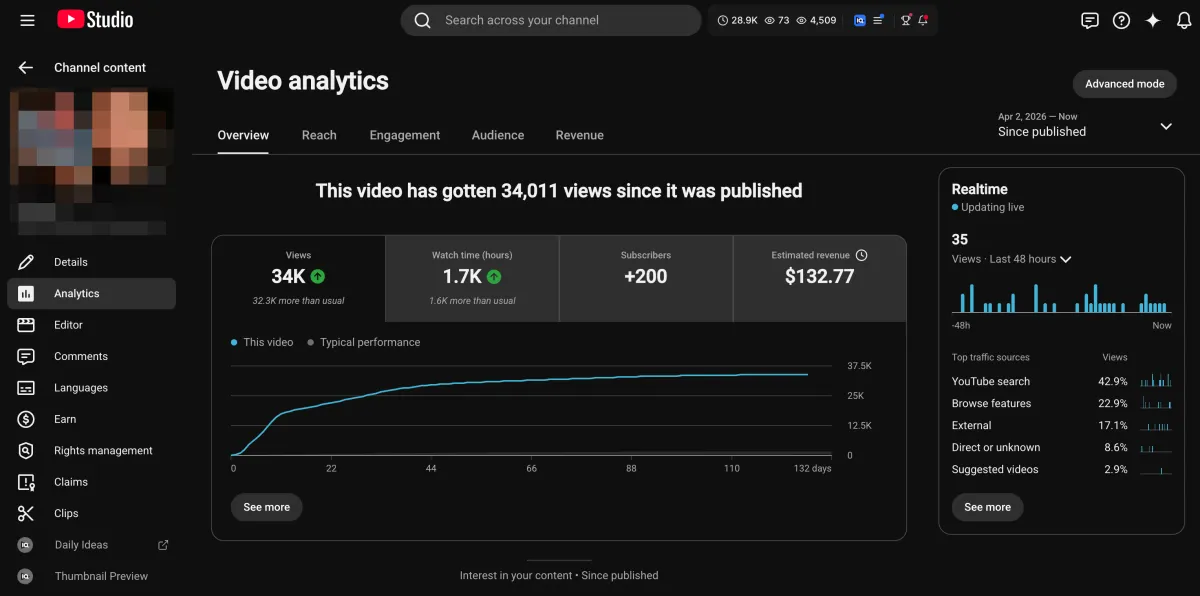
Learn how I turned a $132.77 video into $1000+ per month asset
Full case study on how you can replicate my success with YouTube SEO strategy.
Free downloadThe Zero Audience System
Build permanent YouTube income without a camera or an audience
The full methodology, 31 lessons plus bonuses. Limited spots.