
Short answer first, because that is what most people looking this up actually want: you start a second YouTube channel once your first one is running mostly without you. Not on a calendar date, not at a subscriber milestone, and not because you are bored or impatient.
If that answer raises more questions than it settles, that is the point of this article. Below is the full breakdown, the actual signals to look for, the mistakes that sink people who move too early, and a practical checklist you can use to make the call for your own channel.
The One Rule That Matters More Than Timing
Before anything else, one rule: never start two channels at the same time.
This sounds obvious written down, and it is still the single most common mistake creators make. Splitting your attention between two unfinished, unproven channels does not double your odds of success. It usually cuts both of them off at the knees.
You do not touch a second channel until channel one is fully built out and running largely on its own. Everything else in this article assumes that rule as the starting point.
The Real Signal It Is Time, And It Is Not A Date
There is no universal day count or subscriber number that tells you it is time. "Six months in" or "10,000 subscribers" are the kinds of arbitrary benchmarks people repeat because they are easy to say, not because they are actually true for every channel.
The real signal is operational, not calendar based. Your first channel needs to be running without your daily involvement. That means:
- The upload schedule continues whether or not you personally touch it that week.
- The revenue is steady and not dependent on you actively hustling for it.
- The process behind the channel, from idea to upload, either does not need you at every step or has been handed off to people who can run it without your constant supervision.
Until that is true, you do not have a channel one that is finished. You have a channel one that is still being built, and starting a second one on top of an unfinished first one is how you end up with two half built channels instead of one working one.
Signs You Are Not Ready Yet
If any of the following describe your current channel, it is not time for a second one yet, no matter how tempting it feels.
- You are still personally recording, editing, or uploading every single video yourself, and the channel stops moving the moment you stop showing up.
- Revenue is inconsistent, spiky, or still mostly theoretical. You have had a few good videos but not a repeatable pattern behind them yet.
- You do not have a documented process. If someone else had to run your channel for a month, they would not know what to do, because the process only exists in your head.
- You are still actively learning the model itself, the research, the positioning, what converts. If you are still figuring out what works on channel one, you do not have a proven system to copy onto channel two yet. You would just be repeating the same learning curve twice, at the same time, with half the attention on each.
None of these are permanent disqualifiers. They are just signs the finish line for channel one has not been crossed yet.
What You Are Actually Building Is A Portfolio, Not "Another Channel"
Here is a mental shift worth making before you go any further. You are not building a second channel. You are building a portfolio of assets, and a channel is just one unit inside that portfolio.
Framed that way, the question changes. It is not "when do I start channel number two." It is "when is asset number one finished enough that I can responsibly start building asset number two without damaging it."
One channel today can realistically become ten or fifteen over the course of several years, each one a separate, largely independent income stream. Some creators take this all the way into building a small media company out of it. Most do not need to go that far, and that is fine too, which brings us to the next point.
Is Bigger Always Better? No
It is worth saying directly: scaling to multiple channels is a choice, not a requirement, and it is not automatically the correct next move just because it is available.
A single, well run channel making a genuinely healthy income can be more than enough. Plenty of creators reach a strong five figure monthly income from one channel alone and decide that is the right stopping point for their life. Not because they could not scale wider, but because they did not need to.
If your first channel is already funding the life you actually want, there is no rule that says you have to add a second one.
Scaling wide is available to you once channel one is finished. It is not owed to you, and it is not automatically the better outcome for everyone.
How Much Revenue Should Channel One Be Making First?
There is no single dollar figure that applies to everyone, because cost of living, goals, and risk tolerance are all different. What matters more than a specific number is whether the revenue is repeatable and largely hands off relative to your daily time.
A channel making a modest but completely consistent amount, driven by traffic that keeps arriving without new uploads, is in a stronger position to spin off a second channel than a channel making more money but requiring constant hands on hustling to sustain it.
If you need a rough gut check: could you stop uploading to channel one for a full month and have the revenue stay roughly flat? If yes, you likely have a real asset, not just an active side hustle, and you are in a reasonable position to consider a second channel. If the answer is no, that is your answer too.
Two Ways To Actually Fund And Staff A Second Channel
Once channel one is genuinely finished, there are two realistic paths for building the second one.
1. Reinvest channel one's profit
Use the income from your first channel to hire out the work on your second one from day one. Editing, thumbnails, even the initial research. This is the faster path if channel one is generating enough surplus income to comfortably support it, and it lets you avoid repeating the most time consuming grind phase yourself.
2. Grind it yourself until it can pay for itself
Some creators do all the early work on channel two personally, the same way they did on channel one, and only start hiring once channel two's own revenue reaches a comfortable break even point. This path is slower but requires less upfront capital, and it works well if you would rather not divert cash from a channel that is already performing.
Neither path is wrong. The mistake is trying to do the second channel's early grind work at the same time as still actively grinding channel one. Pick one channel to actively build at a time.
The Actual Process Is Sequential, Not Simultaneous
Put simply, the whole approach only works in this order.
- Put all of your focus into channel one until it is automated and self running.
- Once it is genuinely running on its own, decide your direction. Stay deep with one channel, or go wide with a second.
- If you are going wide, fund and staff channel two using one of the two paths above.
- Repeat the exact process that worked on channel one. Do not reinvent your approach from scratch for channel two. The whole point of having a system is that it is reusable.
This is deliberately sequential. It is never simultaneous. Trying to run the early, labor intensive build phase on two channels at once is functionally the same mistake as starting two channels on day one, just with a more sophisticated excuse attached to it.
Why This Gets Easier Every Single Year
Worth knowing if you are on the fence. Running multiple channels gets structurally cheaper and easier every year, because the tools around content creation, editing, and general production keep getting more capable and more affordable.
The version of starting a second channel that required a full time hire five years ago increasingly requires a fraction of that today. This does not change the core rule, channel one still has to be finished first, but it does mean the second channel, once you are actually ready for it, is a lighter lift than it used to be.
A Practical Checklist Before You Start Channel Two
Before you commit to a second channel, go through this list honestly.
- Channel one keeps generating consistent revenue even during weeks you do not actively work on it.
- You could describe your entire content and monetization process in a written document clear enough for someone else to follow.
- You have identified whether you are funding channel two by reinvesting profit or grinding it out yourself, and you are not doing both approaches half heartedly at once.
- You genuinely want to go wide, not just because you are bored with channel one, but because you see a real opportunity for a second, related asset.
- You are prepared to give channel two the same full, undivided early attention that channel one got, without letting channel one slide backward in the meantime.
If you can honestly check every box, you are in a good position to start. If you are missing more than one, the better use of your time is still channel one.
Frequently Asked Questions
Can I run two YouTube channels at the same time from the very start?
Technically yes, practically it is a mistake for almost everyone. Splitting focus across two unproven channels early on tends to slow down or stall both of them, rather than doubling your progress. Build one channel to the point of running on its own first.
How long does it usually take before a channel is automated enough?
There is no fixed timeline. It depends on the niche, the consistency of uploads, and how quickly traffic starts compounding. The signal to watch for is not a specific month count, it is whether the channel keeps performing during a stretch where you are not actively working on it.
Should my second channel be in the same niche as my first?
It can be, but it does not have to be. What matters more than niche overlap is whether you are able to apply the same proven process, the same approach to research, video structure, and monetization, to a new topic area. A completely unrelated niche works fine as long as you are reusing the system, not starting from zero on strategy as well as content.
What is the biggest mistake people make when starting a second channel?
Starting it before the first one is actually finished, then splitting attention between two channels that are both still in their fragile early stage. The second most common mistake is treating the second channel as a fresh strategic experiment instead of a repeat of what already worked.
The Bottom Line
There is no calendar date for this. The right time to start a second YouTube channel is when your first one has stopped needing you every day to keep performing, when you have a real, repeatable process instead of a habit that only lives in your head, and when you actually want to build a second asset rather than just feeling restless with the first one.
Everything else, the exact niche, the exact revenue number, the exact funding method, is a detail you figure out once that one real condition is met.
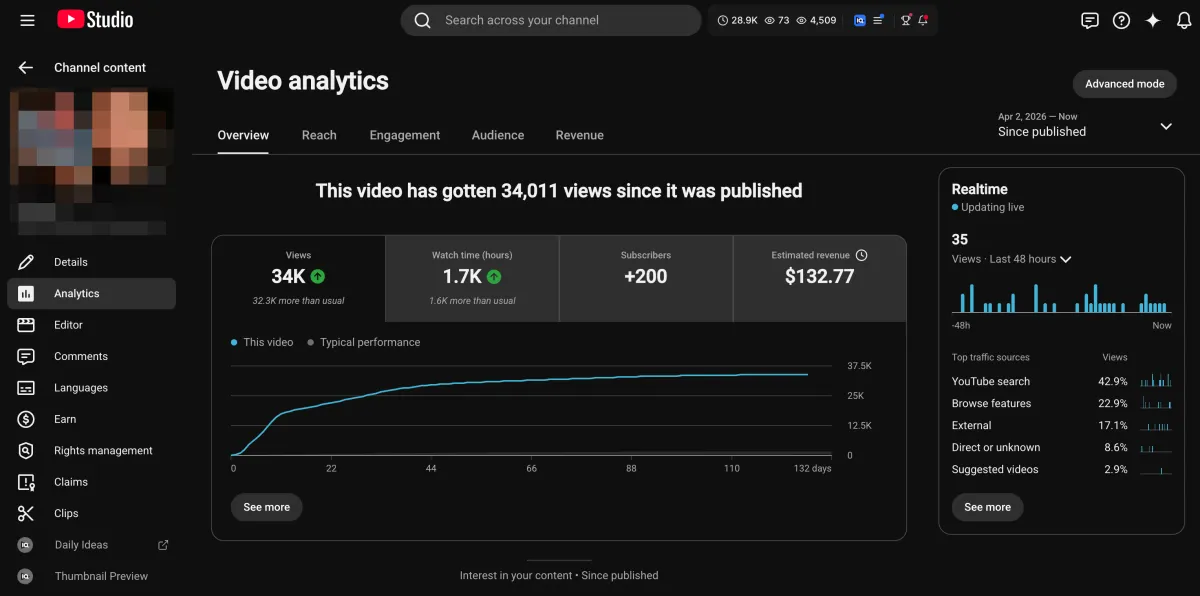
Learn how I turned a $132.77 video into $1000+ per month asset
Full case study on how you can replicate my success with YouTube SEO strategy.
Free downloadThe Zero Audience System
Build permanent YouTube income without a camera or an audience
The full methodology, 31 lessons plus bonuses. Limited spots.