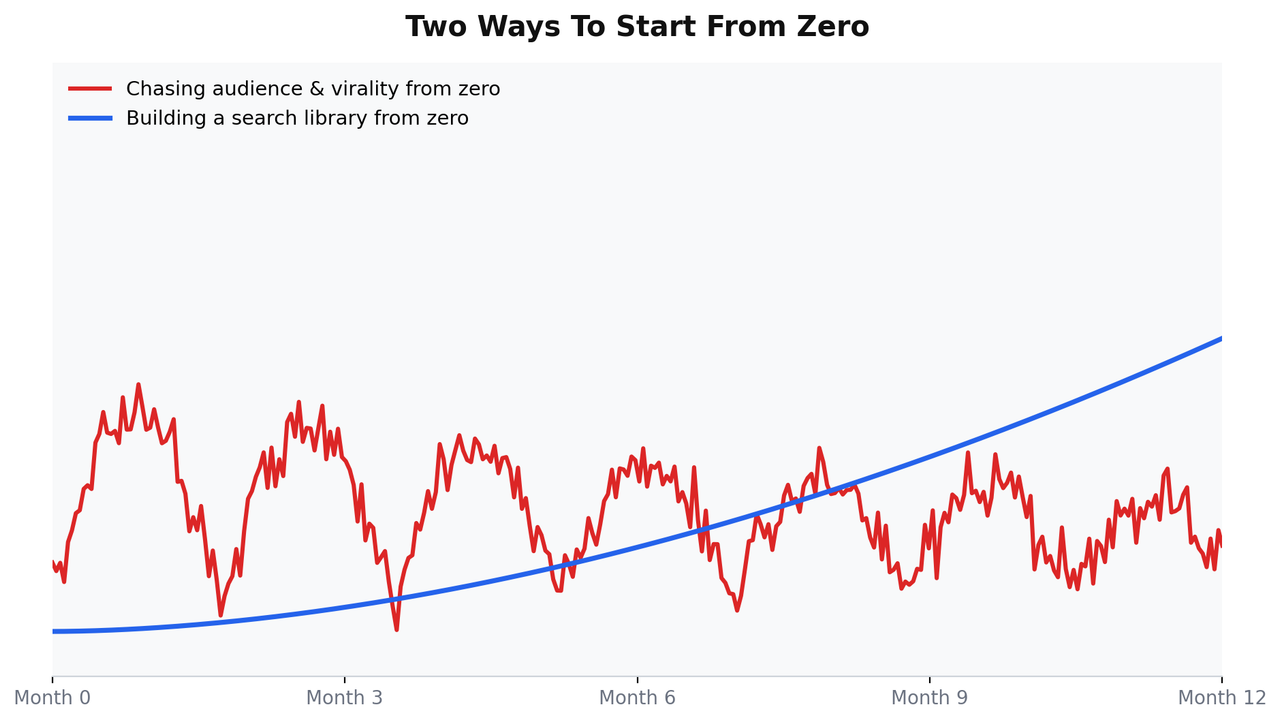
The honest answer starts with a correction: if you're at zero subscribers, chasing an audience directly is the slowest way to get one. The channels that actually grow from nothing in 2026 don't start by trying to build a following, they start by building a library of specific, evergreen videos that each independently attract the exact right viewer through search. The audience shows up afterward, as a byproduct of videos that kept solving real problems for months, not as something you can go out and recruit before you've made anything worth subscribing to.
Here's why the traditional advice fails most people starting from zero, and the actual sequence I'd follow instead.
What People Actually Mean When They Search This
Almost nobody typing "how to build an audience from zero" actually wants an audience for its own sake. They want reach, income, and enough momentum that the channel stops feeling like shouting into an empty room. Subscriber count is the proxy people reach for because it's the number YouTube shows you first, not because it's actually the thing that predicts whether a channel succeeds. A channel with 800 subscribers and consistent search traffic can out-earn a channel with 80,000 subscribers and no real conversion mechanism behind it. Keep that distinction in mind for everything below, because it changes what you should actually be optimizing for in the first few months.
Why Traditional Audience-Building Advice Fails From Zero Specifically
Most audience-growth advice, post consistently, engage with your community, ride trends, was written for channels that already have some momentum, some subscriber base, some existing signal for YouTube's systems to work from. None of that applies the same way at zero. A brand-new channel has no watch history, no established pattern, nothing for YouTube to compare your content against. Trend-chasing specifically backfires here: a big channel catching a trend gets a temporary boost on top of an existing base. A zero-subscriber channel catching the same trend gets a brief spike that vanishes in days, because there was no foundation underneath it to convert that spike into anything lasting.
The Zero-To-One Reframe: Build A Library, Not A Following
Treat every video as an independent asset aimed at one specific, searchable problem, not as a contribution to a growing personality-driven following. A video built this way doesn't need an existing audience to succeed, it needs to be the correct, complete answer to something people are already typing into a search bar. That's the entire mechanism that lets a zero-subscriber channel compete: search doesn't care how many subscribers you have, it cares whether your video resolves the query better than what's currently ranking.
Subscribers accumulate naturally from this approach, just later than people expect, and for a different reason than most advice assumes. People subscribe after a video has already solved their problem once, as a bet that you'll do it again for their next problem. That's a trailing signal, not a starting strategy.
The Actual Sequence, Starting From Zero
Pick one broad umbrella topic you already know something about, not a narrow niche and not something so broad it has no shape. Something with enough range to cover a dozen distinct, specific problems.
List 10 to 15 specific problems inside that topic, the kind of specific, narrow questions people actually type into a search bar, not vague broad ones nobody searches directly.
Decide what you're pointing toward before you make anything, an affiliate product, your own offer, ad revenue as a baseline. Knowing this changes how you structure every video from the first one.
Publish consistently for the first 90 days without judging results. This is the stretch almost everyone quits during, and it's also the stretch where a brand-new channel is least able to interpret its own numbers correctly, since there isn't enough data yet for any single video's performance to mean much on its own.
Track which videos show any early signal, even a small one, relative to your other early uploads. You're not looking for proof of success this early. You're looking for the first faint sign of which direction to lean once you do have enough data to act on it.
Let subscribers happen, don't chase them. Once a handful of videos are consistently getting found through search, subscriber growth tends to follow on its own, driven by people who already got real value from you once.
What Changed In 2026 That Actually Helps A Zero-Subscriber Channel
YouTube overhauled its Browse feed personalization in early 2026, shifting away from broad topic categories toward clusters based on individual viewer watch history. The practical effect: niche, specific content has a better shot at reaching the exact viewers whose history already matches it, instead of getting buried inside a broad category dominated by established channels. If you're building narrow, specific content instead of chasing broad appeal, this shift works in your favor, not against you, and it's a meaningfully different landscape than it was even a couple of years ago.
The platform has also shifted toward weighing genuine viewer satisfaction, direct feedback, returning viewers, alongside raw watch time, rather than watch time being treated as the dominant proxy on its own. That matters for a zero-subscriber channel specifically, because it means a smaller channel making something genuinely useful isn't structurally disadvantaged against a bigger channel padding out runtime. Quality of resolution counts for more than it used to relative to sheer channel size.
The Realistic Timeline From Zero
Months one through three usually look like close to nothing, this is normal, not a sign anything is broken. Months three through six is typically when a handful of early videos start showing real, if modest, traction, assuming the content was built around specific, searchable problems rather than broad topics. Months six through twelve is where it usually compounds, the early videos are still climbing while newer ones benefit from everything you learned in between. Judging a zero-subscriber channel's real potential before month three is judging it before there's enough evidence to judge anything.
Common Mistakes People Make Trying To Build An Audience From Zero
Leading with personality and vlogging before proving there's a specific, searchable problem your channel actually solves, personality-driven content is far harder to grow from zero than search-driven content, since it depends entirely on people already wanting to watch you specifically. Chasing trends too early, before there's any foundation of search traffic to catch the resulting spike and convert it into something lasting. Splitting focus across too many unrelated topics instead of staying inside one umbrella long enough to accumulate real signal. And treating subscriber count as the primary metric to check, instead of tracking which specific videos are actually converting into revenue or repeat viewership.
A Practical 90-Day Starting Plan
- Week 1: Pick your umbrella topic, list your first 10 specific problems, decide your offer, and publish one video aimed at the most specific, well-defined problem on your list.
- Weeks 2-4: Publish one to two more videos, each aimed at a different specific problem from your list. Start watching for any early signal, however small.
- Weeks 5-8: Settle into a cadence you can sustain for months, not a burst you'll abandon. Add a tracked link to whatever you're promoting so you have real data, not guesses, about what's converting.
- Weeks 9-12: Review your first real batch of data. Lean into whichever specific problems or formats showed the strongest early signal, and don't judge the channel's overall potential yet, this is still early.
Frequently Asked Questions
How long does it actually take to build a real audience from zero on YouTube?
Most channels built around specific, searchable content start showing real traction between three and six months in, with meaningful compounding usually visible by month six to twelve. Channels built around chasing trends or virality without a search foundation often show faster spikes that don't hold.
Should I focus on subscribers or views first when starting from zero?
Neither, directly. Focus on whether each video resolves a specific search query completely. Views and subscribers both follow from that, chasing them directly tends to produce content that does neither well.
Is it harder to grow from zero subscribers in 2026 than it used to be?
In some ways easier for specific, narrow content, since 2026's Browse feed changes favor niche content reaching relevant viewers more than the broader, category-based system did before. It's harder for generic, broad content trying to compete on popularity alone.
Do I need to post every day to grow from zero?
No. A sustainable, consistent cadence you can maintain for months matters more than daily posting you'll burn out on within weeks. Consistency of specificity matters more than raw frequency.
Where I'd Start This Week
Pick your umbrella topic and publish one video this week aimed at the single most specific problem you can think of inside it, not a broad introduction to your channel. If you want the deeper mechanics behind why specific, evergreen content outperforms broad content for a new channel, I've covered the underlying ranking signals in what actually determines YouTube ranking factors, and the pre-launch setup worth doing before your very first upload in how to warm up a new YouTube channel.
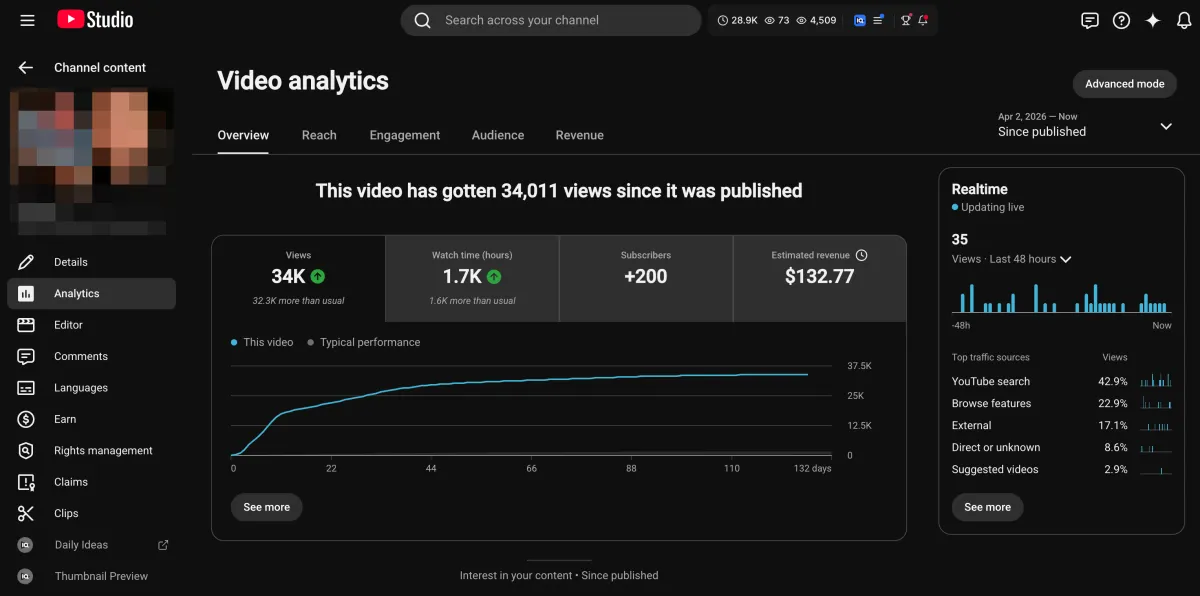
Learn how I turned a $132.77 video into $1000+ per month asset
Full case study on how you can replicate my success with YouTube SEO strategy.
Free downloadThe Zero Audience System
Build permanent YouTube income without a camera or an audience
The full methodology, 31 lessons plus bonuses. Limited spots.