There's no official public indicator for this, no badge, no checkmark, no page anywhere on YouTube that says "this channel earns ad revenue." YouTube treats monetization status as private, tied to a creator's own AdSense account, and it removed the last reliable technical workaround, a hidden source-code tag, back in November 2023. What you can actually do is combine a handful of visible signals to make a reasonably confident judgment, not a certain one.
Here's what those signals are, which ones actually mean something, and the one extremely common mistake that makes most people's guess wrong.
The Biggest Misconception: Seeing Ads Doesn't Prove A Channel Is Monetized
Since June 2022, YouTube can run ads on videos regardless of whether the channel is in the Partner Program at all. That revenue doesn't go to the creator in that case, it goes to YouTube, or in some cases to a third-party rights holder if the ad appeared because of a copyright claim on music or footage used in the video. Seeing a pre-roll ad on a small, brand-new channel used to be a fairly reliable signal. It isn't anymore. This single fact invalidates a huge share of the "just watch for ads" advice still floating around on this exact question.
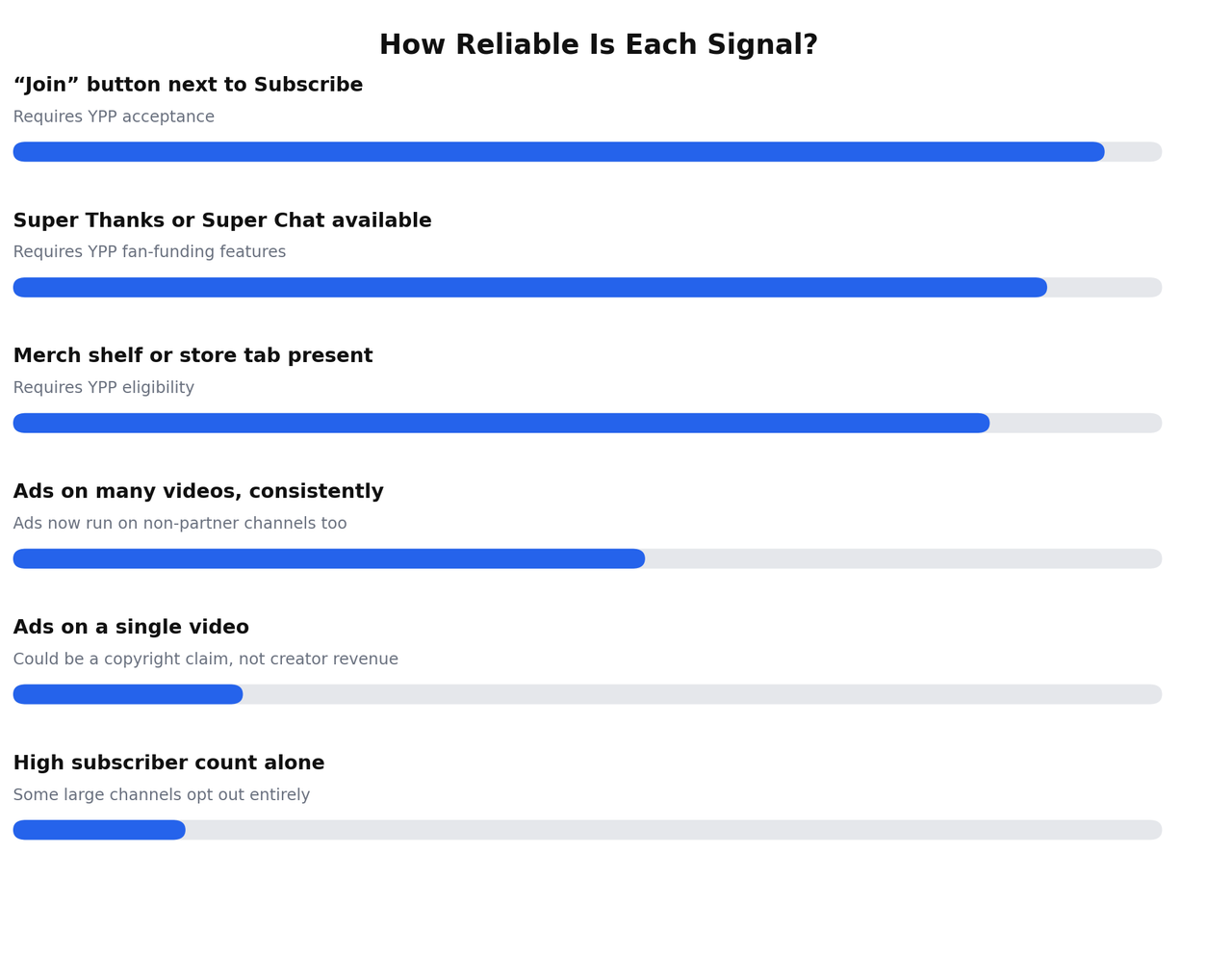
The Signals Actually Worth Checking
A "Join" button next to Subscribe
This is the strongest public signal available. Channel memberships require acceptance into the YouTube Partner Program, so a visible Join button means the channel has cleared at least the first monetization tier. It doesn't confirm ad revenue specifically, a channel could have memberships on without full ad monetization enabled, but it's strong evidence the channel is a real, accepted Partner Program member.
Super Thanks or Super Chat availability
Same logic. These fan-funding features also require Partner Program acceptance and an accepted Commerce Product Module. If you see the option to send Super Thanks under a video, or Super Chat during a livestream, that channel has cleared real monetization requirements.
A merch shelf or store tab
YouTube Shopping features are also gated behind Partner Program eligibility. A visible store or product shelf on a channel page is a solid, if slightly less common, signal.
Ads appearing consistently across many videos
One ad on one video means very little now. Ads showing up consistently across a wide sample of a channel's videos is a moderately useful signal, though still not definitive on its own, given that ads can run on non-partner content too.
Subscriber count and upload history, as context only
A channel with a few hundred subscribers and no memberships, Super Thanks, or merch is unlikely to be monetized yet, simply because it probably hasn't crossed the Partner Program thresholds. This is weak evidence on its own, plenty of large, well-established channels choose not to monetize through ads at all, so a big subscriber count doesn't guarantee anything either.
How To Actually Check A Specific Channel
- Open the channel page and look for a "Join" button next to Subscribe.
- Open a few recent videos and check whether Super Thanks appears as an option beneath them.
- Check the channel's tabs for a Store or Shopping section.
- Watch three or four different videos, ideally on different days, and note whether ads appear consistently, not just once.
- Weigh all of this against the channel's approximate size. A channel with none of the above and under a thousand subscribers is very likely not yet monetized. A channel with several of the above signals present is very likely monetized in some form.
What Third-Party "Monetization Checker" Tools Actually Do
A number of free tools online claim to instantly tell you whether a channel is monetized. Worth understanding what's actually happening behind them: none of these tools have real access to a channel's private AdSense or Partner Program status, because YouTube doesn't expose that through any public API. What they're actually doing is automating the same public-signal analysis described above, checking for the Join button, scanning for ad-related markers, and estimating from there. Treat their output as a faster version of the manual check, not as a definitive, verified answer.
Why A Channel Might Show No Signals And Still Be Monetized
A channel can be fully accepted into the Partner Program and still show none of these signals if the creator chose not to turn on memberships, Super Thanks, or a store, some monetized creators only run ads and skip the rest entirely. An ad blocker on your end can also hide ads that are genuinely running for other viewers. And a channel can show ads on some videos and not others depending on individual video settings, advertiser-friendliness, or regional ad availability. None of these signals are perfect in isolation, which is exactly why combining several of them gives a far more reliable read than checking just one.
Why This Is Worth Checking In The First Place
Beyond simple curiosity, this comes up in a few real situations: vetting a channel before a brand partnership, researching how established a competitor actually is, or evaluating a channel you're considering buying. If that last one is why you're here, I've covered the full mechanics of buying and selling channels, including how monetization status factors into a real valuation, in whether and how you can actually sell a YouTube channel.
Frequently Asked Questions
Does seeing ads on a video mean the creator is earning money from it?
Not necessarily. Since June 2022, YouTube can run ads on channels outside the Partner Program, with that revenue going to YouTube or a rights holder rather than the creator. Ads alone aren't proof of creator monetization.
Is there an official way to check a channel's monetization status?
No. YouTube keeps this private by design and removed the last public technical indicator, a hidden page-source tag, in November 2023. Every method available now relies on indirect, public signals.
What's the single most reliable public signal?
A visible "Join" button for channel memberships, since that feature requires actual Partner Program acceptance to enable.
Can a channel with a huge subscriber count be unmonetized?
Yes. Some well-known creators have chosen not to enable ad monetization even with a very large following, so subscriber count alone is not reliable evidence either way.
The Honest Bottom Line
You can get a reasonably confident answer by checking for a Join button, Super Thanks, a store tab, and consistent ads across multiple videos, all together rather than any single one. You can't get a certain answer, because YouTube deliberately doesn't publish that information, and any tool claiming otherwise is running the same public-signal check you could run yourself in a few minutes.
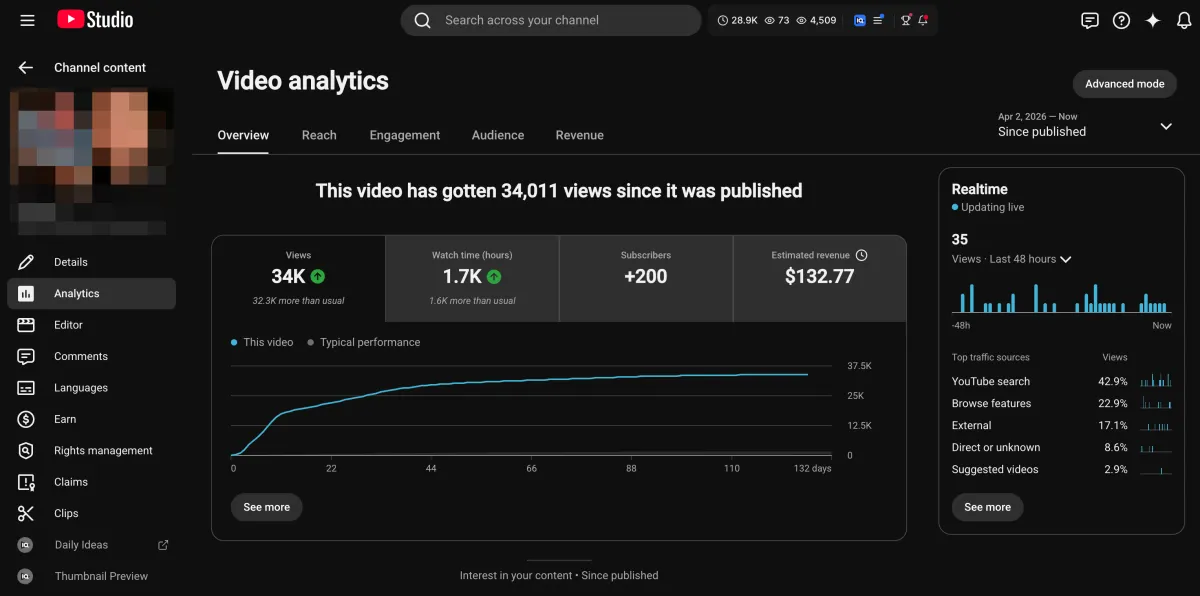
Learn how I turned a $132.77 video into $1000+ per month asset
Full case study on how you can replicate my success with YouTube SEO strategy.
Free downloadThe Zero Audience System
Build permanent YouTube income without a camera or an audience
The full methodology, 31 lessons plus bonuses. Limited spots.