Ranking number one on YouTube search has nothing to do with subscriber count, channel age, or how much personality you bring to camera. It comes down to being the single most complete, correctly targeted answer to one specific search query, and out-performing whatever's currently sitting in that spot on the metrics YouTube actually measures: click-through rate, retention, and what happens after someone finishes watching. A brand new channel with zero subscribers can rank above a channel with a million of them, for the right keyword, built the right way.
This is the actual process I'd run through, step by step, to take a video from nothing to the top result for a specific search term. No vague "make good content" advice, an actual sequence you can follow.
.png)
What "Ranking Number One" Actually Means, And Why Most People Target The Wrong Kind
Most people who want to rank number one aim at a broad, heavily contested term, "how to make money on YouTube," "best budget laptop," terms with millions of monthly searches and years of established competition sitting on page one. That's the wrong target for almost every channel, especially a new one. Not because ranking number one for a broad term is impossible, but because you're competing against every advantage an established channel has, subscriber base, backlink profile, years of accumulated authority, for a keyword where winning barely matters anyway, since broad terms rarely convert to anything specific.
The better target is a specific, correctly scoped term with real search volume behind it and thin competition sitting on top of it right now. Ranking number one for "best budget laptop for video editing under $600" is genuinely achievable for a small channel, and it converts better than a broad term ever would, because it matches exactly what the searcher wants. This is the entire logic behind a zero-audience approach to ranking: you're not trying to out-muscle bigger channels on their home turf, you're finding the specific query nobody's actually answered well yet.
Step One: Pick A Keyword You Can Actually Win
Before you script anything, check who's currently ranking for your target term. Open the top five results and look at three things: how recently they were uploaded, how small or large the channels behind them are, and how complete their answer actually is. If the current top results are old, thin, or from channels with minimal search-specific optimization, that's a winnable keyword regardless of your own channel size. If the top five are recent, thorough, and from channels clearly built around search, that's a term to skip for now, not because you can't ever win it, but because your time is better spent on a term with a real gap in it.
Step Two: Confirm The Real Intent Behind The Keyword
The exact words in a search term don't always tell you what the searcher actually wants. Watch the current top three videos for your target keyword and pay attention to what they assume the viewer needs. Sometimes this reveals a gap: five videos assuming the searcher is a complete beginner when the term actually gets searched heavily by people with some experience looking for an advanced detail. Matching intent more precisely than the current top results is one of the most reliable ways a smaller channel outranks a bigger one, because YouTube's search system rewards videos that resolve the query completely, not just videos that are generically relevant to the topic.
Step Three: Build The Single Most Complete Answer
This is the step most competing advice skips entirely. Don't aim to make "a good video" on the topic, aim to make the video that means nobody who watches it needs to click back to search results and try again. Go through every current top-ranking video for your term and note what each one leaves out, a step they gloss over, a follow-up question they don't answer, a specific case they don't cover. Your video should close every one of those gaps. A searcher who bounces back to search after watching you is a direct signal your video didn't resolve their query, and that signal actively works against you for that specific term.
Step Four: Win The Click
Your title and thumbnail are doing one job: getting the right person to click relative to the other results they're seeing. Keep your title's core promise inside the first 60 characters, since that's what stays visible across most surfaces, and make sure it matches what the video actually delivers, a mismatch here tanks retention immediately after the click you just won. Your thumbnail needs one clear focal point, readable at a small size, with nothing important placed in the bottom-right corner where YouTube automatically overlays the video's duration.
Step Five: Win The Retention
Retention gets measured relative to similar videos, not against some universal benchmark, so the real question is whether people stay with you longer than they stay with the videos currently ranking above you. Get to the actual answer fast, don't spend the first ninety seconds on a preamble the viewer didn't ask for. Cut anything that doesn't directly serve the query you're targeting, padding a video to inflate watch time is a weaker strategy than it used to be, since YouTube weighs viewer satisfaction signals, direct feedback, returning viewers, alongside raw watch time now, not just watch time on its own.
Step Six: Win The Session
What happens after your video ends matters almost as much as what happens during it. A video that hands the viewer off to another relevant video, yours or otherwise, extends the session and gets treated as more valuable to recommend than one that ends the viewing session outright. Point your end screen and cards at a specific related video, not a generic subscribe prompt, and get the video added to a relevant playlist before you publish, not as an afterthought days later.
Step Seven: Give It Real Time Before You Judge Or Iterate
A new video, especially on a smaller channel, typically needs weeks to a few months before its search ranking stabilizes, not days. Judging a video's ranking potential in the first 48 hours is judging it before YouTube's systems have gathered enough data to place it accurately. If you're going to revisit and improve a title or thumbnail, do it after a genuine evaluation window, not out of impatience three days after publishing.
What To Do If You're Still Not Ranking After A Few Months
Go back through the process in order rather than guessing at a single fix. Check whether the keyword itself was actually winnable in the first place, sometimes the competition was heavier than it first looked. Check retention against the current top-ranking videos for that term specifically, if you're losing viewers faster than they are, that's usually the real issue, not your title or thumbnail. And check whether your video actually closes the gaps the top-ranking videos leave open, or whether it just covers the same ground everyone else already has. Ranking failures are almost always traceable to one specific step in this sequence, not a mysterious algorithm problem.
Why This Works Better Starting From Zero Audience
A channel with an existing large audience has a real advantage on broad, competitive terms, an established base of returning viewers and accumulated channel authority. A channel starting from zero doesn't have that advantage, and trying to compete on the same broad terms is a losing strategy early on. What a zero-audience channel can do just as well, sometimes better, is win a specific, correctly scoped term through precision: closer intent match, a more complete answer, and stronger relative retention than whatever's currently sitting on top. Ranking number one for the right specific term doesn't require an audience at all. It requires being the correct, complete answer to one real question, which is a fight a new channel can actually win.
Frequently Asked Questions
Do I need a large subscriber count to rank number one on YouTube search?
No. YouTube evaluates each video largely on its own relative performance for a given search term, not on the channel's overall subscriber count. A small channel with a more complete, better-targeted video can outrank a much larger one.
How long does it take to rank number one for a keyword?
There's no fixed timeline, but weeks to a few months is typical before a ranking stabilizes, especially for a newer channel. Judging a video's ranking within the first few days is too early to draw real conclusions.
Should I target broad keywords or specific ones first?
Specific ones, especially for a newer or smaller channel. Broad terms have more total search volume but far more competition and worse intent-matching. A specific term with real volume and thin competition is a more realistic, and often more valuable, target.
What matters more, the title or the thumbnail?
Both work together, but the thumbnail is generally the stronger lever for click-through rate specifically, while the title carries more weight for keyword relevance and setting accurate expectations. Neither should promise something the video doesn't deliver.
Where I'd Actually Start
Pick one specific keyword this week using the process above, not ten. Check the real competition on it, confirm the intent behind it by watching what's currently ranking, and build one video specifically to close the gaps those results leave open. For a deeper breakdown of the individual signals feeding into all of this, watch time, satisfaction, session behavior, I've covered that in more detail in what actually determines YouTube ranking factors. And before you publish the video itself, run it through the pre-publish checklist so none of this work gets undercut by a missed setting on the way out the door.
For YouTube's own guidance on how it evaluates search relevance, YouTube's official help page on how YouTube search works is worth reading directly rather than relying only on third-party interpretations of it, mine included.
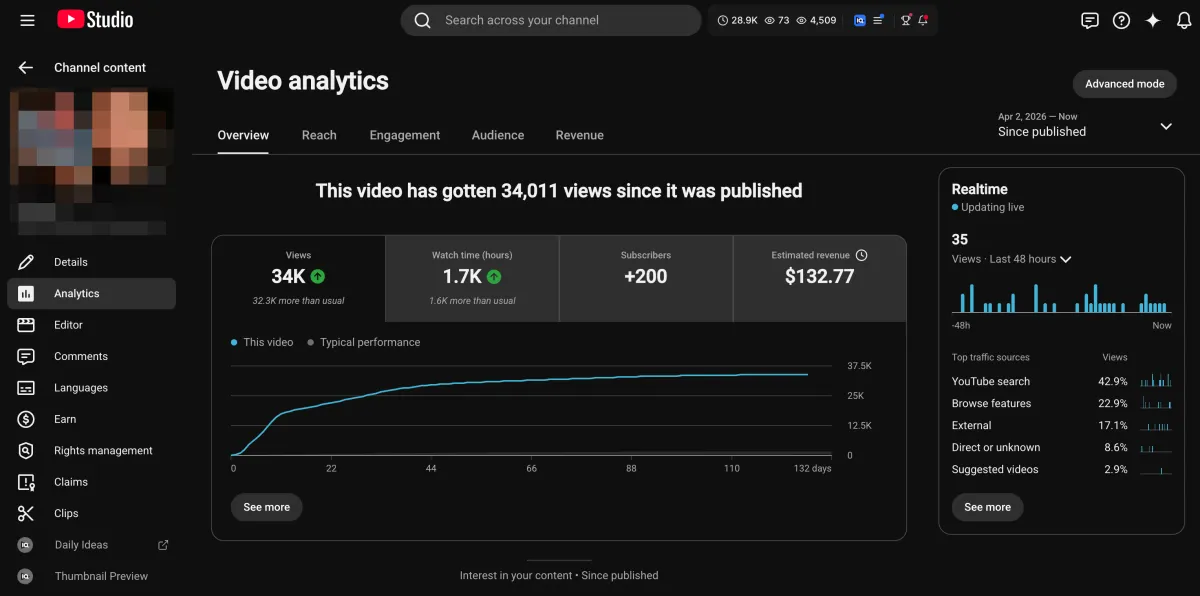
Learn how I turned a $132.77 video into $1000+ per month asset
Full case study on how you can replicate my success with YouTube SEO strategy.
Free downloadThe Zero Audience System
Build permanent YouTube income without a camera or an audience
The full methodology, 31 lessons plus bonuses. Limited spots.