No, and the gap between them is bigger than most explanations suggest. Google owns YouTube, but the two run genuinely different ranking systems, different enough that the same video, for the same search term, often lands in a completely different position on Google's own search results than it does inside YouTube's own search bar. A widely cited study found this mismatch happens more than half the time. Understanding why reveals what actually separates these two systems, and what still overlaps between them.
The Short Answer
Google SEO and YouTube SEO share some fundamentals, matching content to search intent, using clear and relevant titles, earning genuine engagement, but they run on different signals underneath. Google's core search algorithm leans heavily on backlinks, site authority, and page-level trust signals. YouTube's algorithm leans on watch time, session behavior, and satisfaction signals specific to video consumption. They're related disciplines, not the same one.
The Study That Proves These Are Genuinely Different Systems
A widely referenced analysis from Stone Temple Consulting pulled YouTube search rankings for 424 queries known to also return YouTube videos in Google's own results. The rankings matched only a fraction of the time. For queries where Google showed more than one video, the relative order differed from YouTube's own order 56.8% of the time.
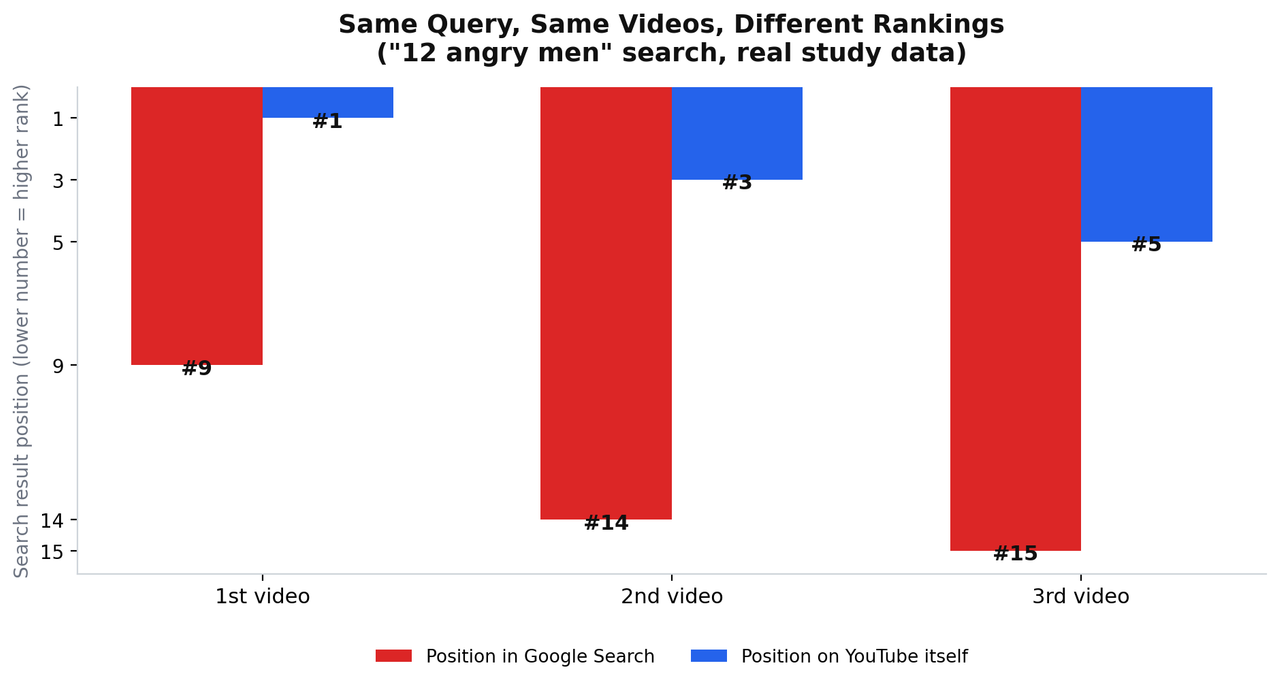
One example makes this concrete. For the search "12 angry men," Google's results placed three YouTube videos at positions 9, 14, and 15. On YouTube's own search, the same three videos ranked 1, 3, and 5.
A separate RankRanger analysis reached the same conclusion from a different angle. Looking at the search "how to make pizza," the top-ranked video on YouTube itself, with millions of views, didn't appear in Google's video carousel at all. Researchers pointed to the video's thin, largely irrelevant surrounding text as a likely reason it succeeded on YouTube but failed to earn a spot in Google's results.
Why Google And YouTube Rank The Same Video Differently
The core reason comes down to what each platform is optimizing for. YouTube wants to keep someone watching video content, so it leans on engagement signals specific to that goal, watch time, session length, how a video performs against similar content on the platform. Google wants to satisfy a specific search query as directly as possible, and its systems seem to favor videos that are concise, clearly relevant, and well-supported by real textual context around them, over videos that are simply popular within YouTube's own ecosystem.
A video optimized purely for YouTube engagement, long, designed to maximize watch time, thin on descriptive text, can rank brilliantly inside YouTube while barely registering in Google's own results for the identical query.
Three Distinct Ranking Systems, Not Two
Most explanations frame this as a two-way comparison. It's actually three separate systems worth understanding on their own terms.
Google ranking a webpage
Traditional web SEO. Backlinks, domain authority, page structure, and content relevance to a typed query.
Google ranking a YouTube video directly
This happens through video carousels and rich results inside regular Google search. It draws on some of the same signals as webpage ranking, relevance and trust, alongside video-specific factors like structured markup and how directly the video answers the query.
YouTube ranking a video inside its own search
This is what most "YouTube SEO" advice actually describes: watch time, click-through rate, session contribution, and satisfaction signals measured relative to similar videos already on the platform.
A video can perform well in one of these three systems and poorly in another, because each one is answering a slightly different question.
What Actually Overlaps Between The Two
Real similarities exist, and they're worth naming clearly. Both systems reward content that genuinely matches what the searcher is looking for over content that only technically mentions the right keywords. Both weigh some form of trust and relevance around the content, whether that's backlinks and domain history on the Google side or channel and engagement history on the YouTube side. And both increasingly reward content that fully resolves a query rather than just touching on it.
What's Genuinely Different
| Google Search | YouTube Search | |
|---|---|---|
| Primary trust signal | Backlinks and domain authority | Watch time and engagement history |
| Content favored | Concise, directly relevant, well-supported by text | Content that holds attention within the platform |
| Ranking scope | Entire web, including but not limited to video | Video content within YouTube only |
| Where it shows up | Web search results, video carousels, rich results | YouTube's own search bar and recommendations |
If your priority is being found by someone typing a question into Google's search bar, optimize for concise relevance and real supporting text around your content. If your priority is being found by someone searching inside YouTube itself, optimize for watch time and session behavior specific to that platform. They're related goals, not the same task.
How To Actually Rank A YouTube Video On Google Search Specifically
This is the part most YouTube SEO advice skips entirely, since it stops at watch time and click-through rate, signals that only affect ranking within YouTube itself. A few things move the needle specifically for Google's own results. Implementing VideoObject schema markup on any webpage where you embed the video gives Google structured, machine-readable context about what the video contains, and its presence is often the difference between showing up in Google's video rich results and not appearing at all in competitive topics. Adding timestamps or chapters inside YouTube, or Clip schema on your own site, can also let Google surface specific moments as "key clips" directly in search results, letting someone jump straight to the relevant part of your video before they even click through, which tends to lift click-through rate from Google specifically.
Practical Takeaway: Optimizing For Both At Once
Treat these as two related but separate targets rather than one combined effort. Build your video the way you always would for YouTube's own search and recommendation systems, clear title, strong retention, genuine topic match. Then, separately, make sure the page where the video lives, whether that's a blog post, a landing page, or YouTube's own video page, has real supporting text, proper markup, and enough context that Google's systems can independently verify what the video is about. Skipping that second step is the most common reason a video that performs well inside YouTube never shows up when the same question gets typed into Google instead.
Frequently Asked Questions
Does ranking well on YouTube guarantee a video will also rank on Google?
No. Research shows the two rankings match less than half the time when multiple videos appear for the same query, since each platform weighs different signals.
Does Google favor its own YouTube videos over other video platforms?
Some research has pointed to a strong presence of YouTube content in Google's video results generally, though that reflects YouTube's overall content volume and structured data support as much as any deliberate platform preference.
Is backlink building relevant to YouTube SEO?
Not directly to YouTube's own internal ranking, which doesn't weigh backlinks the way Google's core search does. Backlinks matter more for getting a video's surrounding webpage to rank well in Google search specifically.
Should I optimize a video for Google search or YouTube search first?
Start with YouTube's own systems, since that's where most video discovery still happens, then layer on the Google-specific steps, schema markup and supporting text, once the video itself is performing well on YouTube.
The Real Distinction Worth Remembering
Google SEO and YouTube SEO are neighboring disciplines built on different foundations, not the same skill applied to two platforms. A video can be a genuine YouTube hit and remain nearly invisible on Google, or the reverse, and neither outcome says much about the video's actual quality. It says something about which system's specific signals it happened to match. For a deeper look at the mechanics driving YouTube's own internal rankings specifically, I've covered that in full in what actually determines YouTube ranking factors, and the foundational definition of YouTube SEO itself in what is YouTube SEO, and why most explanations get it wrong.
For primary source detail on how Google evaluates video content within search more broadly, Google's own documentation on video SEO is worth reading directly.
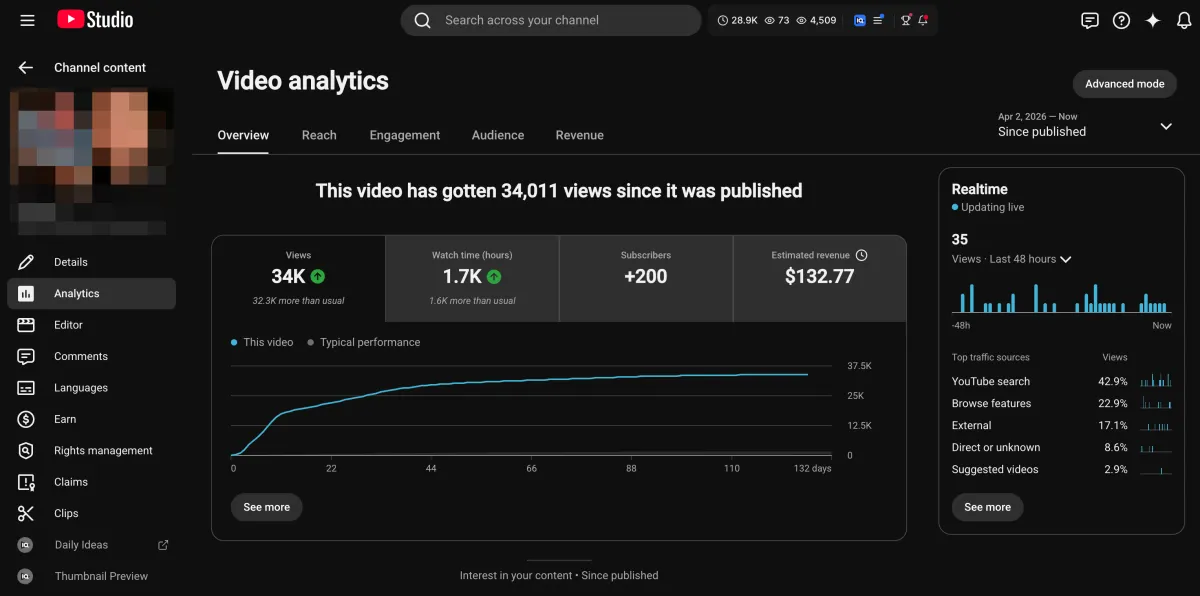
Learn how I turned a $132.77 video into $1000+ per month asset
Full case study on how you can replicate my success with YouTube SEO strategy.
Free downloadThe Zero Audience System
Build permanent YouTube income without a camera or an audience
The full methodology, 31 lessons plus bonuses. Limited spots.