
TubeLab itself doesn't have a meaningful free tier, so "free alternatives" really means finding tools that cover similar ground, outlier detection, niche research, title pattern analysis, without paying its $29 a month or $178.80 a year price. This breakdown is built from verified current pricing and documented user feedback across each tool rather than a personal trial of every product, and it's worth knowing upfront that most existing comparisons of TubeLab against its competitors are written by one of the competing companies themselves, including TubeLab's own blog.
What TubeLab Actually Does, And What It Costs
TubeLab is a research-only platform built around outlier discovery, videos performing far above a channel's normal average, along with a title formula library pulled from millions of indexed outlier videos and niche-level saturation data. It doesn't write scripts, generate voiceovers, or produce video, it's purely a research layer sitting before production. As of recent verification, pricing runs $29 a month billed monthly, or roughly $14.90 a month billed annually at $178.80 a year. There's no free trial for the core product. The one genuinely free piece is a separate Chrome extension that checks whether a channel or video is monetized, with RPM and revenue estimates, a narrow utility that doesn't touch the outlier database at all.
Worth Knowing Before Trusting Any "TubeLab Alternative" Article
This space has an unusually tangled web of self-interested comparisons. TubeLab's own blog has published "alternatives" articles positioning itself as the better choice against 1of10, ViewStats, and TubeBuddy. 1of10's blog has published its own comparison against TubeLab, with an upfront disclosure that it builds 1of10. Other blogs in this same niche run similar comparisons while promoting their own competing products. None of this makes their factual claims about pricing false, several are specific and verifiable, but their overall verdicts consistently favor whichever company is publishing the article. Read pricing and feature claims from any single source, including this one, with that in mind.

The Real Free Alternatives, Compared Honestly
1of10's Free Tier
Includes outlier search, bookmarks, three tracked channels, and 60 AI credits at no cost. This is the closest free equivalent to TubeLab's core outlier-hunting function, though at a smaller scale, tracking three channels rather than searching a full indexed database.
vidIQ's Free Tier
Covers limited Daily Ideas, basic keyword data, and an Outlier Score surfaced within its broader Feed. It won't match TubeLab's dedicated outlier database in depth, but it adds keyword research TubeLab doesn't offer at any price.
TubeBuddy's Free Tier
Offers basic tag suggestions and limited bulk editing tools. It's the weakest option here specifically for outlier or trend research, TubeBuddy's actual strength is SEO and workflow optimization, not viral pattern discovery.
YouTube Studio's Own Research Tab
Completely free and often overlooked. It shows real search terms your own audience is using, directly from YouTube's own data, which no third-party tool can fully replicate since it's first-party information about your specific channel.
Google Trends
Free, and genuinely useful for confirming whether a topic's interest is rising, falling, or seasonal before committing a video to it, a different but complementary kind of research to outlier detection.
TubeLab's Own Free Extension
Worth using on its own terms, checking whether a channel is monetized is a real, free, standalone utility, even though it doesn't provide any access to TubeLab's paid research features.
What You Actually Give Up By Going Free
Be honest with yourself about the tradeoff. No combination of free tools matches TubeLab's specific outlier database size or its title formula library built from millions of indexed videos. Free tools cover pieces of that research process, but not with the same depth or the API access TubeLab offers for connecting research directly into other workflows. If your channel depends heavily on fast, high-volume outlier research, that gap is real, not just marketing language from either side.
A Practical Free Stack That Covers Most Of The Same Ground
- Use 1of10's free tier for direct outlier search on a small set of channels you're actively studying.
- Use vidIQ's free tier for keyword validation on topics your outlier research surfaces.
- Check Google Trends before committing to confirm the topic isn't fading or purely seasonal.
- Use YouTube Studio's Research tab regularly to see what your own specific audience is already searching for.
- Use TubeLab's free monetization checker when researching competitor channels' revenue potential specifically.
When It's Actually Worth Paying For TubeLab Or A Similar Tool
If you're publishing frequently enough that manually piecing together free tools costs more time than the subscription would, or if you need the scale of an indexed, searchable outlier database rather than tracking a handful of channels by hand, a paid tool starts making practical sense. For a smaller or newer channel still validating whether a niche has real legs, the free stack above covers enough ground to make that call without paying anything.
Frequently Asked Questions
Does TubeLab have any free plan at all?
Only a separate Chrome extension for checking channel monetization and RPM estimates. The core outlier research platform has no free tier and no free trial.
What's the closest free alternative to TubeLab's outlier detection?
1of10's free tier, which includes outlier search across three tracked channels, is the closest direct equivalent, though at a smaller scale than TubeLab's full indexed database.
Can I fully replace TubeLab with free tools?
For most smaller channels, a combination of free tools covers enough research ground to be genuinely useful. For high-volume, database-scale outlier research, free tools don't fully replicate that specific depth.
Why do so many TubeLab comparison articles disagree with each other?
Several are published by TubeLab itself or by directly competing tools, each concluding in favor of whichever product the publisher sells. Their pricing details are generally accurate, but their overall recommendations reflect that conflict of interest.
The Honest Recommendation
Start with the free stack, 1of10's free tier plus vidIQ's free tier plus your own YouTube Studio data, and only consider paying for TubeLab or a comparable tool once you can point to a specific research bottleneck the free tools genuinely aren't solving. For the deeper mechanics of how outlier and view-history data actually signal whether a topic is still worth pursuing, independent of which specific tool you use to check it, see the best free YouTube SEO analyzer in 2026, and for the fuller picture of free research tools worth knowing about generally, the best free YouTube SEO tools, tested and ranked.
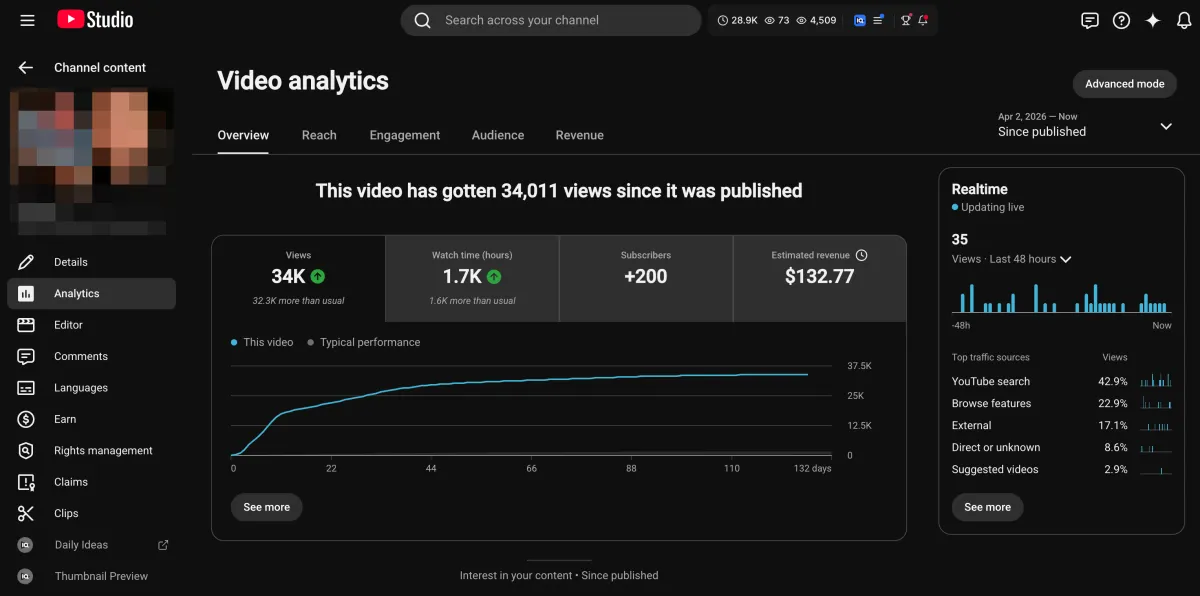
Learn how I turned a $132.77 video into $1000+ per month asset
Full case study on how you can replicate my success with YouTube SEO strategy.
Free downloadThe Zero Audience System
Build permanent YouTube income without a camera or an audience
The full methodology, 31 lessons plus bonuses. Limited spots.