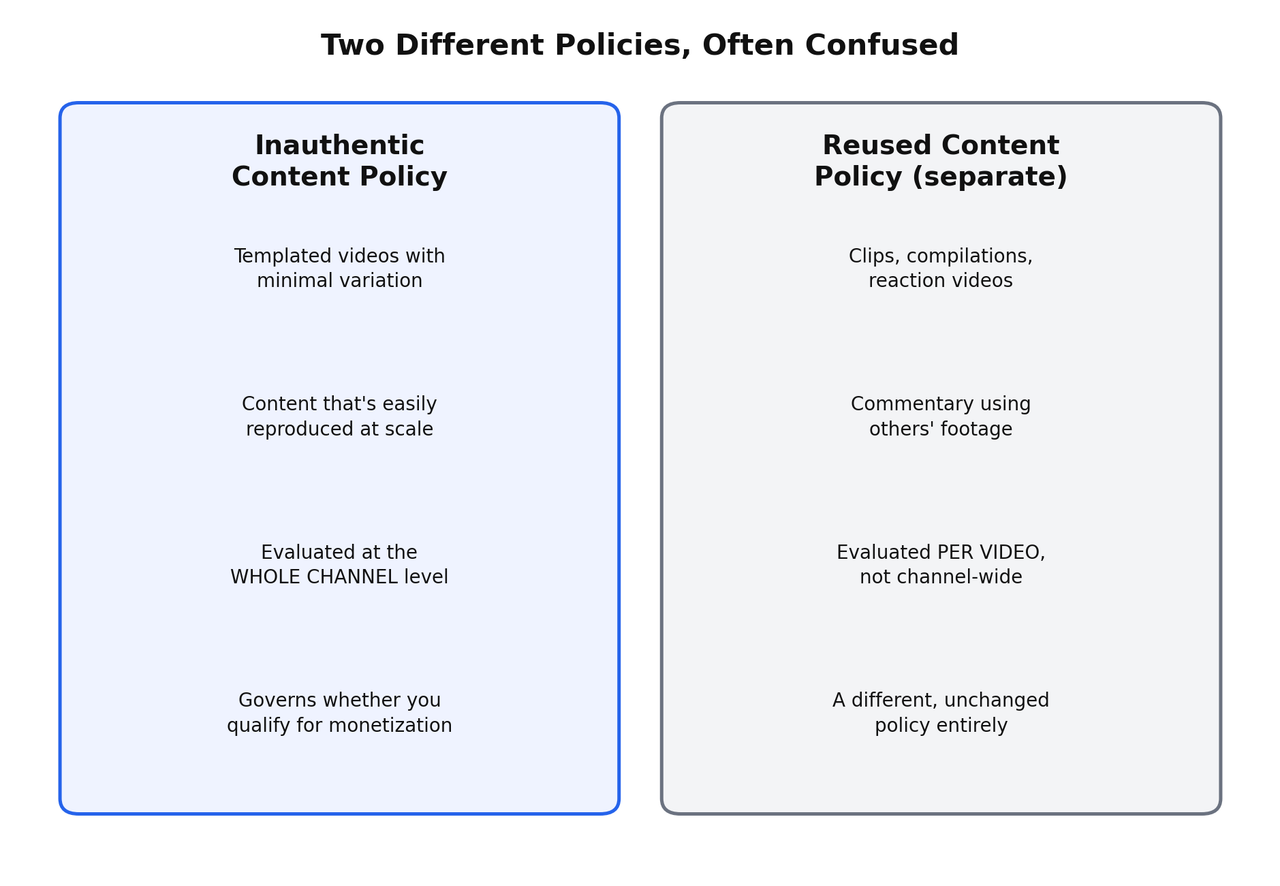
According to YouTube's own policy language, inauthentic content is "mass-produced or repetitive content," including anything that looks like it was made from a template with little to no variation across videos, or content that's easily replicable at scale. That's the official definition, word for word. What trips people up isn't the definition itself, it's that YouTube evaluates this at the level of your entire channel, not one video at a time, and that it gets confused constantly with a completely separate policy covering clips and reaction content.
Here's the actual breakdown: where this policy came from, what it does and doesn't cover, real examples of what's crossed the line, and a practical way to check where your own channel stands.
Where This Policy Actually Came From
This isn't a brand new rule. YouTube has always required monetized content to be original and authentic. What changed on July 15, 2025 was the name and the clarity, the policy was previously called "repetitious content," and YouTube renamed it to "inauthentic content" specifically to make clear it covers mass-produced and templated videos, not just literally repeated ones. Creator Liaison Rene Ritchie confirmed directly that this was a clarification of existing rules, not a new prohibition.
A further clarification followed in July 2026, breaking the general principle down into more specific, concrete examples for reviewers and creators alike. The core standard hasn't shifted. What's shifted is how precisely YouTube can identify content that fits it.
The Three Things That Actually Define It
Strip the official wording down and three conditions are doing the real work:
- Template with minimal variation. The video follows a visible, repeatable structure, same opening, same pacing, same format, with only the topic or a single variable swapped out each time.
- Easily reproduced at scale. Nothing about the video requires meaningful individual effort, research, or judgment, it could be generated dozens of times over with little additional work.
- Evaluated at the channel level. This is the part most people miss. YouTube isn't just reviewing whether one video fits this pattern, it's looking at your channel's main theme, your top-performing videos, and your recent uploads together, as a pattern.
A single video that happens to follow a common format isn't automatically a problem. A channel where every video follows the same format with nothing distinguishing one from the next is exactly what this policy is built to catch.
What This Is Not: The Reused Content Policy
This is the confusion that comes up constantly, and it's worth settling directly. Clips, compilations, reaction videos, and commentary using someone else's footage are governed by a completely separate rule, YouTube's reused content policy, which was explicitly unaffected by the inauthentic content rename. If you make reaction videos, the July 2025 and July 2026 updates didn't change anything about your monetization eligibility on their own. The two policies get lumped together constantly in creator discussions, but YouTube itself has been clear they're separate, with different evaluation criteria.
Real Examples: What's Actually Crossed The Line
Enforcement here isn't theoretical. A cluster of large channels, widely reported to be in the range of a dozen or more, collectively holding tens of millions of subscribers and billions of views, lost monetization in late 2025 and into 2026 for content that fit the mass-produced, templated pattern. I'd treat the exact figures reported in industry coverage with some caution, since they vary slightly between sources, but the direction is clear and consistent: this isn't a policy sitting unused on paper.
One detail worth knowing: some affected channels tried adding disclaimers like "concept trailer" or "parody" to their video titles or descriptions after losing monetization, hoping to reclassify their content and get reinstated. Several lost monetization again shortly after, this time cited for spam and misleading metadata stacked on top of the original issue. Relabeling a template doesn't change whether it's still a template.
AI Content Specifically: What's Allowed And What Isn't
YouTube has been explicit that AI tools themselves aren't the target of this policy. AI-assisted content remains eligible for monetization when it offers genuine original and authentic value. The distinguishing question isn't whether AI touched the video, it's whether a real person made meaningful decisions about what the video says and whether it adds something the next video in the same format doesn't.
This runs alongside a separate, unrelated requirement worth keeping straight: videos using realistic AI-generated or altered content need the "Altered or synthetic content" disclosure switched on in YouTube Studio, regardless of whether the content is otherwise authentic or templated. Skipping that disclosure is its own issue, entirely apart from whether the inauthentic content policy applies at all.
The Self-Audit: Checking Your Own Channel
Run this test honestly. Open your last ten uploaded titles and read only the titles, nothing else. If you could regenerate your next twenty by doing a simple find-and-replace on one noun, "Top 10 Facts About X," then "Y," then "Z," that's a visible pattern, and it's exactly the kind of pattern a reviewer sees before watching a single second of any of them.
Then ask the harder question: can a viewer tell why each individual video exists? Not why the channel exists as a whole, why that specific video, on that specific day, needed to be made, and what it adds that the other videos around it in your catalogue don't already cover. If the honest answer is "not really, it's just another one in the format," that's the actual signal worth paying attention to, independent of whether a reviewer has looked at your channel yet.
How This Connects To The Bigger Automation Question
If you're building or running an automated channel and want the fuller picture of how this policy interacts with production models, outsourcing, and whether that approach is still worth pursuing, I've covered that in more depth in Is YouTube Automation Worth It In 2026? This article is deliberately narrower, focused on what the policy itself actually says and how to check your own risk against it, not the broader strategic decision of whether to build an automated channel in the first place.
A Practical Checklist To Stay On The Right Side Of This
- Run the find-and-replace title test on your last ten uploads.
- Check whether each video answers a distinct, specific question rather than a generic version of your channel's broad topic.
- Confirm the AI disclosure toggle is on for any video where it applies, separate from the authenticity question entirely.
- Look at your channel's About section and top videos the way a reviewer would, as a pattern, not as isolated uploads.
- If you've been flagged once, fix the underlying pattern rather than relabeling the same content with a new disclaimer.
Frequently Asked Questions
Does using AI automatically make a video inauthentic?
No. YouTube has stated AI-assisted content remains eligible for monetization when it provides genuine original value. The policy targets templated, easily-reproduced content, not the use of AI tools specifically.
Is this the same policy that affects reaction and compilation videos?
No. Reaction videos, clips, and compilations fall under a separate reused content policy that was explicitly unaffected by the inauthentic content updates.
Can one templated video get a whole channel demonetized?
The policy is evaluated at the channel level, looking at your main theme, top videos, and recent uploads as a pattern, rather than triggering entirely off a single upload. A consistent pattern across many videos is what actually creates risk.
Does adding a disclaimer like "parody" or "concept trailer" protect a templated video?
Not reliably. Several channels that tried this after losing monetization lost it again, this time also cited for spam and misleading metadata on top of the original issue.
Where To Go From Here
If you're unsure whether your channel fits this definition, don't wait for a policy notice to find out. Run the title test, look honestly at whether your last ten videos would mean anything to someone who watched all of them back to back, and fix the pattern at the source rather than the label on top of it. For the broader question of whether an automated production model is still worth building around in the current environment, that's covered separately in my breakdown of YouTube automation in 2026.
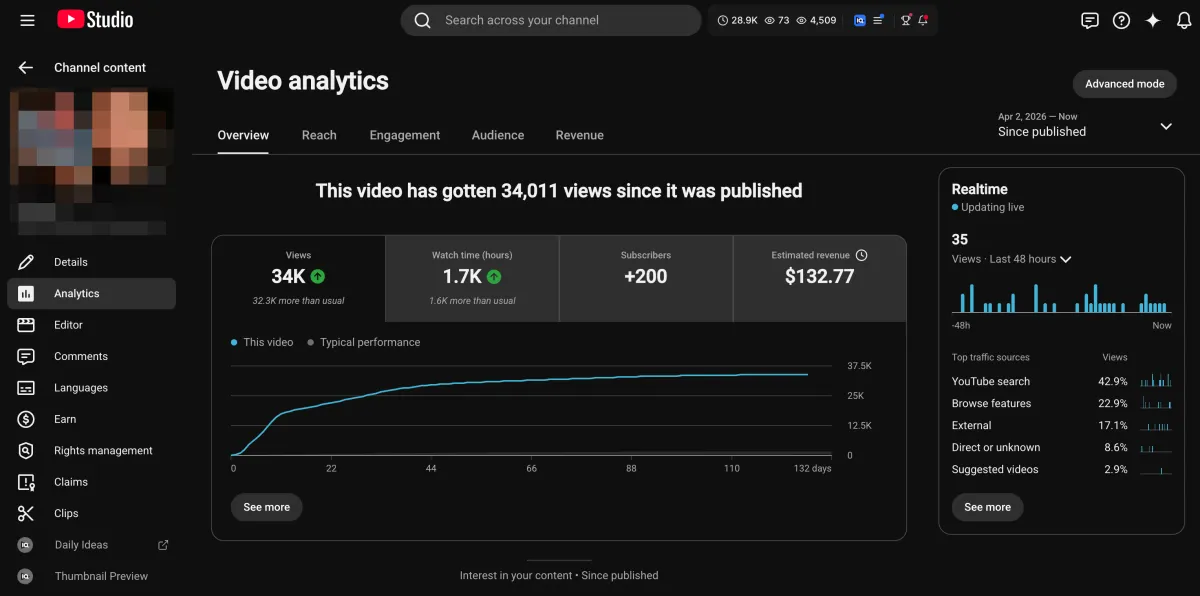
Learn how I turned a $132.77 video into $1000+ per month asset
Full case study on how you can replicate my success with YouTube SEO strategy.
Free downloadThe Zero Audience System
Build permanent YouTube income without a camera or an audience
The full methodology, 31 lessons plus bonuses. Limited spots.