YouTube automation is the practice of running a channel where most of the production work, research, scripting, voiceover, editing, thumbnails, is handled by someone other than the person appearing (or not appearing) in the videos, usually through a mix of freelancers, contractors, and AI tools. The person running the channel focuses on strategy: picking topics, deciding what to promote, and reviewing what gets published, rather than doing every step themselves.
That's the accurate version. The version most people have in their head, buy a template, hire someone off Fiverr, upload a hundred videos, watch the money roll in, isn't automation. It's a shortcut that skipped the one part of the process that actually matters, and it's why most channels built that way go nowhere.
Here's the real breakdown of what this actually is, how it works, and where the common explanations get it wrong.
What YouTube Automation Actually Means
Strip away the marketing around it, and automation is really just a production model. It answers one question: who does the physical work of making a video?
In a traditional channel, one person, or one small team working closely together, does everything. In an automated channel, the work gets split up, often across people who never talk to each other directly, coordinated by whoever owns the channel.
That's it. That's the core definition. Everything else, the AI voiceovers, the faceless presentation, the outsourced editors, is a common implementation choice, not a requirement. You can run an automated channel where you're on camera and someone else edits. You can run one where nobody's face ever appears and you write every script yourself. The word "automation" describes how the labor is distributed, not whether a human is involved at all.
The Three Ways People Actually Do This
Most explanations treat automation as one single thing. It isn't. In practice, it sits on a spectrum, and where a channel sits on that spectrum changes almost everything about how it runs.
| Model | Who does what | Where it tends to work |
|---|---|---|
| Full outsourcing | A freelancer or small team handles scripting, voice, and editing from an outline you provide | High-volume channels where you're mainly directing strategy |
| Hybrid / AI-assisted | You write or heavily edit the script yourself, use AI tools for voice and first-pass editing, handle final review | Channels where tone and accuracy matter a lot |
| Tool-assisted, solo | You do most of the work yourself, but use AI and software to speed up research, captions, and repurposing | Smaller channels, or people testing whether a topic works before scaling |
None of these is "the real" version of automation. They're different tradeoffs between cost, control, and speed. A lot of the confusion around this topic comes from people assuming everyone means the first row when they say "automation," when plenty of successful automated channels actually run closer to the second or third.
What A Real Automated Video Workflow Looks Like
Here's what the process actually looks like, broken into the stages that typically get divided up.
Research and topic selection. Someone decides what the video is actually about, and just as important, what it's trying to get the viewer to do afterward. This step is the one people skip when they treat automation as "make videos faster." Skipping it is the single most common reason an automated channel fails.
Scripting. A script gets written, either by a freelance writer working from an outline, an AI tool prompted with specific instructions, or the channel owner directly. The quality gap between a script that was genuinely reviewed and one that was generated and published untouched is usually obvious within the first thirty seconds of the video.
Voice. This is either a hired voice actor, an AI-generated voice, or the channel owner recording it themselves. AI voice tools have gotten good enough that this step alone doesn't determine whether a video feels low-effort. What determines that is everything else around it.
Visuals and editing. Stock footage, AI-generated visuals, screen recordings, or original filming get assembled into the final video, usually by an editor working from the script and a style guide.
Thumbnail and title. Often handled separately from editing, sometimes by the same editor, sometimes by a dedicated designer or the channel owner.
Upload and review. Someone checks the finished video before it goes live. In a well-run automated channel, this step never gets skipped, even when everything before it was outsourced.
The pattern across all six stages is the same: execution can be delegated. Judgment, deciding what to make and whether it's actually good, usually can't, not without the channel starting to feel hollow.
The Biggest Misconception: That Automation Means No Human Involved
People hear "automation" and picture a fully hands-off system, set it up once, let it run forever. That's not how any working channel actually operates.
What gets automated is the repetitive, time-consuming execution. What doesn't get automated, at least not in any channel that holds up over time, is the decision about which specific problem a video should solve and whether the finished product is actually worth publishing. A channel that hands off both of those decisions to a tool or a freelancer with no oversight isn't automated. It's unmanaged, and unmanaged channels tend to look exactly like what people already assume automation looks like: generic, interchangeable, and easy to spot.
If you're evaluating whether to build a channel this way, the real question isn't "can I automate this." Almost everything can be executed by someone else. The real question is which decisions you're keeping for yourself, and whether you're actually making them.
Is YouTube Automation Against The Rules?
No, not on its own. YouTube doesn't prohibit outsourced production, AI-assisted editing, AI voiceovers, or faceless channels. What the platform's monetization policy does target is content with no real, distinguishable value, videos that are templated, interchangeable, or built entirely from a formula with a word swapped out each time.
There's also a straightforward disclosure requirement: videos using realistic AI-generated or altered content need the appropriate toggle switched on in YouTube Studio. That's separate from the quality question entirely. Skipping the disclosure is a policy issue on its own, regardless of how good the video is.
I've written a separate, more detailed breakdown of exactly what changed in the platform's policy around this and whether building this way is still worth it. The short version for this article: the tools and the outsourcing were never the problem. Content with nothing distinguishing one video from the next is.
What Automation Doesn't Mean
A few assumptions are worth correcting directly, because they shape how people approach this before they've made a single video.
It doesn't mean guaranteed income. The production model has nothing to do with whether a channel finds an audience or converts viewers into revenue. A well-produced automated channel aimed at nothing specific will underperform a rough, self-filmed video aimed at a real, specific problem.
It doesn't mean faceless. Faceless channels are common in this space because they're easier to hand off entirely, nobody needs to match a specific person's appearance or voice across videos made by different people. But plenty of automated channels have a consistent on-camera host, with everything else, editing, research, thumbnails, handled by someone else.
It doesn't mean AI-written from start to finish. Some of the strongest channels built this way use AI for speed on the parts that don't require judgment, first drafts, captions, repurposing into shorter clips, while a person still writes or heavily edits anything that requires actual expertise or a specific point of view.
Why Some Automated Channels Work And Most Don't
The channels that hold up long term share a pattern that has nothing to do with how much of the work was outsourced.
They aim at something specific. Not a broad topic, a specific problem a specific person is actively trying to solve. A video answering a narrow, well-defined question converts and gets found in ways a broad, generic video never does, regardless of who wrote or edited it.
They keep someone accountable for what gets published. Not necessarily reviewing every frame, but genuinely deciding, video by video, whether it's good enough to represent the channel.
They don't treat the production model as the strategy. Outsourcing or using AI tools is a way to execute a strategy faster. It was never a replacement for having one. Channels that skip straight to "how do I automate this" without first answering "what specific problem am I solving and for whom" tend to produce a lot of content that goes nowhere, quickly.
How I'd Evaluate Whether This Fits You
Before committing to an automated model, it's worth being honest about a few things.
Do you have more capital or more time? Full outsourcing costs real money upfront, often before any revenue arrives. If you don't have that buffer, a hybrid or solo model, where you're doing more of the work yourself early on, is usually the more realistic starting point.
Are you comfortable being a manager, not just a creator? Running an outsourced channel means writing clear briefs, reviewing work you didn't personally make, and giving direction on things you might not be an expert in. Some people find this frustrating. Others find it's the only way they'd ever produce consistently.
Can you clearly describe what makes a video from your channel good? If you can't answer that in a sentence or two, whoever you hand production to won't be able to either, and the channel will drift toward generic fast.
None of these questions have a universally right answer. They're just the honest version of what "should I automate my channel" actually depends on.
Frequently Asked Questions
Is YouTube automation the same thing as a faceless channel?
No. Faceless channels are common within automation because they're easier to outsource entirely, but plenty of automated channels have a consistent on-camera presence. The two ideas overlap a lot but aren't the same thing.
Do I need to know how to edit video to run an automated channel?
Not necessarily, but you need to know what good editing looks like well enough to judge someone else's work. Without that, it's hard to give useful feedback or catch problems before they publish.
Is it expensive to get started?
It depends heavily on the model. Full outsourcing from day one costs the most upfront. A hybrid approach, where you handle more of the early work yourself and outsource specific pieces, costs far less to start and is usually the more realistic entry point.
Can one person run multiple automated channels at once?
Technically yes, but each channel still needs someone making the real decisions, what to cover and whether the output is good enough. Running several channels well usually means the owner has gotten efficient at that judgment step, not that they've eliminated it.
The Part You Can't Outsource
If you're deciding whether to build a channel this way, don't start by researching tools or freelancers. Start by deciding exactly what problem your channel is going to solve and for whom, in a sentence you could say out loud. Everything downstream of that, who writes it, who edits it, whether AI touches any part of it, is a production detail you can figure out afterward. Automation speeds up execution. It's never been able to replace the one decision that actually determines whether a channel works.
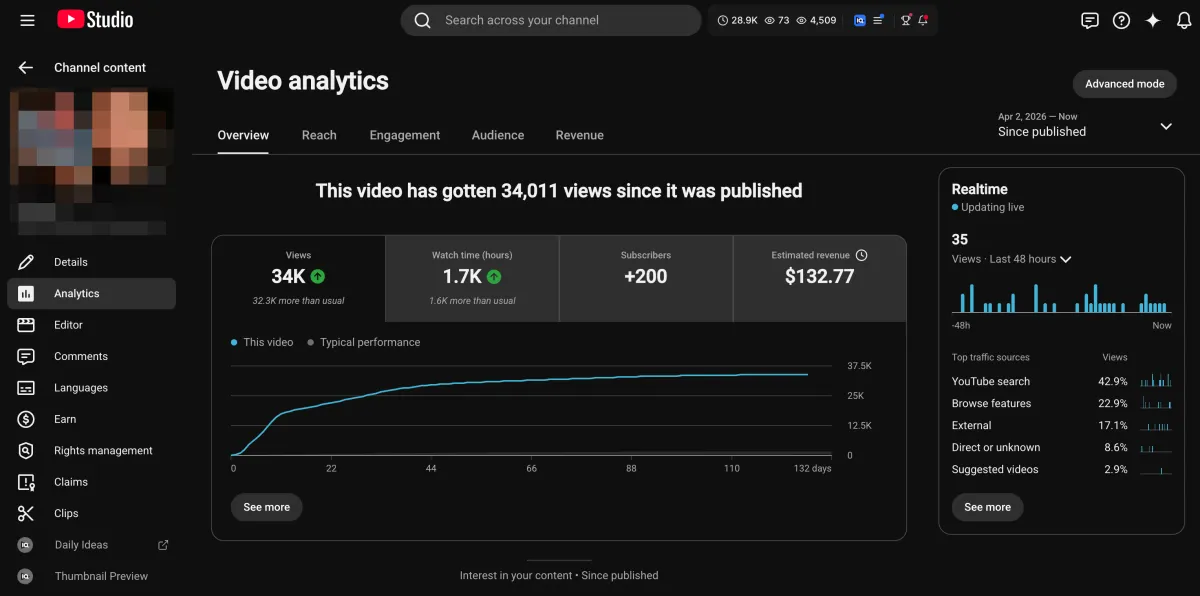
Learn how I turned a $132.77 video into $1000+ per month asset
Full case study on how you can replicate my success with YouTube SEO strategy.
Free downloadThe Zero Audience System
Build permanent YouTube income without a camera or an audience
The full methodology, 31 lessons plus bonuses. Limited spots.