Choose YouTube if reach and total income ceiling matter most. Choose Rumble if you want a genuinely different revenue mix, a better ad split plus a licensing system YouTube doesn't offer, especially if you've already run into demonetization or restrictions elsewhere. Neither answer is universally correct. The right choice depends on your content type, your current situation, and how much you value discoverability versus a bigger creator-side percentage. Here's the detailed breakdown behind that decision.
The Core Monetization Difference
YouTube pays creators 45% of ad revenue and keeps 55%. Rumble pays creators 60% of ad revenue and keeps 40%. On paper, Rumble's split looks like the better deal. In practice, the comparison is more complicated, because YouTube's ad rates and audience size are both larger, and Rumble adds a licensing revenue stream that doesn't exist on YouTube at all. A better percentage on a smaller base doesn't automatically beat a smaller percentage on a much bigger one.
YouTube's Monetization Stack
YouTube requires 1,000 subscribers and 4,000 valid public watch hours in the trailing 12 months, or 10 million Shorts views in 90 days, before ad revenue turns on. Once you clear that threshold, income comes from several sources at once: standard ad revenue, channel memberships, Super Thanks, a merch shelf, and brand deals that tend to be easier to close because of YouTube's audience size. RPM varies heavily by niche, often landing somewhere between $2 and $12 or more per thousand views depending on advertiser demand in that specific category.
Rumble's Monetization Stack, Including The Part Most Comparisons Skip
Rumble's ad revenue share sits at 60%, with CPM rates commonly cited in the $2 to $10 per thousand views range. That alone puts it in a similar ballpark to YouTube's lower-to-mid RPM niches. What actually differentiates Rumble is its licensing system, and most comparisons barely mention it.
Creators uploading to Rumble can choose from several licensing terms: Exclusive, which pays more upfront but gives Rumble full distribution rights; Non-Exclusive, which pays less but lets you keep and monetize the same video elsewhere; Rumble Only, which restricts hosting to Rumble itself; or Personal Use, which opts out of licensing entirely. Once a video is licensed, Rumble actively pitches it to media outlets, news networks, and publishers. If a deal closes, creators typically split the resulting fee 50/50 under standard terms or 60/40 under exclusive terms. Licensing deals can run for years, sometimes decades, which means a single well-placed video can keep generating income long after you've stopped thinking about it.
Rumble also runs Rumble Premium, a $9.99 monthly subscription that splits revenue among creators based on watch-time share, alongside a direct tipping feature called Rumble Rants. A newer Creator Partnership Program pushes revenue share as high as 90% for top performers, though it requires at least one licensed video to qualify. The minimum payout threshold sits at $50.
The Real Math: What The Same Views Would Earn
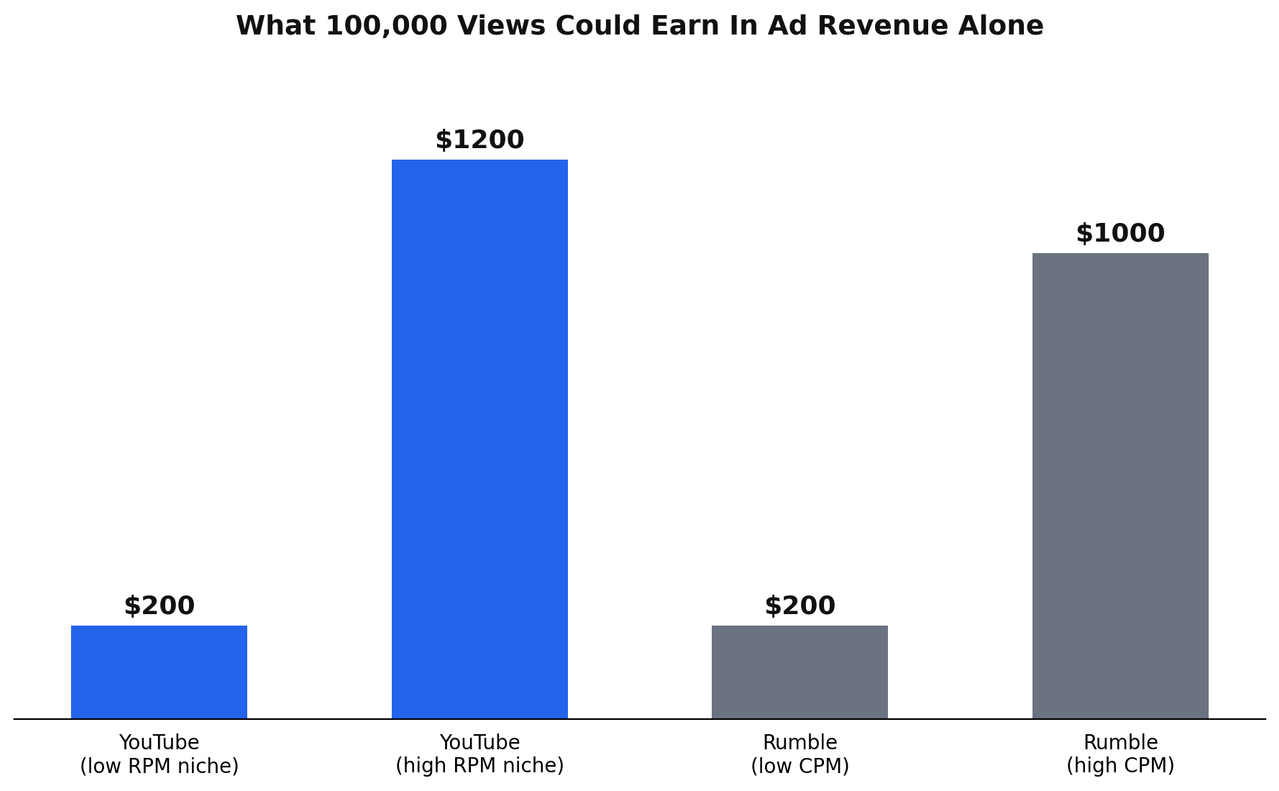
Concrete numbers make this easier to reason about than percentages alone. On YouTube, 100,000 views in a lower-RPM niche might bring in roughly $200. The same 100,000 views in a stronger niche could bring in $1,200 or more. On Rumble, using the commonly cited $2 to $10 CPM range, the same 100,000 views could land anywhere from about $200 on the low end to $1,000 on the high end.
The ranges overlap more than the headline percentages suggest. Rumble's better revenue split partly offsets its smaller audience and thinner advertiser demand in most categories, but it doesn't automatically produce higher earnings than YouTube once you account for actual CPM ranges rather than the split percentage alone.
Decision Factor One: Have You Been Restricted Or Demonetized On YouTube
This is the single most common reason creators move toward Rumble. Its moderation is looser, and its policies tend to be more predictable for content that YouTube treats as borderline or advertiser-unfriendly. If this describes your situation, Rumble solves a real, specific problem YouTube can't.
Decision Factor Two: Does Your Content Fit Rumble's Licensing Market
Licensing income depends entirely on whether media outlets and publishers actually want your content. News clips, political commentary, and viral-moment footage license well because that's exactly what Rumble's media partners are looking to buy. Tutorials, beauty content, and niche hobby videos rarely get picked up the same way, since there's no equivalent syndication demand for that kind of content. Know which category you fall into before treating licensing as a real income projection.
Decision Factor Three: Do You Need Income Now Or Are You Building Long-Term
YouTube's monetization system is older, more predictable, and better documented. Rumble's licensing model can pay well, but deals aren't guaranteed, and payout timing depends on whether a media partner actually picks up your content. If you need steady, near-term income, YouTube's maturity works in your favor. If you're building a long-term library and can wait for a licensing deal to materialize, Rumble's upside is real.
Decision Factor Four: How Much Does Discoverability Matter To You
YouTube's discovery engine reaches a far larger audience than Rumble's roughly 70 million monthly active users, and Rumble's audience skews heavily toward political and news content specifically. A cooking channel or a software tutorial series will generally struggle to find an audience on Rumble the way it might on YouTube. Discoverability isn't just about revenue, it determines whether your content gets found at all.
Why Running Both Isn't Mutually Exclusive
Neither platform requires exclusivity outside of Rumble's own Exclusive licensing tier, which only applies to specific videos you choose to license that way. Posting the same content to both platforms is common practice. YouTube handles reach and brand-deal credibility. Rumble adds ad revenue plus a licensing path that can generate income YouTube simply doesn't offer. Treating this as a single, permanent choice usually costs more upside than it protects.
My Direct Recommendation
If you're starting from zero with no history on either platform, build on YouTube first. Its combination of scale, ad demand, and multiple monetization surfaces gives new creators the best odds of building something sustainable. Add Rumble once you have a real content library, particularly if any of it touches news, commentary, or political topics that could realistically get picked up through licensing, or if you've specifically run into trouble with YouTube's policies. Don't choose based on the revenue split alone. Choose based on which platform's actual audience and monetization mechanics match the content you're already making.
Frequently Asked Questions
Does Rumble's 60/40 split mean creators earn more than on YouTube?
Not automatically. Rumble's percentage is higher, but its typical CPM range overlaps with YouTube's lower and mid-tier niches once you account for actual advertiser demand rather than the split alone.
Is Rumble's licensing income realistic for most creators?
It depends heavily on content type. News, political, and viral-moment content has real syndication demand. Niche tutorial or lifestyle content generally doesn't see the same licensing interest.
Can I monetize the same video on both platforms at once?
Yes, as long as you don't select Rumble's Exclusive or Rumble Only licensing terms for that specific video. Non-Exclusive licensing and standard ad monetization both allow you to keep distributing the content elsewhere.
Which platform is better for a creator who's been demonetized on YouTube?
Rumble is the more common landing spot in that situation, given its looser moderation and more predictable policy stance, though its smaller audience means discoverability will likely be harder than what you had on YouTube.
The Bottom Line
YouTube wins on scale, predictability, and total monetization surfaces for most creators. Rumble wins specifically for creators who've hit real friction with YouTube's policies, or whose content genuinely fits its licensing market. Match the platform to your actual content and situation rather than picking based on which revenue split sounds better in isolation. For the complete picture of every realistic way to earn from a YouTube channel specifically, I've covered that in full in faceless YouTube channel monetization, every way to actually get paid.
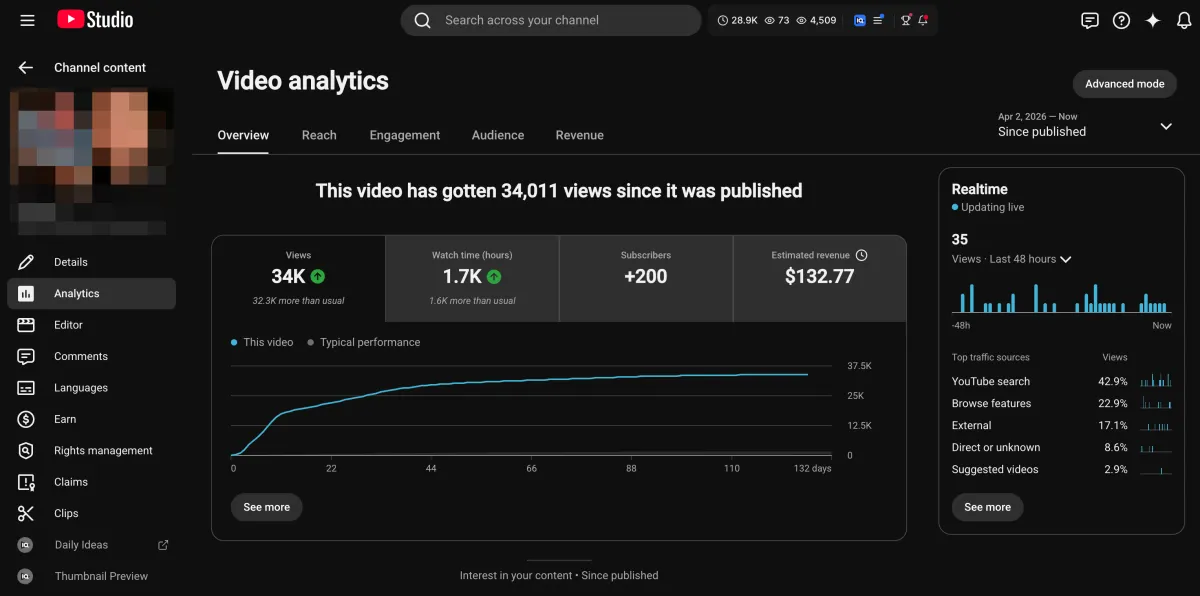
Learn how I turned a $132.77 video into $1000+ per month asset
Full case study on how you can replicate my success with YouTube SEO strategy.
Free downloadThe Zero Audience System
Build permanent YouTube income without a camera or an audience
The full methodology, 31 lessons plus bonuses. Limited spots.