
Yes, but through a completely different mechanism than long-form videos, and that difference explains almost every confusing thing people notice about Shorts earnings. There's no per-video ad slot on a Short the way there is on a long-form upload. Instead, ad revenue from the entire Shorts feed gets pooled together and split among eligible creators based on their share of total views. Here's exactly how that works, what it actually pays, and whether it's worth building a strategy around.
The Short Answer
YouTube Shorts can be monetized once a channel meets specific eligibility thresholds, and earnings come from a shared regional ad pool rather than ads placed directly on an individual Short. Creators keep 45% of their allocated share of that pool, the same percentage split used for long-form ad revenue, but the amount that reaches any individual creator depends on their proportion of total eligible Shorts views in their region, not on ads shown specifically on their own videos.
How Shorts Monetization Actually Works
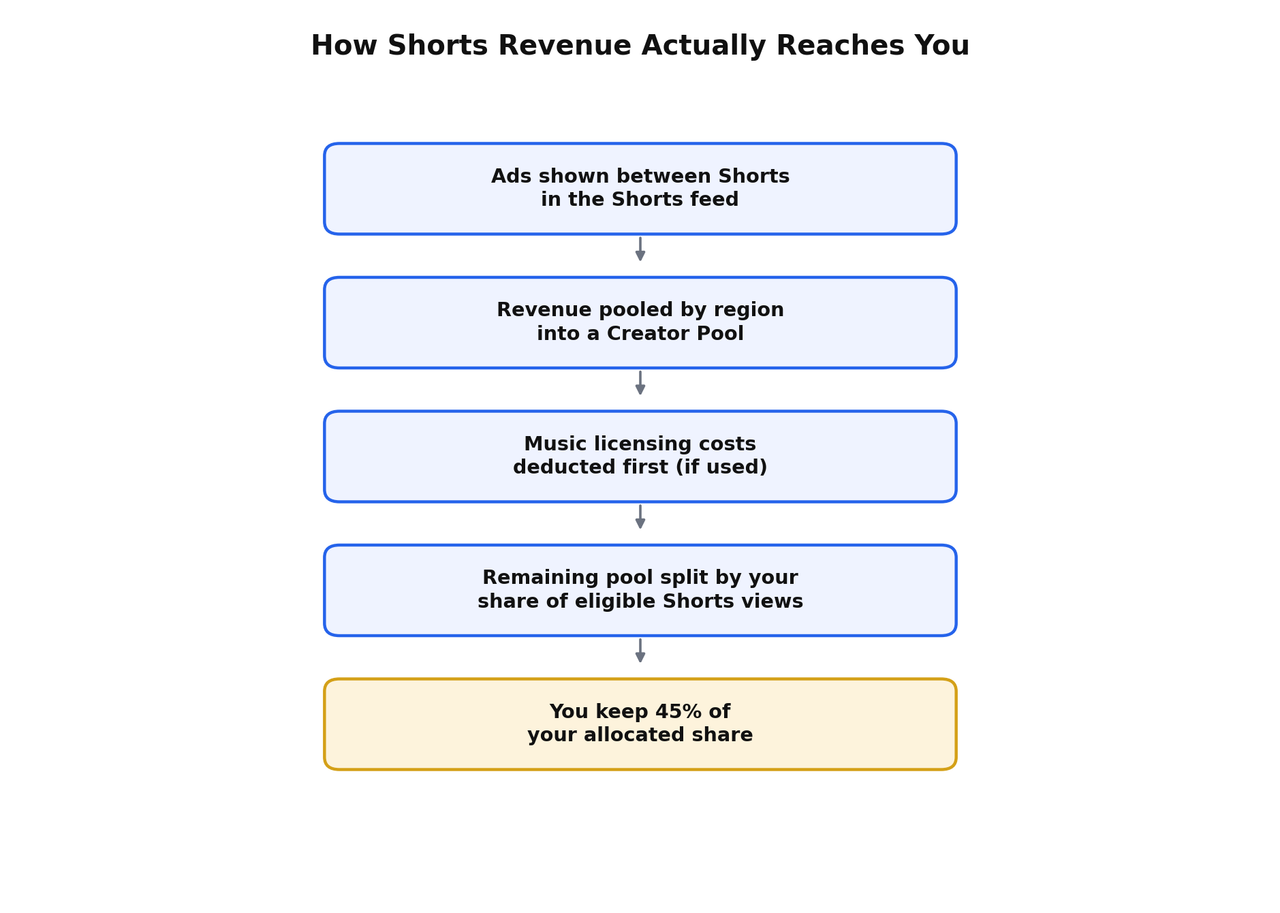
Ads appear between Shorts as people scroll through the feed. That ad revenue doesn't attach to any single video, it flows into a Creator Pool calculated on a regional basis. If a Short uses licensed music, a portion of the pool gets set aside for music publishers before creators are paid at all. Whatever remains gets distributed proportionally, based on each eligible creator's share of total Shorts views in that region for that period. A creator responsible for 5% of eligible regional Shorts views receives roughly 5% of the remaining pool, then keeps 45% of that allocation.
Eligibility Requirements
| Tier | Requirements | What it unlocks |
|---|---|---|
| Fan funding only | 500 subscribers, plus 3 million Shorts views or 3,000 watch hours in 90 days | Super Thanks, Super Chat, channel memberships, no ad revenue yet |
| Full ad revenue sharing | 1,000 subscribers, plus 10 million Shorts views or 4,000 long-form watch hours in 90 days | Access to the Shorts Creator Pool and standard long-form ad revenue |
How Much Do Shorts Actually Pay?
Realistic Shorts RPM, revenue per 1,000 views after YouTube's cut, typically lands somewhere between $0.01 and $0.10, with stronger niches and markets occasionally reaching the higher end of that range. That's dramatically lower than long-form RPM, which commonly runs $2 to $15 depending on niche. A Short reaching 10 million views might realistically generate somewhere between $100 and $1,000, a wide range, but even the high end requires genuinely massive view counts to add up to meaningful income.
Why Original Audio Can Increase Your Earnings
This is a practical detail worth acting on directly. A Short using licensed, popular music has a portion of its pool contribution routed to music publishers before creator payouts are calculated, which can mean more views but a smaller effective payout per view. A Short using original audio, voiceover, or royalty-free sound keeps the full allocation with no licensing deduction. Chasing a trending song can genuinely help a Short reach more people, but it isn't automatically the higher-earning choice once the licensing split is factored in.
Shorts RPM vs Long-Form RPM
Long-form video wins decisively on a per-view basis, often by a factor of 20 to 50 times depending on niche. Shorts win on reach and volume, a single Short can realistically be shown to far more people, far faster, than a long-form upload competing in a narrower discovery system. If your goal is direct ad income, long-form is the stronger lever. If your goal is discovery and audience growth that eventually feeds a more valuable format, Shorts serve a genuinely different, complementary purpose.
What Changed In 2025 And 2026
YouTube increased the ad load within the Shorts feed over the past year, which expanded the total pool available to creators and pushed average Shorts RPM up by roughly 15 to 25% compared to 2024 levels, according to multiple current industry reports. YouTube also introduced Shorts Bonuses, additional payouts layered on top of standard pool revenue for channels showing rapid growth. The core eligibility thresholds themselves, 1,000 subscribers and 10 million Shorts views for full ad revenue sharing, have remained unchanged since the current model launched.
Should You Rely On Shorts For Income?
Not as a standalone strategy. The pooled model means RPM is largely fixed by structural factors outside any individual creator's control, so the only real lever available is raw view volume, and even substantial view counts translate into modest totals at these rates. The more effective approach treats Shorts as a discovery and growth engine, a fast, low-cost way to reach new viewers, who then get funneled toward long-form content where the real per-view economics live. I've covered the complete range of realistic income sources for a channel, ad revenue and beyond, in faceless YouTube channel monetization, every way to actually get paid, and the real RPM ranges by niche for long-form content specifically in YouTube RPM by niche.
Frequently Asked Questions
Do I need 1,000 subscribers to earn any money from Shorts?
No. At 500 subscribers with 3 million Shorts views or 3,000 watch hours, fan-funding features like Super Thanks and channel memberships become available. Ad revenue sharing through the Shorts Creator Pool specifically requires 1,000 subscribers and 10 million Shorts views, or the long-form watch hour equivalent.
Why did my Short get a million views but earn almost nothing?
This is a common, structural feature of the pooled model, not a mistake. Shorts revenue is split across an enormous, region-wide pool of eligible views, so RPM sits far below long-form rates regardless of how well any individual video performs.
Does using trending music hurt my Shorts earnings?
It can reduce your effective payout per view, since licensing costs are deducted from the pool before creator payouts when licensed music is used. Original audio or royalty-free sound avoids that deduction entirely.
Is it worth focusing on Shorts if I want to make money on YouTube?
Shorts are more valuable as a growth and discovery tool than a direct income source, given how much lower Shorts RPM is compared to long-form. Many creators use Shorts to build reach and drive viewers toward monetized long-form content rather than relying on Shorts ad revenue alone.
The Real Takeaway
Shorts are monetized, but the pooled revenue model means per-view earnings will almost always look thin next to long-form, no matter how well an individual Short performs. Treat Shorts revenue as a small, genuine bonus on top of a growth strategy, not as the plan itself, and prioritize using Shorts to funnel new viewers toward the content that actually pays.
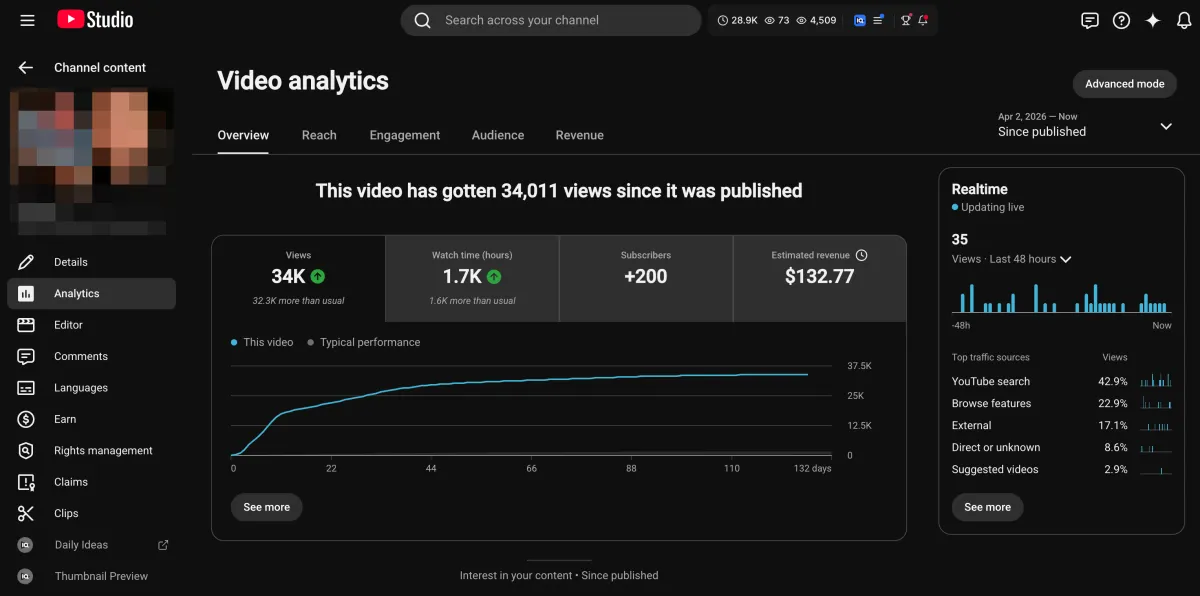
Learn how I turned a $132.77 video into $1000+ per month asset
Full case study on how you can replicate my success with YouTube SEO strategy.
Free downloadThe Zero Audience System
Build permanent YouTube income without a camera or an audience
The full methodology, 31 lessons plus bonuses. Limited spots.