Can Faceless Channels be Monetized in 2027?
Yes, and nothing in YouTube's current policy or announced changes suggests that will stop being true. The confusion around this question comes from a real, well-publicized enforcement wave that hit faceless channels hard through 2026, but the policy behind it was never aimed at facelessness itself. It targets mass-produced, templated content, a problem faceless channels can have, but don't have to. There is one genuine, dated policy change actually arriving by 2027 worth knowing about, and it's not what most people assume.
The Short Answer
Faceless channels remain fully eligible for YouTube monetization. The platform's own enforcement, and multiple independent reports covering it, confirm the actual line sits between original, curated content and repetitive, templated mass production, not between showing a face and not showing one. A faceless channel with real scripts, genuine editing decisions, and a consistent identity monetizes exactly the same as any other channel.
The Core Misconception: Faceless Was Never The Target
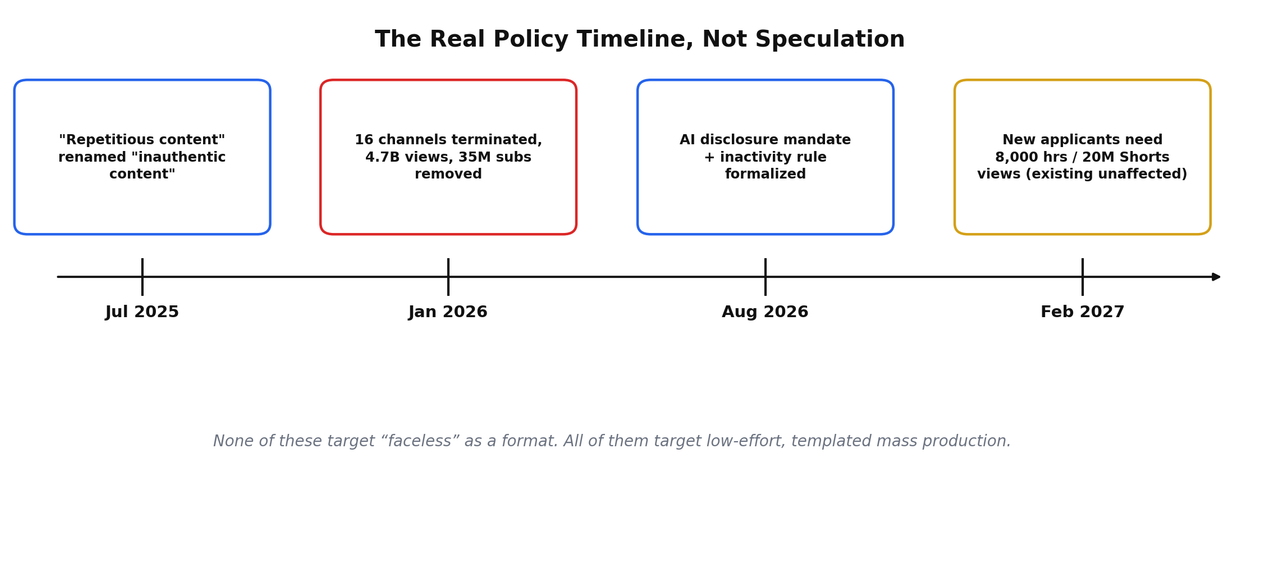
YouTube's policy, renamed from "repetitious content" to "inauthentic content" in July 2025, targets content that looks like it came from a template with little to no real variation, or content easily replicated at scale with no genuine creative input. That description applies to plenty of faceless channels. It also applies to plenty of channels where a person's face is on screen the entire time, reading a formulaic script with zero original thought behind it. The format was never the variable the policy cares about.
What Actually Happened In The 2025-2026 Enforcement Wave
The scale of enforcement was real and significant. In January 2026, YouTube permanently terminated 16 channels, not just demonetized them, erasing a combined 4.7 billion lifetime views and roughly 35 million subscribers, with estimated lost annual creator revenue around $10 million. This wasn't a quiet policy adjustment, it was YouTube's largest enforcement action of this kind to date, and it understandably alarmed a lot of legitimate faceless creators who assumed the format itself was under attack.
The Three Patterns That Actually Get Flagged
Reporting on the enforcement identifies three specific categories that consistently trigger action: content with no real value, faceless compilations with zero commentary or a static image over background audio; template clones, videos that are identical in structure with only a title or character name swapped; and AI slideshows, images moving on screen with no real narration or editing effort behind them. Notice that all three describe an absence of genuine work, not the absence of a face.
The One Real Change Actually Coming In 2027
This is the part most coverage of this topic misses, since it's specific, dated, and genuinely relevant to a "2027" question. Starting February 1, 2027, new applicants to the YouTube Partner Program will need 8,000 watch hours or 20 million Shorts views in the qualifying period, double the current 4,000 hours or 10 million Shorts views. Channels already accepted into the Partner Program before that date are not affected and keep their existing status. If you're planning to start a new faceless channel with 2027 monetization in mind, this threshold, not any faceless-specific restriction, is the real hurdle to plan around.
The Honest Risk: Enforcement Isn't Perfect
It would be dishonest to present this as a clean, well-targeted system with zero collateral damage. Reporting on the crackdown documents real cases of creators with years of genuine, original voiceover work facing demonetization reviews simply because their format resembles the automated channels the policy is actually built to catch. Automated detection at this scale can't perfectly distinguish authentic work from a superficially similar template every time.
If your channel gets flagged, YouTube Studio shows the specific reason, and appeals are available within 21 days of the decision, with reviews typically returning within days to about two weeks. If an appeal is rejected, there's a required 90-day wait before reapplying to the Partner Program. Appeals succeed on demonstrated evidence of originality, your actual production process and script work, not on explaining intent after the fact.
What Actually Protects A Faceless Channel Going Forward
The practical defense is the same work that makes a channel genuinely good in the first place: scripts with a real point of view a template couldn't produce on its own, visible editorial decisions rather than a fixed formula repeated with a new topic swapped in, real variation in structure across uploads, and the AI disclosure toggle switched on wherever it applies. None of this requires showing your face. It requires showing genuine judgment somewhere in the process.
Real Examples Proving Faceless Still Works
This isn't theoretical. I've covered five real, currently active faceless and semi-faceless channels succeeding right now, each with a specific, original angle rather than a generic template, in 5 real YouTube automation examples, with actual numbers. The pattern across all of them is the same one this policy actually rewards: a specific, distinguishing creative choice, not just a faceless production method on its own.
My Honest Projection For 2027
Based on the trajectory so far, renaming a long-standing policy for clarity, then enforcing it at increasing scale as detection tools improve, expect continued tightening around low-effort, templated content rather than any new rule targeting facelessness as a category. The likeness detection tools YouTube has introduced to protect creators from unauthorized AI deepfakes suggest the platform's broader concern is authenticity and consent around AI use generally, not eliminating AI-assisted or faceless production. Treat this as a reasoned expectation based on the current pattern, not a guarantee, policy in this area has moved fast and could shift again with little notice.
Frequently Asked Questions
Is YouTube planning to ban faceless channels entirely?
No. Every credible source covering the current policy confirms faceless channels remain fully eligible for monetization, with enforcement targeting templated, low-effort mass production specifically, regardless of whether a face appears.
Does using an AI voiceover automatically put a channel at risk?
No. Thousands of monetized channels use synthetic narration without issue. The risk appears when an AI voice reads a low-effort, repetitive script over unrelated or generic footage, which fails the originality standard regardless of the voice technology used.
What's actually changing for faceless channels by 2027?
The clearest confirmed change is a higher Partner Program entry threshold for new applicants starting February 1, 2027, 8,000 watch hours or 20 million Shorts views instead of the current 4,000 hours or 10 million views. Existing monetized channels aren't affected by this change.
Can a legitimate faceless channel get wrongly flagged?
Yes, this has genuinely happened during the 2026 enforcement wave. YouTube provides an appeals process within 21 days of a decision, and appeals succeed based on demonstrated evidence of original production work.
The Actual Takeaway
Faceless channels remain monetizable in 2027, and the real risk was never the absence of a face, it's the absence of genuine, original work behind the content. Build around a specific, distinguishing creative choice rather than a repeatable template, keep your AI disclosure settings accurate, and the format itself isn't the liability. For the complete breakdown of exactly where the inauthentic content line sits, including a practical self-audit test, see what is inauthentic content on YouTube, and for the fuller strategic picture on whether this production model is worth pursuing at all right now, is YouTube automation worth it in 2026.
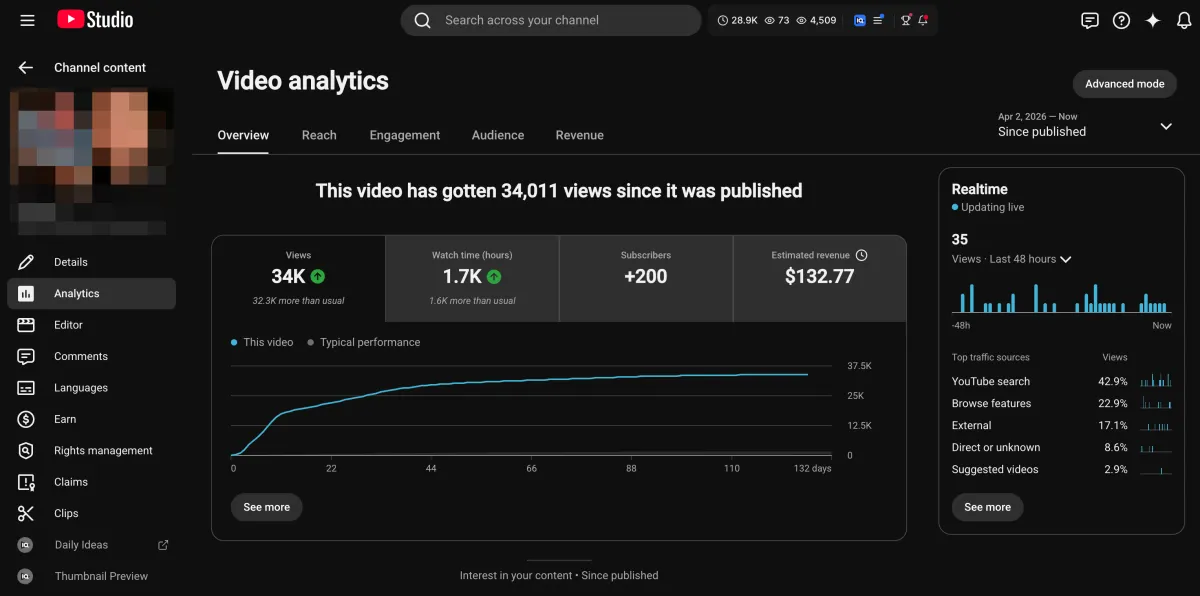
Learn how I turned a $132.77 video into $1000+ per month asset
Full case study on how you can replicate my success with YouTube SEO strategy.
Free downloadThe Zero Audience System
Build permanent YouTube income without a camera or an audience
The full methodology, 31 lessons plus bonuses. Limited spots.