Yes, but the honest odds are worse than most "start a faceless channel" content admits, and reaching monetization isn't the same as reaching profit. Real 2026 data shows only about 4.3% of YouTube's 115+ million channels have ever qualified for the Partner Program at all. Among those that do, a large share earn under $200 a month, technically monetized, not actually a business. Here's the real math: what it costs to run one, what it realistically earns at each stage, and where the actual break-even point sits.
The Real Odds Before Any Profit Math
Start with the honest baseline. Roughly 95% of YouTube channels never meet the basic monetization thresholds, 1,000 subscribers and 4,000 watch hours in 12 months, at all. Of the roughly 4.3% that do qualify, a large share still earn under $200 a month once they get there. A separate, widely cited industry analysis found that around 3% of YouTubers capture roughly 90% of total creator earnings on the platform. This isn't a reason to avoid starting one. It's the context that makes the rest of this math worth taking seriously instead of skipping straight to the exciting part.
What It Actually Costs To Run A Faceless Channel
| Setup | Monthly cost |
|---|---|
| Minimal solo stack (free tools where possible) | $50-$100 |
| Full solo stack (editing, voice, thumbnails, research tools) | $80-$150 |
| Outsourced production (editor, scriptwriter) | $1,500-$5,000+ |
Most people starting today fall into the first two categories. That $50 to $150 a month is a real, recurring cost that has to be subtracted from revenue before anything counts as profit, not after.
What It Actually Earns, Stage By Stage
RPM, what a creator actually takes home per thousand views after YouTube's 45% cut, typically ranges from around $2 to $12 depending on niche, with some finance and business content reaching higher. Gaming and general entertainment content usually sits under $4. Applying that range against a realistic view trajectory for a new, consistently published channel produces a rough month-by-month picture.
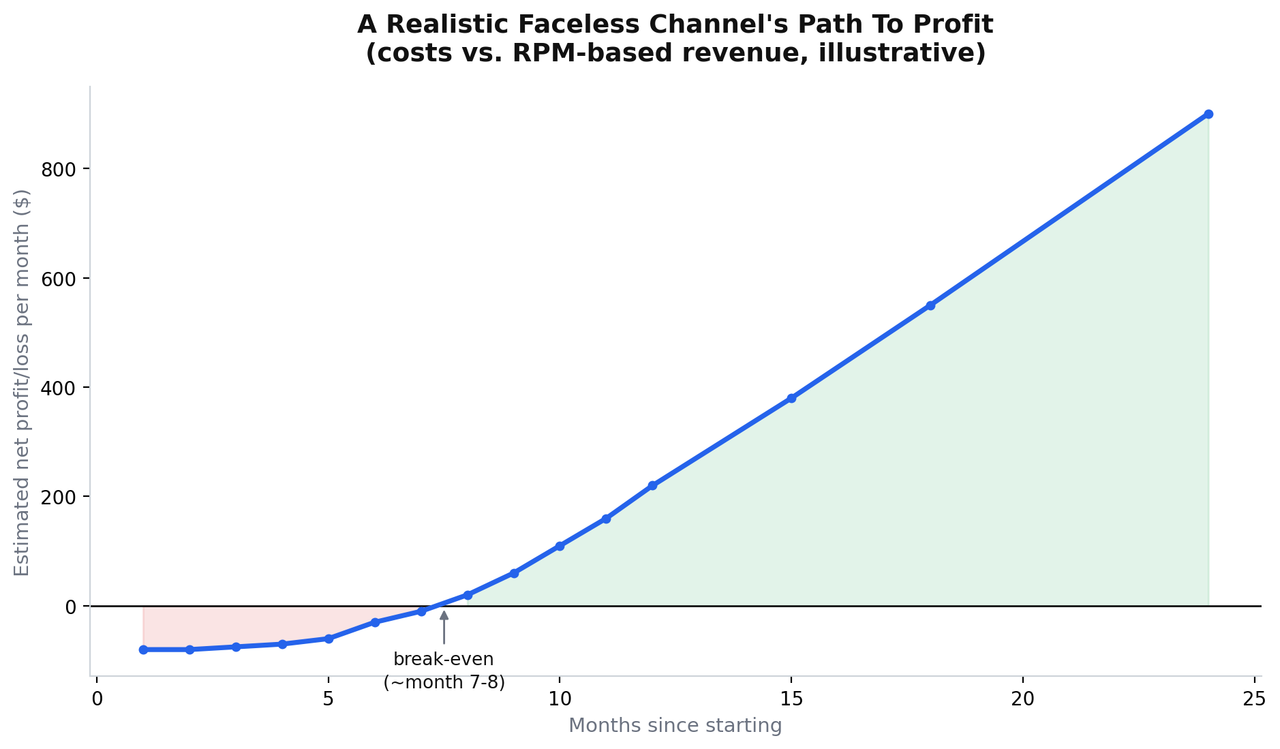
In the first three to four months, before monetization even activates, revenue sits near zero while tool costs keep running, a real, ongoing net loss. Around month five to six, if watch hours are compounding on schedule, ad revenue starts trickling in but usually doesn't yet cover monthly costs. Somewhere around month seven or eight, for a channel built around specific, evergreen topics rather than scattered trend-chasing, revenue typically crosses over into covering costs. From there, if the model is genuinely working, growth tends to compound, since older videos keep earning while new ones stack on top.
Treat these numbers as illustrative, not a guarantee. They assume consistent publishing, a reasonably chosen niche, and content built around real search demand rather than pure speculation. Change any of those assumptions and the timeline shifts meaningfully in either direction.
The Break-Even Point, Explained
Break-even isn't a subscriber count, it's the point where monthly ad revenue plus any affiliate income finally exceeds monthly tool and production costs. For a lean solo operation running the minimal stack, that's a genuinely achievable target within six to nine months for a channel publishing consistently in a reasonable niche. For a channel that jumped straight to outsourced production before proving the model works, break-even can take considerably longer, since the cost side of the equation starts much higher before any revenue exists to offset it.
Why Most Faceless Channels Never Get There
The channels that never reach profitability usually share the same handful of patterns. They chase trending topics with no evergreen foundation underneath, so views spike and vanish instead of compounding. They quit somewhere in the first two to three months, exactly the stretch where the numbers above show the deepest, least encouraging losses, right before the trajectory typically turns. Or they scale production costs up, hiring editors and writers, before confirming the underlying content and niche actually convert, turning a manageable early loss into a much larger one.
What Separates The Profitable Minority From Everyone Else
The channels that do become genuinely profitable tend to do three things consistently: build around specific, searchable problems rather than broad or trending topics, track which individual videos are actually converting rather than judging success by views alone, and keep costs lean until real revenue data justifies spending more. None of that is exciting advice, and it's exactly why it's rare enough that only a small percentage of channels ever get there.
A Realistic Timeline If You're Starting Today
- Months 1-4: Expect a real net loss while you're covering tool costs with no ad revenue yet. Use this window to publish consistently and build a specific, evergreen topic library.
- Months 5-7: Ad revenue starts arriving but likely won't fully cover costs yet. Resist the urge to add paid tools or outsourcing during this stretch.
- Months 7-9: A realistic break-even point for a lean, consistently run channel in a reasonable niche.
- Month 12 onward: If the model is working, this is where compounding from your growing back catalogue starts to show up as real, sustained profit rather than a monthly coin flip.
For the full mechanics of what to actually build during those first months, I've covered the practical setup process in how to start a faceless YouTube channel with zero experience, and the complete list of realistic income sources beyond ad revenue in faceless YouTube channel monetization, every way to actually get paid.
Frequently Asked Questions
How long does it realistically take for a faceless channel to become profitable?
For a lean, consistently published channel in a reasonable niche, somewhere around seven to nine months is a realistic break-even point. Channels that scale up production costs before proving the model, or that chase trends without an evergreen foundation, often take considerably longer.
What percentage of faceless YouTube channels actually make money?
There's no separate published figure specifically for faceless channels, but the broader YouTube data is sobering: only about 4.3% of all channels ever reach monetization eligibility, and a large share of those earn under $200 a month.
Is it worth outsourcing production before the channel is profitable?
Generally no. Keeping costs lean with a minimal or full solo tool stack until the channel has real revenue data is the more common path to actually reaching profitability, rather than scaling costs up on an unproven concept.
Does reaching the YouTube Partner Program mean a channel is profitable?
Not automatically. Monetization eligibility only means ad revenue can start flowing, it doesn't mean that revenue exceeds the channel's actual running costs, which is the real definition of profitable.
The Honest Verdict
A faceless YouTube channel can be genuinely profitable, and the real numbers show a believable path to get there within seven to nine months for someone running it lean and building around specific, evergreen content. The same numbers show most channels never reach that point, usually because they quit during the discouraging early months or scale costs faster than revenue can catch up. If you start one, plan for the real loss in the first few months rather than being surprised by it, and keep costs low until your own data tells you it's time to spend more.
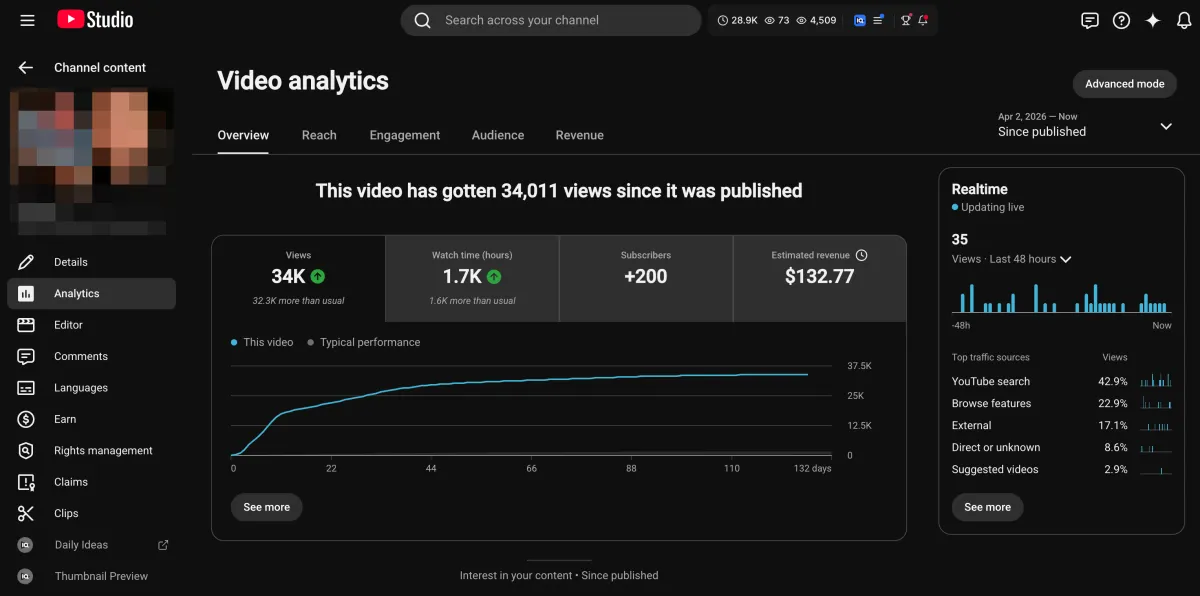
Learn how I turned a $132.77 video into $1000+ per month asset
Full case study on how you can replicate my success with YouTube SEO strategy.
Free downloadThe Zero Audience System
Build permanent YouTube income without a camera or an audience
The full methodology, 31 lessons plus bonuses. Limited spots.