
There isn't a secret broad niche sitting out there undiscovered. If a topic is big enough to sustain an entire automated channel, someone's already found it, and if you're searching "best niches for YouTube automation," you've probably already seen the same list everyone else has: personal finance, tech reviews, true crime, motivation. What's actually underused isn't a category. It's a pattern, and once you see it, you'll notice it everywhere.
I pulled real keyword data to prove this rather than guess at it. Here's what that pattern actually looks like, two real examples with real numbers behind them, and how to go find your own version of it.
Why "Undiscovered Broad Niches" Basically Don't Exist Anymore
Think about what a niche actually needs to sustain a full channel: enough search demand to matter, spread across enough distinct video ideas to keep publishing for months. That combination is visible. It shows up in keyword tools, in competitor channels, in every "best niches" article already written. A category with that much room in it isn't hiding from anyone, it's just competitive, because everyone doing this research finds the same thing.
The actual opportunity sits one level down, in specific, narrow variations of known categories that individually look too small to write an article about, which is exactly why nobody's written about them.
The Actual Pattern: One Structure, Many Ignored Variations
Here's the pattern, stated plainly: find a topic type that naturally repeats across dozens of near-identical variations, a specific state, a specific species, a specific product model, a specific error code, where each individual variation gets ignored for being too narrow, but the full set adds up to a real content library.
Example One: State-Specific Legal And Bureaucratic Process Explainers
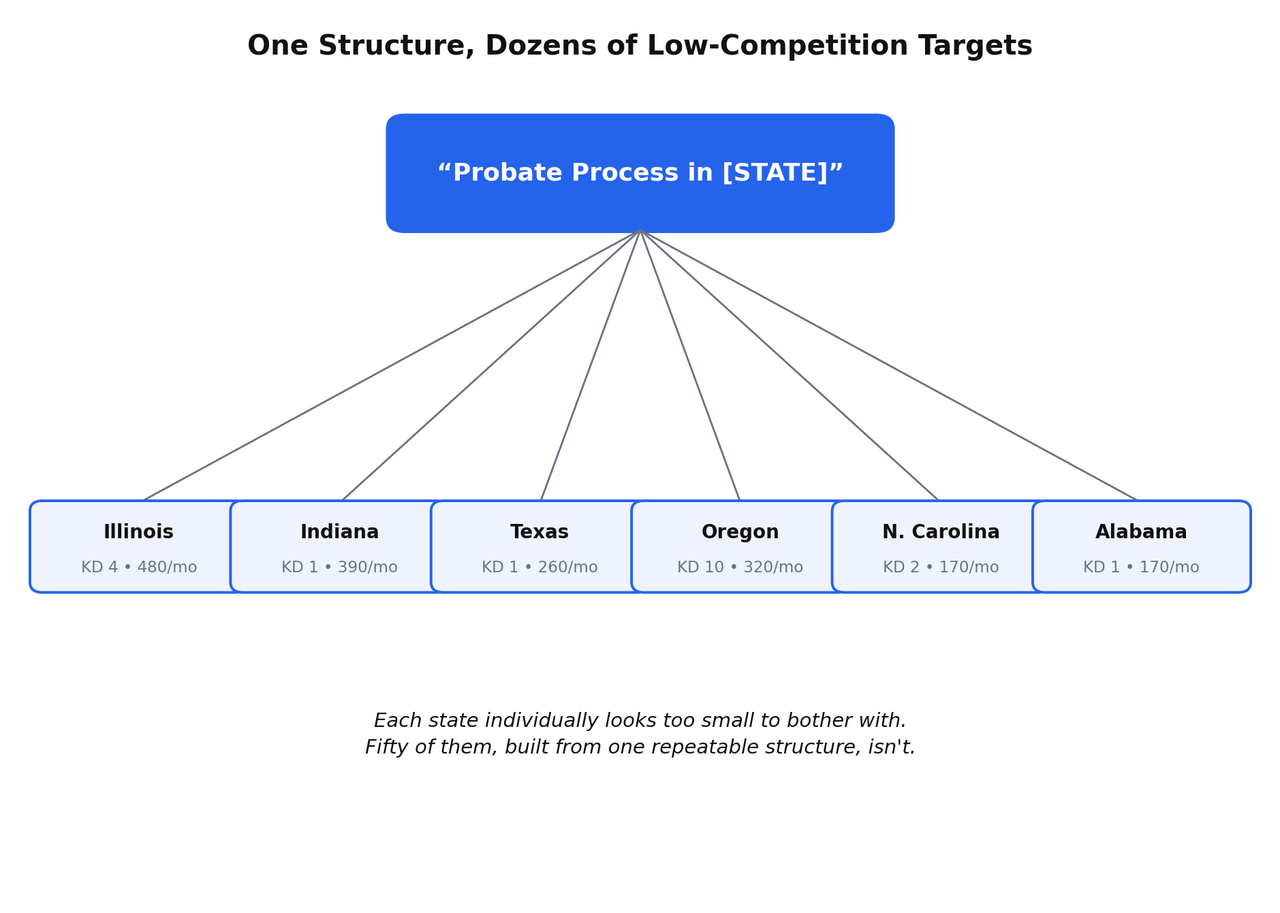
I pulled real search data on probate process content, a topic already covered broadly, "what is probate," at a competitive difficulty level. But when you narrow it to a specific state, the difficulty collapses while real search volume and commercial value stay intact.
| Keyword | Monthly Volume | Keyword Difficulty | CPC |
|---|---|---|---|
| Illinois probate process | 480 | 4 | $3.15 |
| Probate process in Indiana | 390 | 1 | $15.18 |
| Texas probate process | 260 | 1 | $3.88 |
| Probate process Oregon | 320 | 10 | $5.64 |
| North Carolina probate process | 170 | 2 | $5.04 |
| Probate process Alabama | 170 | 1 | $2.74 |
This same pattern held across every state I checked, consistently low difficulty, real informational search volume, and CPCs that signal genuine commercial value behind the searches, since probate involves real financial decisions and often a search for legal help. One creator covering probate broadly is competing with established legal content sites. Fifty separate videos, one per state, each individually easy to rank, is a completely different competitive picture, and it's the same underlying research and script structure repeated fifty times.
This isn't limited to probate. The same "process explainer, narrowed to one state" structure applies to eviction timelines, small business licensing, inheritance tax rules, and small claims court procedures, any bureaucratic process that varies by jurisdiction is a candidate for this exact pattern.
Example Two: Specific-Species And Specific-Ailment Pet Content
Broad pet care content is thoroughly saturated. But narrow it to a specific species most creators skip, and the picture changes. Reptile care specifically showed real, consistent low-competition demand:
| Keyword | Monthly Volume | Keyword Difficulty |
|---|---|---|
| Reptile care | 1,900 | 11 |
| Easiest reptile to take care of | 880 | Very low |
| Reptile pet care | 590 | Very low |
| Pet reptile care | 590 | 8 |
| Reptile care guide | 170 | Very low |
The same narrowing works within a species you already know well. Instead of general dog care, content built around a specific, searched problem, a specific skin condition, a specific at-home treatment, showed real volume with low competition in the same data pull. Broad topic, saturated. Specific problem within that topic, wide open.
How To Find This Pattern Yourself
Start with a category you already understand reasonably well, not a completely cold topic. Look for a natural variable that repeats within it: a jurisdiction, a species, a model number, a specific error message, a certification level. Then check real keyword data for a handful of the variations before assuming the pattern holds. A free tool's Research tab or a proper keyword tool, the kind I've covered in more depth in my breakdown of the best free YouTube SEO tools, will show you the real difficulty and volume numbers rather than a guess. Tools like DataForSEO let you pull this kind of data directly, and Google Trends is worth checking to confirm the category itself isn't fading before you invest in it. Niche-site researchers at Niche Pursuits have documented similar patterns for years in the blogging and SEO space, the same underlying logic applies directly to video.
Why This Pattern Specifically Suits Automation
A repeatable structure with a single swapped variable is close to the ideal shape for an automated production workflow. The research process, the script skeleton, and the format stay consistent across every video in the set, only the specific variable changes each time. That consistency makes outsourcing or AI-assisted production genuinely efficient without sacrificing the thing that actually matters: each individual video is still answering a real, distinct, specific search, not just wearing a different label on the same generic content.
What To Watch Out For
This pattern only works if each variation genuinely earns its own video. Fifty videos that are truly just "probate in Illinois" versus "probate in Texas," with real state-specific detail, real differences in process and timeline, are fifty legitimate, distinct pieces of content. Fifty videos that swap one word and repeat identical generic advice underneath it are exactly the kind of templated, interchangeable pattern that YouTube's monetization policy is built to catch. I've covered what actually crosses that line in detail in what counts as inauthentic content on YouTube, and it's worth reading before you scale this approach to dozens of videos. The difference between a smart repeatable structure and a risky templated pattern comes down entirely to whether the variable you're swapping actually changes the substance of the video, not just its title.
Frequently Asked Questions
Are these two specific niches, probate and reptile care, the actual recommendation?
They're proof the pattern works, not a prescription. The real recommendation is the underlying method, find a repeatable variable within a category you understand, and check the real data before assuming it's saturated or too small.
How many variations does a niche like this need to sustain a channel?
It depends on the category, but a variable that repeats at least 20 to 50 times, states, species, models, gives you a genuine multi-month content runway from one research and script structure.
Does this approach still require real research for each video?
Yes. The structure repeats, the substance shouldn't. Each variation needs real, specific detail, not the same generic paragraph with one word changed, both for viewer value and to stay clearly on the right side of YouTube's content policies.
Where I'd Start This Week
Pick one category you already know something about, and spend thirty minutes checking real keyword data on five or six specific variations within it before deciding whether the opportunity is real. The two examples here, state-specific legal explainers and specific-species pet care, aren't the only patterns that work, they're proof that checking real data beats guessing at a "hidden niche" that was never actually hidden in the first place.
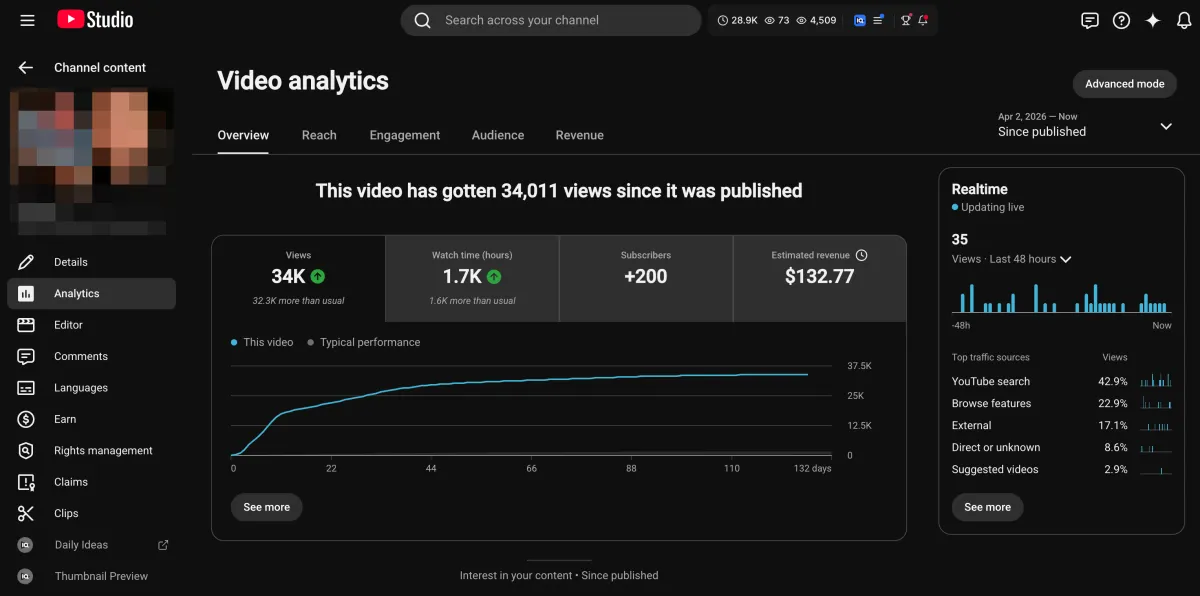
Learn how I turned a $132.77 video into $1000+ per month asset
Full case study on how you can replicate my success with YouTube SEO strategy.
Free downloadThe Zero Audience System
Build permanent YouTube income without a camera or an audience
The full methodology, 31 lessons plus bonuses. Limited spots.