YouTube SEO is the process of structuring a video, and the choices you make around it, so it matches what someone is actually searching for and satisfies that search well enough that YouTube keeps recommending it. That's the accurate definition. The version most articles give you, optimize your title, tags, and description with the right keywords, isn't wrong exactly, it's just answering a question from about a decade ago, back when metadata carried far more weight than it does now.
Here's the actual, current picture: what YouTube SEO really is, why the keyword-stuffing advice from most competing articles is outdated, and what to focus on instead.
The Definition Most Articles Give You, And Why It's Incomplete
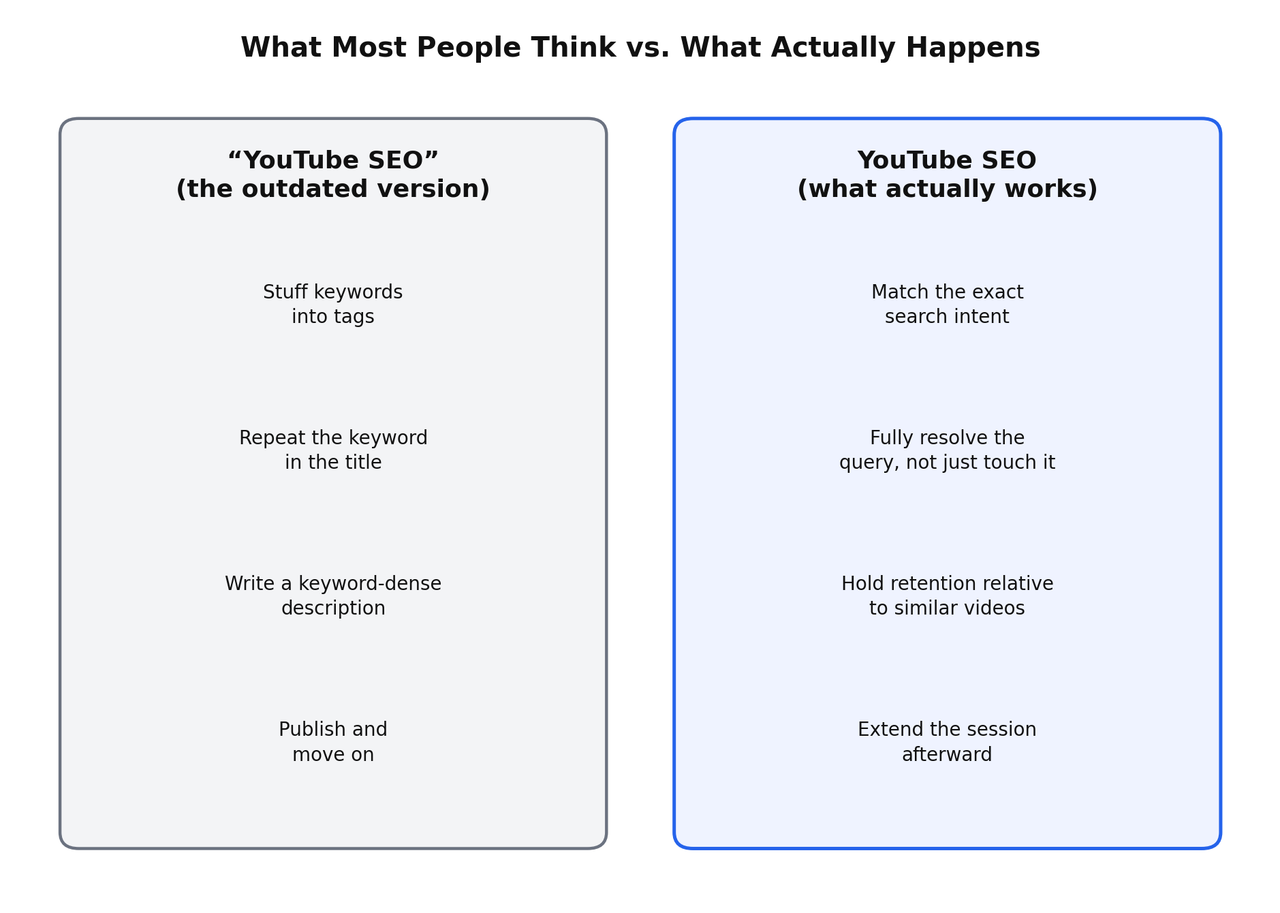
Search almost any explanation of YouTube SEO and you'll find some version of the same advice: put your keyword in the title, add it to your tags, work it into the description a few times. This isn't fabricated nonsense, it was genuinely closer to accurate years ago, when YouTube's search system leaned more heavily on literal keyword matching in metadata. Treating this as the whole picture in 2026 misses most of what actually determines whether a video ranks.
What YouTube SEO Actually Is Right Now
YouTube evaluates a video for a given search term through a combination of relevance and performance. Relevance covers whether your title, content, and even your spoken words, indexed through captions, genuinely match the topic. Performance covers what happens after someone clicks: whether they stay relative to similar videos, whether they seem satisfied rather than bouncing back to try another result, and whether the video extends their session afterward instead of ending it.
Metadata still plays a role, mainly by helping YouTube correctly categorize an ambiguous video, but it's a supporting signal now, not the primary lever. A perfectly tagged video that loses most of its audience in the first thirty seconds will lose to a lightly tagged video that actually holds attention and resolves the search.
YouTube SEO Isn't One System, And Treating It Like Google SEO Is A Mistake
A lot of the confusion around this topic comes from people porting over general web SEO thinking wholesale. YouTube doesn't run one unified ranking system the way people often assume. Search, the Home feed, Suggested videos, and Shorts are separate systems, each weighing signals differently. A video can perform strongly in one and barely register in another, and that's expected behavior, not a bug.
This matters practically: optimizing purely for Home feed engagement and optimizing for Search intent-matching are different skills. Search rewards a video for being the correct, complete answer to a specific typed query. The Home feed rewards a video for being something a specific viewer is statistically likely to enjoy based on their watch history. Confusing the two leads to advice that half-applies at best.
The Three Layers That Actually Make Up YouTube SEO
Relevance
Does your title, content, and spoken material genuinely match the topic being searched. This is where metadata still matters, but as a clarifying signal, not a keyword-stuffing opportunity.
Performance
Click-through rate relative to similar videos, retention relative to similar videos, and increasingly, direct satisfaction signals, whether viewers rate the video well, return, or click "not interested." Watch time alone stopped being the dominant proxy once satisfaction signals were layered on top of it.
Session and channel-level signals
What happens after the video ends, and a channel's accumulated track record of satisfying the searches and recommendations that brought people there. This is where playlists, end screens, and a consistent, specific catalogue start to matter more than people expect.
I've broken these down in much more depth, with the current 2026 specifics behind each one, in what actually determines YouTube ranking factors. This article stays at the definitional level on purpose, that one goes deep on the mechanics.
Why Keyword Stuffing In Tags Doesn't Work Anymore
Tags exist mainly to help YouTube disambiguate an unclear title, not to function as a ranking lever you can load up with every variation of your target keyword. A video titled clearly enough doesn't need fifteen tags to be understood correctly, and stuffing tags with loosely related terms doesn't meaningfully help relevance the way it might have years ago. If you're spending real time on tags before you've nailed the title, thumbnail, and whether the video actually resolves the query, you're optimizing the wrong layer first.
A Simple Way To Think About It Going Forward
Stop thinking of YouTube SEO as decorating a video with the right words. Think of it as answering one specific question so completely that the person who searched it never needs to click on another video. Everything that actually moves a video's ranking, relevance, retention, satisfaction, session behavior, is a downstream consequence of how well the video does that one job.
How This Differs From Website SEO
| Website SEO | YouTube SEO | |
|---|---|---|
| Primary trust signal | Backlinks and domain authority | Watch behavior and satisfaction signals |
| Content structure | Headers, internal links, page structure | Hook, pacing, and whether the video resolves the query |
| Ranking systems | Largely one search index | Separate systems for Search, Home, Suggested, and Shorts |
| Metadata role | Meaningful ranking factor | Mostly disambiguation, a supporting signal |
If you care about being found through a typed search, YouTube SEO is closer in spirit to website SEO. If you care about being recommended to someone who wasn't searching at all, that's closer to a recommendation engine problem, and the tactics genuinely diverge from there.
What I'd Actually Do If I Were Starting Today
Pick one specific, narrow search query you can realistically answer completely, not a broad topic. Watch the current top three results for it and note exactly what they leave out or handle poorly. Build your video to close those gaps and deliver the answer faster and more completely than what's currently ranking. Write a title that plainly states what the video is about within the first 60 characters, keep tags minimal and accurate rather than exhaustive, and treat your thumbnail as the actual determinant of whether anyone gets far enough to have their retention measured at all. Before you publish, run through a proper pre-publish checklist so none of this gets undone by a rushed upload screen.
Frequently Asked Questions
Do tags still matter for YouTube SEO?
Some, mainly for disambiguating an unclear title, not as a major independent ranking lever. Time is better spent on the title, thumbnail, and whether the video actually resolves the search.
Is YouTube SEO the same as general SEO?
Related but distinct. Both care about matching search intent, but YouTube evaluates performance signals, retention, satisfaction, session behavior, far more heavily than website SEO's traditional reliance on backlinks and domain authority.
How is YouTube SEO different for Shorts versus long-form videos?
Shorts and long-form run on separate recommendation systems with different dominant signals, completion rate and rewatch behavior matter more for Shorts, while retention and session contribution weigh more heavily for long-form search ranking.
Can a video rank well without any tags at all?
Yes, if the title and content are clear enough that YouTube doesn't need tags to understand the topic. Tags help most when a title is genuinely ambiguous, not as a universal requirement.
The Actual Starting Point
If you take one thing from this: stop treating YouTube SEO as a metadata exercise you finish before publishing. It's an ongoing question about whether your video is the best available answer to something someone actually typed, judged by whether they stayed, whether they were satisfied, and whether they kept watching afterward. Optimize for that, and the tags take care of themselves.
For further reading on how search engines evaluate content quality more broadly, YouTube's own help documentation on how search works and Google's guidance on creating helpful, people-first content are both worth reading directly from the source.
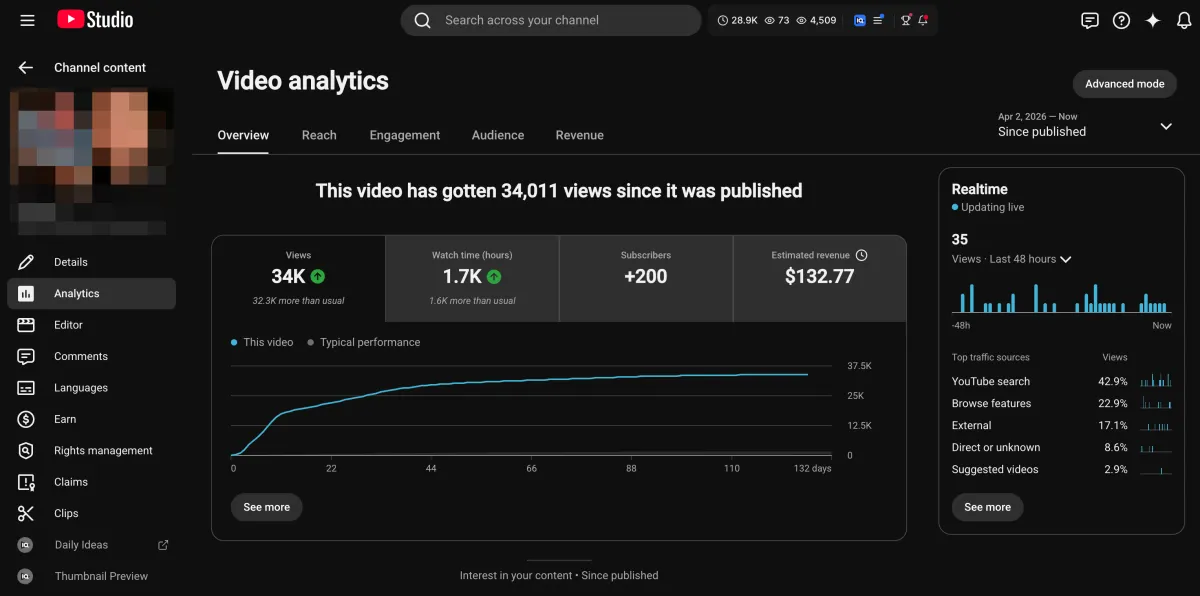
Learn how I turned a $132.77 video into $1000+ per month asset
Full case study on how you can replicate my success with YouTube SEO strategy.
Free downloadThe Zero Audience System
Build permanent YouTube income without a camera or an audience
The full methodology, 31 lessons plus bonuses. Limited spots.