For nearly every English-speaking creator focused on actually earning income, YouTube remains the stronger platform in 2026, by a meaningful margin, not a marginal one. Bilibili is a genuinely interesting platform to know about, especially given how fast it's expanding internationally right now, but its creator monetization outside China is still early-stage, with lower, less predictable payouts than YouTube's mature ad infrastructure offers. Here's the honest, detailed comparison, including where Bilibili actually does have a real edge worth paying attention to.
What Bilibili Actually Is, For Readers Who Don't Know
Bilibili started as a Chinese platform built around anime, comics, and games, the ACG community, and has since grown into a much broader video platform often described as "China's YouTube." It's genuinely massive: users spend an average of about 112 minutes a day on the platform, roughly the length of a feature film, and the average user is 26 years old, with new users trending slightly younger at 23. Creators with more than 100,000 followers grew over 20% year over year in 2025, and average creator income rose 22% over the same period.
One feature genuinely doesn't exist on YouTube: danmaku, or bullet chat, real-time comments that scroll directly across the video as it plays, visible to everyone watching, rather than sitting in a separate comment section below. It fundamentally changes how a video feels to watch, closer to a shared, live reaction than a solo viewing experience, and it's one of the platform's most distinctive, sticky features.
The Core Difference: Search-Driven Discovery vs Community-Interest Discovery
This is the distinction that actually matters most for how you'd build a channel on each platform, more than subscriber counts or payout rates. YouTube's discovery engine is built substantially around search intent, someone types a specific problem into a search bar, and a well-matched video gets found, sometimes years after it was published. That's the entire mechanism this site is built around, and it's a large part of why YouTube content can compound in value over time rather than just spiking and fading.
Bilibili's discovery leans more heavily on community interest and engagement signals, danmaku activity, coins, favorites, shares, closer in spirit to an interest-based community platform than a pure search engine. That's not a weakness exactly, it produces real, sticky engagement, but it means the evergreen, search-first strategy this site teaches doesn't transfer to Bilibili in the same direct way. Content there tends to live and die more by community reception than by matching a specific, lasting search query.
Monetization: The Real Numbers, Side By Side
| YouTube | Bilibili | |
|---|---|---|
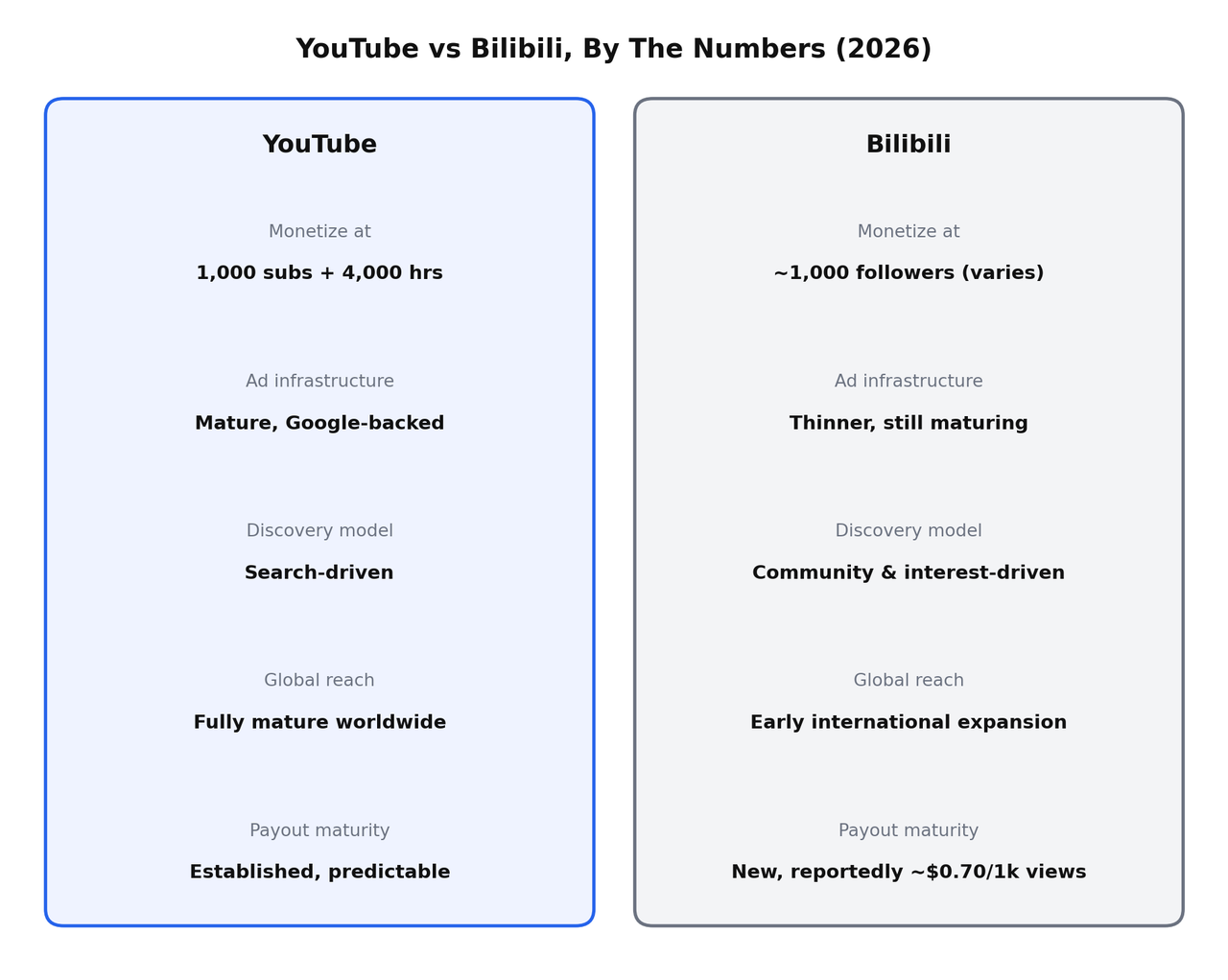
| Core monetization threshold | 1,000 subscribers + 4,000 valid public watch hours in 12 months | Reported figures vary by source, commonly cited around 1,000 followers plus a total view threshold, though Bilibili doesn't publish one universal number |
| Primary revenue source | Ad revenue (AdSense), mature and predictable | Creator Incentive Program, a performance-based cash bonus, historically capped around RMB 2,000 (roughly $278 USD) per month since March 2024, regardless of total views |
| International/global payout | Fully mature, available essentially worldwide | Reportedly newly rolling out, cited at roughly $0.70 per 1,000 views, with a lower entry threshold around 100 followers and 2,000 views for the international program specifically |
| Additional income streams | Channel memberships, Super Thanks, brand deals, YouTube Shopping | Fan charging (paid subscriptions), live-stream gifts, brand collaborations, reportedly higher revenue shares for certain content categories like animation |
Treat the exact Bilibili figures with some caution, they come from a mix of platform statements and third-party reporting rather than one single, official, consistently updated source, and eligibility criteria appear to vary by content category and region. The direction is clear regardless: YouTube's monetization system is older, more standardized, and more predictable. Bilibili's is real, growing, and still working out its international shape.
Why YouTube's Ad Infrastructure Still Wins On Raw Earning Potential
YouTube's ad system is backed by Google's advertising infrastructure, built and refined over close to two decades. Bilibili's ad revenue has historically made up a smaller share of its total business, with gaming revenue and other diversified income sources carrying more weight at points in its financial history. A reported international payout around $0.70 per 1,000 views sits well below typical YouTube RPMs across most niches, meaning the same view count generally translates to meaningfully less revenue on Bilibili right now, at least through its currently available international monetization path.
Where Bilibili Actually Has A Real Edge
This isn't a one-sided comparison, and it would be dishonest to present it that way. Bilibili's international expansion is happening right now, with a real English-language version of the app and active recruitment of creators outside China, which means genuinely lower competition for English-language content than you'd find in an equivalent, saturated YouTube niche. The platform has also rolled out AI-powered translation tools that can adapt existing content, including content you've already published on YouTube, for a Chinese-speaking audience with comparatively little extra effort on your part.
Specific content categories consistently outperform general content on Bilibili: animation, anime, gaming, and educational content in particular. If your existing content already fits one of those categories, testing Bilibili as a secondary platform costs very little beyond the time to re-upload, and you're reaching an audience of hundreds of millions that mostly isn't seeing your content anywhere else yet.
Who Should Actually Consider Bilibili
This makes sense for creators already working in anime, gaming, animation, or educational content, since that's where the platform's audience and algorithm both favor you. It makes sense for anyone willing to treat international expansion as a genuine long-term bet, given creator income there grew over 20% year over year and the platform is actively investing in monetization infrastructure. And it makes sense for anyone with an existing content library, since repurposing videos you've already made, aided by Bilibili's own translation tools, is a low-cost way to test the platform without diverting time from your primary channel.
Who Should Stick To YouTube As The Primary Platform
If your actual goal is building predictable, compounding income from specific, evergreen content matched to real search demand, the model this entire site is built around, YouTube remains the platform built for that job. Search-driven discovery, a mature and predictable ad system, and monetization infrastructure that doesn't require guessing at shifting international thresholds all favor YouTube as the primary platform for that strategy. I've covered the actual mechanics of what makes a video rank and earn on YouTube specifically in what actually determines YouTube ranking factors, which is a fundamentally different set of mechanics than what drives visibility on Bilibili.
A Practical Way To Test Both Without Betting Everything On One
Keep YouTube as your primary channel and income source, that's where the mature, predictable infrastructure lives. Treat Bilibili as a genuinely low-cost secondary experiment: re-upload existing content that fits its strongest categories, use the platform's own translation tools rather than building an entirely separate content pipeline, and judge results over a few months before deciding whether it's worth real, dedicated effort. If you're starting either platform from zero followers, the early-stage discipline is the same regardless of which one you're building on, I've covered that starting process in more depth in how to build an audience from zero.
Frequently Asked Questions
Is Bilibili bigger than YouTube?
No. YouTube remains dramatically larger globally. Bilibili is enormous within China and growing internationally, but it isn't close to YouTube's overall global scale.
Can international creators actually get paid on Bilibili?
Yes, through a newly expanding international program reportedly paying around $0.70 per 1,000 views, alongside other income streams like fan subscriptions and live-stream gifts. It's real, but considerably less mature than YouTube's ad system.
Does content need to be in Chinese to succeed on Bilibili?
Not necessarily anymore. The platform's AI-powered translation tools can adapt existing content for its audience, lowering the barrier for English-language creators to test the platform without producing entirely separate content.
Which platform is better for a completely new creator with no existing content?
YouTube, in almost every case. Its monetization path is more predictable, its search-driven discovery model rewards specific, well-targeted content regardless of channel size, and there's no need to navigate a still-developing international payout system.
The Honest Recommendation
Build your primary strategy on YouTube. It's the more mature, more predictable, more search-friendly platform, and for a creator without existing content in Bilibili's strongest categories, there's no compelling reason to make it a primary focus in 2026. If you already have anime, gaming, animation, or educational content sitting in your library, testing Bilibili as a secondary channel costs little and reaches a genuinely large, fast-growing audience most of your competitors haven't found yet. Just don't mistake that secondary experiment for a replacement of the platform that's actually built to pay you predictably.
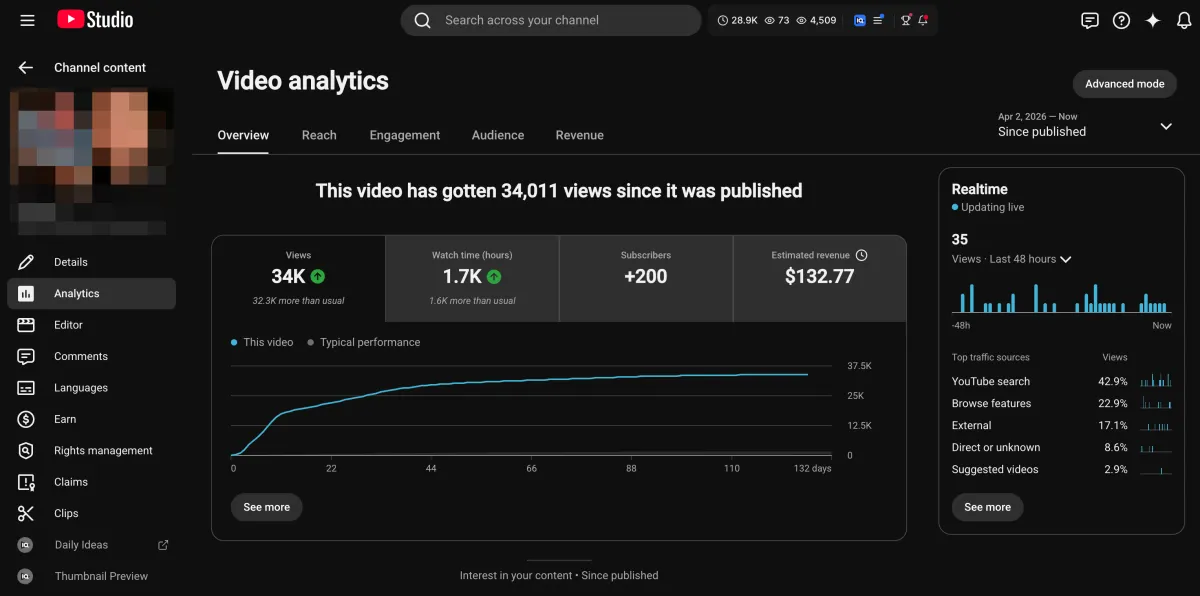
Learn how I turned a $132.77 video into $1000+ per month asset
Full case study on how you can replicate my success with YouTube SEO strategy.
Free downloadThe Zero Audience System
Build permanent YouTube income without a camera or an audience
The full methodology, 31 lessons plus bonuses. Limited spots.