Choose YouTube if predictable, primary income is the goal, its ad system is older, better funded, and pays meaningfully more per view in most cases. Choose Bilibili as a deliberate secondary platform if your content specifically fits its strongest categories, animation, anime, gaming, or educational content, and you're willing to treat its still-maturing international monetization as a long-term bet rather than a primary income source. That's the short version. The real decision depends on a handful of specific factors most comparisons skip, so here's the actual framework.
The Core Monetization Numbers, Compared Directly
| YouTube | Bilibili | |
|---|---|---|
| Ad revenue rate | RPM typically ranges from roughly $2 to $12+ depending on niche, sometimes higher in high-value categories like finance | Reportedly around $0.70 per 1,000 views under the newer international program |
| Domestic incentive structure | Not applicable, YouTube uses one global ad system | Creator Incentive Program, performance-based, historically capped around RMB 2,000 (~$278 USD) per month since March 2024, regardless of total views |
| Entry threshold | 1,000 subscribers + 4,000 valid public watch hours in 12 months | Reported figures vary, commonly cited around 1,000 followers domestically, or a lower 100 followers plus 2,000 views for the newer international program specifically |
| Other income streams | Channel memberships, Super Thanks, brand deals, YouTube Shopping | Fan charging, live-stream gifts, brand collaborations, reportedly higher shares for certain content categories |
The Real Math: What The Same 100,000 Views Would Actually Earn
Numbers make this concrete in a way a feature comparison alone doesn't. On YouTube, 100,000 views in a lower-RPM niche might earn somewhere around $200 in ad revenue. The same 100,000 views in a stronger, higher-RPM niche could realistically bring in $1,200 or more. On Bilibili, under the reported international rate of roughly $0.70 per 1,000 views, the same 100,000 views would bring in somewhere around $70.
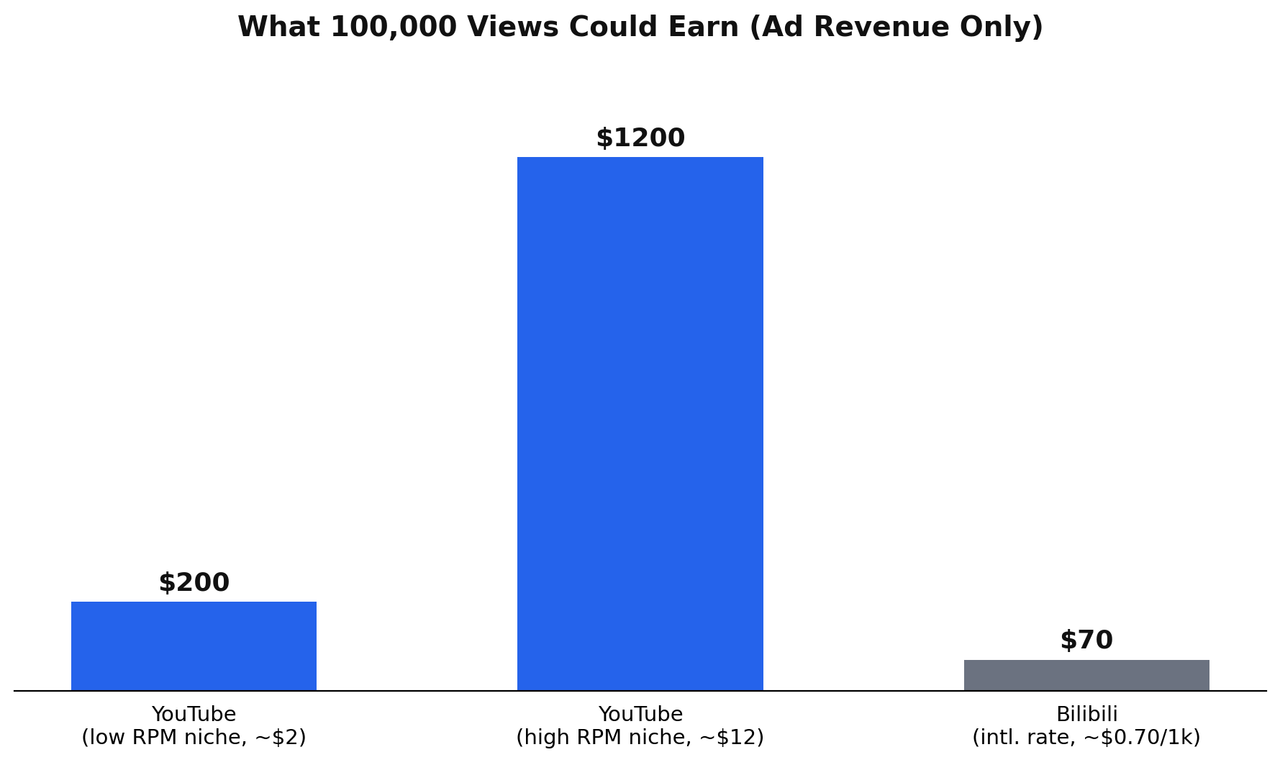
Treat these as directional estimates, not guarantees, actual rates shift by niche, audience location, and specific advertiser demand at any given time. The gap itself is the real takeaway: even YouTube's lower-earning niches tend to out-earn Bilibili's current international ad rate by a wide margin, on ad revenue alone.
Decision Factor One: What Language Is Your Content In
If your content is in English or another language with strong existing YouTube advertiser demand, YouTube's infrastructure is built for exactly that audience already. If you're specifically trying to reach a Chinese-speaking audience, or you're comfortable using Bilibili's AI translation tools to adapt existing content, Bilibili offers a real audience YouTube doesn't reach the same way, that's a genuine advantage, just not a monetization advantage yet.
Decision Factor Two: How Fast Do You Need Income
YouTube's monetization system is mature and predictable. Once you clear the threshold, the payout mechanics are well documented and consistent. Bilibili's international payout structure is newer, and its domestic incentive program comes with a real, specific monthly cap that limits how much a single high-performing video can earn through that channel regardless of view count. If you need reliable, near-term income, that difference matters more than any audience-size argument.
Decision Factor Three: What's Your Content Category
This is the one place Bilibili genuinely competes, not on rate, but on fit. Animation, anime, gaming, and educational content specifically outperform general content on Bilibili, both in reported creator income growth and audience receptiveness. If your content already lives in one of those categories, the platform's audience and algorithm both work in your favor in a way that partially offsets the lower per-view rate. Generic vlogging, commentary, or broad lifestyle content doesn't get the same benefit.
Decision Factor Four: Do You Want One Platform Or Two
Running two platforms well takes more than double the attention of running one, since each has its own upload rhythm, community expectations, and format quirks. If you're not prepared to actually maintain a presence on both, pick the one with better core economics for your specific content and put your full effort there rather than splitting attention across two platforms and doing neither particularly well.
When Running Both Actually Makes Sense
The strongest case for using both: you already have an existing YouTube content library in one of Bilibili's strongest categories, and you're willing to repurpose it using Bilibili's own translation tools rather than building a separate production pipeline. That's a genuinely low-cost way to test a second income stream without diverting real time from your primary platform. It stops making sense the moment it requires original content made specifically for Bilibili before you've seen real returns from the low-cost version.
My Direct Recommendation Based On Your Situation
If you're starting from zero with no existing content, build on YouTube first. Its monetization is more mature, its search-driven discovery model rewards specific, well-targeted content regardless of channel size, and the per-view economics are simply stronger right now. I've covered the full mechanics of building income this way, including every realistic monetization stream beyond ad revenue, in faceless YouTube channel monetization, every way to actually get paid, and the real RPM ranges by niche in YouTube RPM by niche.
If you already have a content library in animation, anime, gaming, or educational topics, add Bilibili as a genuine secondary experiment using its translation tools, and judge results over a few months before deciding whether it deserves more direct investment. For the fuller platform-by-platform breakdown beyond just monetization, discovery model, audience culture, and content fit, I've covered that separately in YouTube vs Bilibili, the complete comparison.
Frequently Asked Questions
Does Bilibili pay more than YouTube for the same views?
No, not currently. YouTube's ad revenue rates generally exceed Bilibili's reported international payout by a wide margin, even in YouTube's lower-earning content categories.
Is there a monthly earnings cap on YouTube like Bilibili's incentive program?
No. YouTube's ad revenue scales directly with views and RPM, with no equivalent monthly ceiling on standard ad earnings the way Bilibili's domestic Creator Incentive Program has had since March 2024.
Should a brand-new creator start on Bilibili instead of YouTube?
Generally no, unless their content specifically fits Bilibili's strongest categories and they're targeting a Chinese-speaking audience directly. For most new creators, YouTube's more mature monetization system is the stronger starting point.
Can I monetize the same content on both platforms at once?
Yes, and it's a reasonable approach once you have an existing content library, particularly using Bilibili's translation tools to adapt content you've already produced for YouTube rather than creating separate content for each platform.
The Bottom Line
YouTube wins on raw monetization economics for almost every creator right now, the ad system is more mature, more predictable, and pays more per view in the vast majority of comparisons. Bilibili is worth a real look specifically if your content fits its strongest categories and you're building a long-term, secondary income stream rather than expecting it to match YouTube's economics today. Don't choose based on audience size alone, choose based on which platform's actual payout structure fits the income timeline you need.
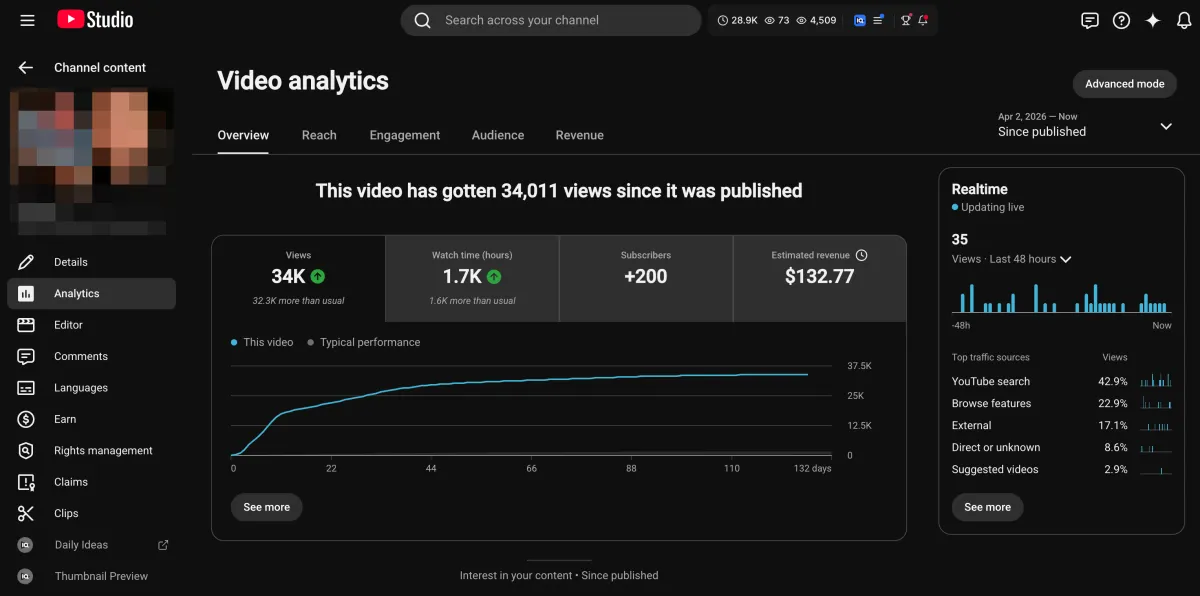
Learn how I turned a $132.77 video into $1000+ per month asset
Full case study on how you can replicate my success with YouTube SEO strategy.
Free downloadThe Zero Audience System
Build permanent YouTube income without a camera or an audience
The full methodology, 31 lessons plus bonuses. Limited spots.