
The first time someone shows me their Shorts analytics, the reaction is almost always the same. Millions of views, and a payout that looks like a rounding error.
That is not a bug and it is not because they did something wrong. Shorts pay differently from long form, at a structural level, and the number that captures it is RPM.
This post is the honest version. Real Shorts RPM ranges, why they are so low, how the money is actually calculated, and when Shorts still make sense despite the numbers.
What Shorts RPM means
RPM is revenue per mille, your earnings for every thousand views after YouTube takes its cut. Not what advertisers paid. What lands in your account.
For long form video, RPM typically runs between $2 and $30 depending on niche, and I broke that down properly in YouTube RPM by niche.
For Shorts, the entire realistic range is roughly $0.02 to $0.20 per thousand views.
Read that again. Not two dollars. Two cents to twenty cents.
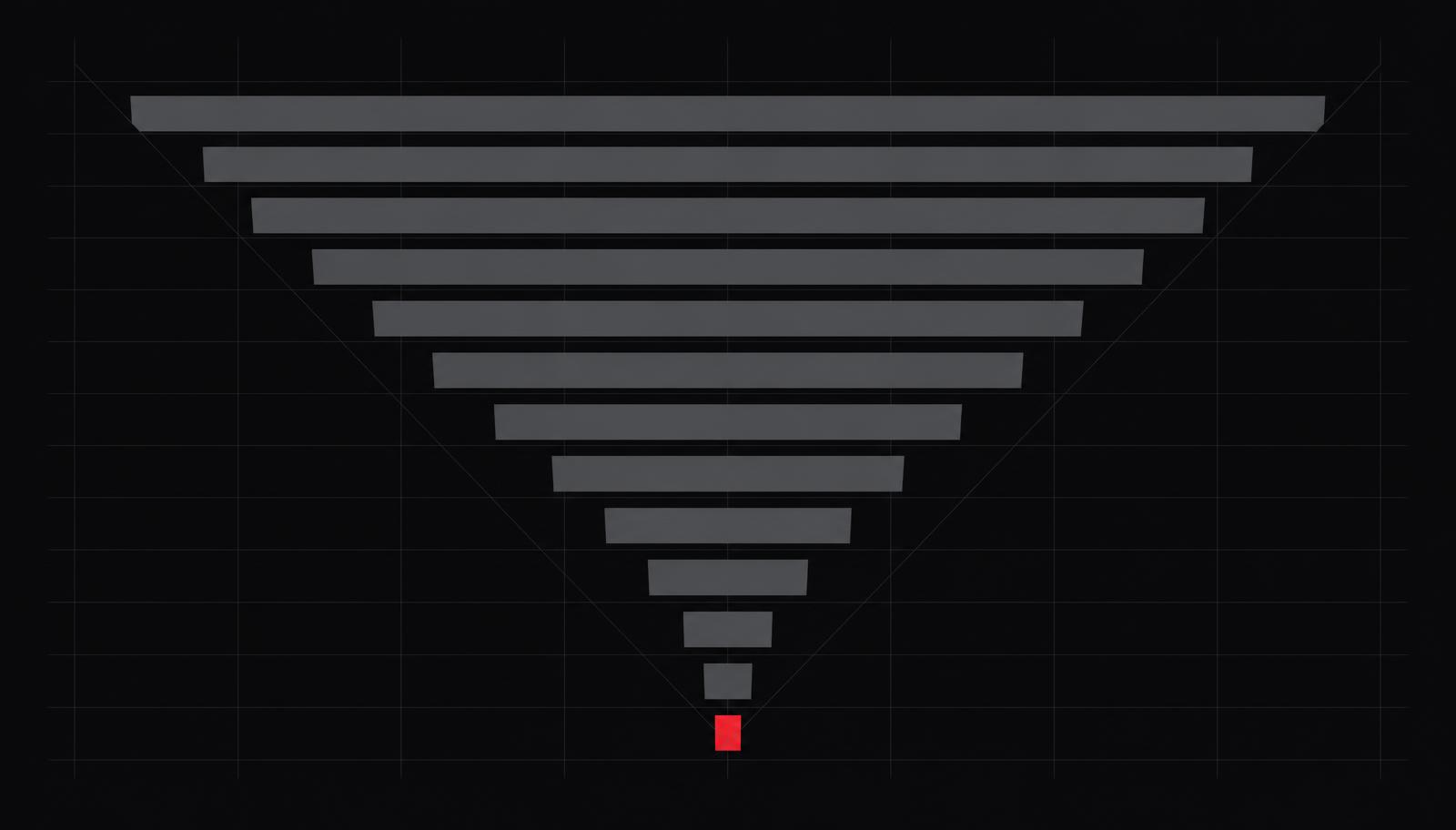
That means a Short with one million views often earns somewhere between $30 and $150. A long form video with one million views in a mid tier niche earns $2,000 to $8,000.
Same platform. Same view count. Roughly a fiftieth of the money.
Why the gap is that large
Shorts revenue does not work like long form revenue, and once you understand the mechanism the numbers stop being surprising.
Long form: ads run on your specific video. The revenue from those ads is attributed to your video. You keep 55 percent.
Shorts: ads run between Shorts in the feed, not attached to any single one. All of that ad money goes into a monthly pool. YouTube first takes money out of that pool to pay music licensing for every Short that used a licensed track. What is left is split among eligible creators based on their share of total Shorts views. Creators keep 45 percent of their allocated share.
So there are three compressions stacked on top of each other:
- Feed ads are worth less than pre roll on a video someone chose to watch
- Music licensing comes out before creators get paid
- Your slice is proportional to your share of every Short viewed that month, globally
Point three is the one people miss. Your Shorts RPM is partly determined by how much everyone else uploaded. A month where Shorts volume across the platform spikes can lower your RPM even if your own performance was identical.
Hear it from YouTube directly
YouTube's creators channel walks through Shorts eligibility, the revenue sharing mechanism, and how the analytics are reported. It is worth watching once so you have the official framing alongside the real numbers.
Shorts RPM by niche
Niche affects Shorts RPM far less than it affects long form RPM, because the ads are not matched to your specific content. It still matters, mostly through who your viewers are and where they live.
| Niche | Typical Shorts RPM | Notes |
|---|---|---|
| Personal finance | $0.10 to $0.20 | Highest Shorts RPM I see reported, still 100x below its long form equivalent |
| Business / software | $0.08 to $0.18 | Mostly a geography effect, these audiences skew United States |
| Health / wellness | $0.06 to $0.14 | Decent, wide advertiser interest |
| Education / how to | $0.05 to $0.12 | Stable and predictable |
| Technology | $0.05 to $0.12 | Competitive but solid |
| Food / cooking | $0.04 to $0.10 | High volume, mid rate |
| Travel | $0.04 to $0.10 | Varies heavily with audience country |
| Gaming | $0.02 to $0.07 | Enormous view counts, low rate |
| Entertainment / clips | $0.02 to $0.06 | Music licensing deductions bite hardest here |
| Motivation / quotes | $0.01 to $0.05 | Usually licensed audio, usually non tier one audience |
| Kids / family | $0.01 to $0.04 | Limited ad inventory, strict rules |
These are ranges from creator reported figures and public screenshots, not official YouTube data. Treat them as a realistic band, not a promise.
Geography matters more than niche
For Shorts, where your viewers live is the biggest single variable.
| Audience country | Relative Shorts RPM |
|---|---|
| United States | Highest, the benchmark |
| Canada, UK, Australia | Roughly 70 to 90 percent of US |
| Western Europe | Roughly 50 to 75 percent of US |
| Japan, South Korea | Roughly 50 to 70 percent of US |
| Brazil, Mexico | Roughly 15 to 30 percent of US |
| India, Indonesia, Philippines | Roughly 5 to 15 percent of US |
This is why two Shorts channels with identical view counts can report a 10x difference in earnings. Shorts spread globally by default, far more aggressively than long form does, so a channel that goes wide often ends up with a heavily non tier one audience and an RPM near the floor.
If your goal is revenue, the country mix in your analytics tells you more than your view count does.
The math that puts Shorts in perspective
Run the numbers honestly.
Scenario A. Shorts channel. 5 million Shorts views a month at $0.06 RPM. That is $300 a month. To make that happen you probably uploaded 60 to 90 Shorts, which is two or three a day, every day.
Scenario B. Long form channel. 100,000 views a month at $6 RPM. That is $600 a month, from perhaps four to eight uploads.
Twice the money, from 50x fewer views, with a fraction of the output.
That is not an argument that Shorts are worthless. It is an argument that Shorts revenue alone is a bad business.
You can plug your own numbers into the Shorts revenue calculator instead of estimating.
What Shorts are actually good for
I still use Shorts. Just not as an income line.
Qualifying for monetization. The Shorts path to the Partner Program is 10 million valid public views in 90 days. If you can produce volume, that is a legitimate door, and I laid out both paths in the 2026 monetization requirements checklist.
Sponsorship leverage. Brands pay per campaign, not per view. A Short with 2 million views is worth far more as a sponsorship pitch than as $80 of ad revenue. Work out realistic rates with the sponsorship calculator.
Feeding long form. A Short that answers half a question and points to the full video moves real viewers to the side of your channel that actually pays.
Testing angles cheaply. A Short costs an hour. A long form video costs a day. Test which framings land before you invest.
Selling something. If you have an offer, a Short that converts at even a fraction of a percent beats its own ad revenue by an enormous margin.
The moment Shorts stop being an income source in your head and start being a distribution tool, they get much more useful.
Do Shorts hurt long form performance?
This comes up constantly and the honest answer is no, not directly. YouTube surfaces Shorts and long form in largely separate systems, so a Shorts run does not poison your long form reach.
What does hurt is a subscriber base built entirely on Shorts. Those people subscribed to a feed habit, not to you. When your 12 minute video appears in their subscriptions, a lot of them will not watch it, and that early signal is weak.
If you plan to run both, treat them as one funnel deliberately rather than as two unrelated content streams. My breakdown of what actually ranks Shorts covers how the discovery side differs.
How to raise your Shorts RPM
There is a ceiling here, but there are levers.
- Skew your audience toward tier one countries. Language, references, and topic choice drive this more than anything. Content specific to a market pulls viewers from that market.
- Use original or royalty free audio. Licensed music means a deduction from the pool before you get paid. Original audio keeps more of it.
- Pick commercially valuable topics. Finance, software and business Shorts pull higher rates because of who watches them.
- Keep them tight. Retention and rewatch feed your view share, which feeds your allocation.
- Stay advertiser friendly. Limited ads on a Short with 3 million views is a very expensive mistake.
- Do not chase raw volume across every language. Global spread looks great in analytics and hollows out your RPM.
Common questions
What is a good Shorts RPM? Anything above $0.10 is strong. Between $0.04 and $0.08 is normal. Below $0.02 usually means either a heavily non tier one audience or licensed music deductions.
Why did my Shorts RPM drop this month? Most often audience mix. A Short that spread internationally pulls your average down. Platform wide Shorts volume and seasonal ad spend also move it. January is reliably the worst month.
Do Shorts views count toward the 4,000 watch hours? No. The two qualification paths are counted separately and cannot be combined.
Can I earn from Shorts without joining the Partner Program? Not from ad revenue. Sponsorships and your own products have no threshold at all.
Is Shorts RPM going up over time? Slowly, as Shorts ad inventory matures. It is not going to converge with long form, because the pooled model and the feed ad format are structural.
Should a beginner start with Shorts or long form? If you want income, long form. If you want to qualify for monetization on volume and you can genuinely sustain two or three uploads a day, Shorts is a faster gate. Most people overestimate what they can sustain.
The takeaway
Shorts RPM is low because of how the money is structured, not because you are doing it wrong. Two cents to twenty cents per thousand views is the reality, and no tactic moves that by an order of magnitude.
So use Shorts for what they are good at. Reach, testing, qualifying, and feeding people toward the content that actually earns. Then build your income on the side of YouTube where one good video keeps paying for years.
If you want the wider financial picture, how much faceless channels really make puts all of it together.
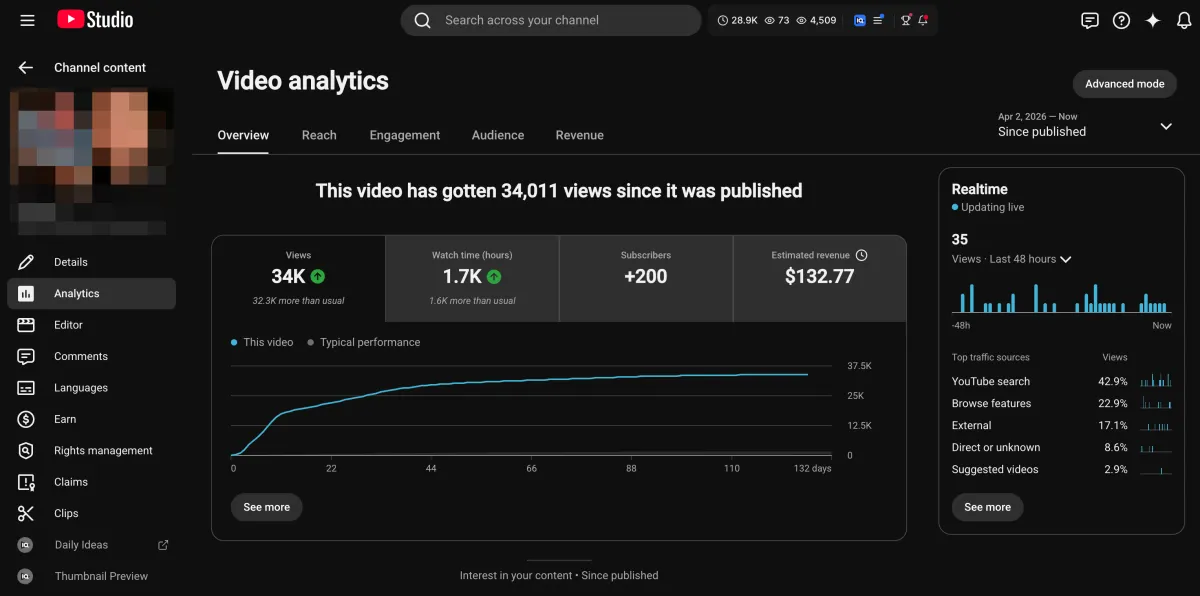
Learn how I turned a $132.77 video into $1000+ per month asset
Full case study on how you can replicate my success with YouTube SEO strategy.
Free downloadThe Zero Audience System
Build permanent YouTube income without a camera or an audience
The full methodology, 31 lessons plus bonuses. Limited spots.