Most people asking about a YouTube automation course are not really asking about a course. They are asking a simpler question. Is there a repeatable process here, or is this just people selling the idea of a process to each other. Fair question. I have built and sold channels for years, and I have also bought my share of training that turned out to be three hours of somebody explaining what a thumbnail is.
So instead of reviewing programs, here is the thing I would actually want if I were starting over. What a course on this subject has to contain to be worth money, what it can safely leave out, and how to test one before you hand over a card.
First, What Is Actually Being Taught
The term covers two very different businesses, and courses rarely separate them.
The first is a content operation. You hire writers, voice talent, and editors, publish daily, and try to win attention against everyone else publishing daily. It works, but it is a media company with staffing problems and a hungry publishing calendar.
The second is an asset operation. You find specific topics people actively look up, publish a small number of videos that answer them properly, and those videos keep pulling views and revenue for years without you touching them. Far fewer videos, far less staff, much slower start. I broke the difference down in detail in what YouTube automation actually is.
A course that does not tell you which of these two it teaches is not worth your time, because the daily workflows, budgets, and timelines have almost nothing in common.
The Five Things It Has To Cover
1. Demand selection, with real data
This is the whole game and it is where most training is thinnest. You should walk away able to answer, before filming anything, whether a topic has consistent monthly demand, whether the existing videos on it are weak, and whether the viewer is worth anything to an advertiser. If a course teaches topic selection as "pick something you enjoy," you are paying for encouragement rather than method.
What good coverage looks like: a documented process, a tool stack, thresholds for when to proceed and when to walk away, and worked examples on topics that are not the instructor's own channel.
2. Competition reading
Two topics with identical demand can be twenty times harder from each other. You need to be able to look at what is already published and judge whether you can beat it with a better video, or whether a large channel owns it and you should move on. My breakdown of what actually decides whether a video wins is the short version of what that module should contain.
3. Production that is boring on purpose
Scripting structure, hook and retention shape, voice, visuals, and a repeatable file workflow. The goal is not cinematic. The goal is that video 30 takes half as long as video 5 and looks the same. Anything that requires your personality to be present is a job, not an asset.
4. Channel setup and the first ninety days
Most people fail here quietly. They build eight videos, nothing happens, and they conclude the model is broken when they were simply looking at the wrong dashboard for the wrong number of days. A course should tell you exactly what the first three months look like, including how flat it feels. See how to warm up a channel and when you actually start earning.
5. What happens after it works
Reinvesting, adding a second channel, and the exit. Channels sell for real multiples, and the buyer cares about things you have to build in from day one, which is why selling a channel belongs in the curriculum and not in a bonus PDF.
What A Course Does Not Need
- A software suite you must rent monthly. Most of the stack is cheap or free. I listed what is genuinely worth paying for in the tools worth paying for in 2026.
- Mindset modules. If a third of the curriculum is about belief, the other two thirds are thin.
- A private community as the main value. Useful as support. Not a method.
- Income screenshots as proof of teaching. Someone earning well proves they can run channels. It does not prove they can hand you the process.
How To Judge One Before Paying
Five checks I use, and they filter out almost everything.
- Ask for the lesson list. Not a sales bullet list. The actual module titles and counts. If nobody will show you what you are buying, that is your answer.
- Look for a walkthrough of a topic they do not own. Anybody can explain their own winner in hindsight. Picking a fresh topic on camera and reasoning through the numbers is much harder to fake.
- Check the timeline they promise. Honest answers land between four and twelve months to meaningful revenue. Anything promising a fast result is selling excitement.
- Check whether the method survives without ads or a following. If the model needs you to already have attention, it is not built for someone starting at zero.
- Read the refund terms before the testimonials. Terms tell you more about confidence than a wall of praise does.
Free Versus Paid
You can learn every part of this for free. I have written most of the core of it on this blog, and the answers hold up. What free content will not give you is order and calibration. You will not know which of forty tactics matters first, and you will not know whether your topic list is good or terrible before you spend three months on it. That is what people are really buying, and if a program does not compress that decision time, it is overpriced at any number.
Where My Own Work Fits
I teach this as [The Zero Audience System](/), which is the asset version of the model rather than the daily publishing version. It runs 31 lessons plus bonuses and it is built around one assumption. You have no subscribers, no camera, and no interest in becoming a personality. The order is deliberate. Demand selection first, competition reading second, production last, because getting the first two wrong makes the third irrelevant.
I am not going to pretend it is the only way to learn this. If you would rather assemble it yourself from free material, do that, and use the five checks above on whoever you learn from. If you want the shortcut on judgment rather than effort, that is what a paid program is actually for.
The Honest Summary
A YouTube automation course is worth paying for when it shortens the part you cannot shorten alone, which is knowing whether a topic is worth your next three months. Everything else, the editing, the voice, the upload workflow, you can learn in a weekend from free material.
Judge on the curriculum, the demand method, and the timeline honesty. Ignore the screenshots.
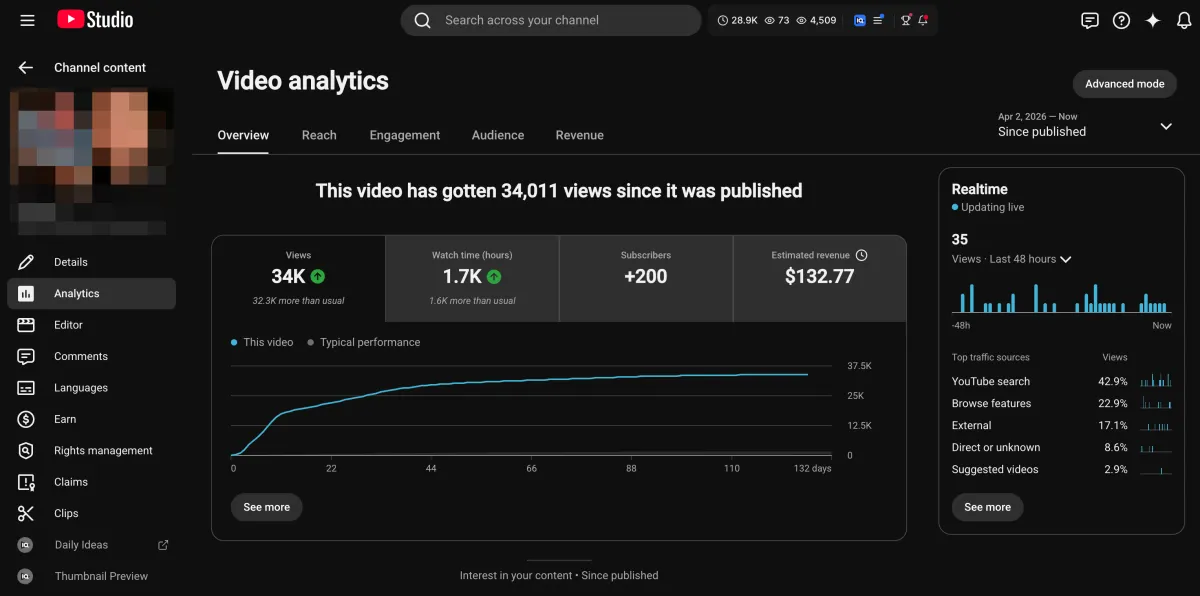
Learn how I turned a $132.77 video into $1000+ per month asset
Full case study on how you can replicate my success with YouTube SEO strategy.
Free downloadThe Zero Audience System
Build permanent YouTube income without a camera or an audience
The full methodology, 31 lessons plus bonuses. Limited spots.